

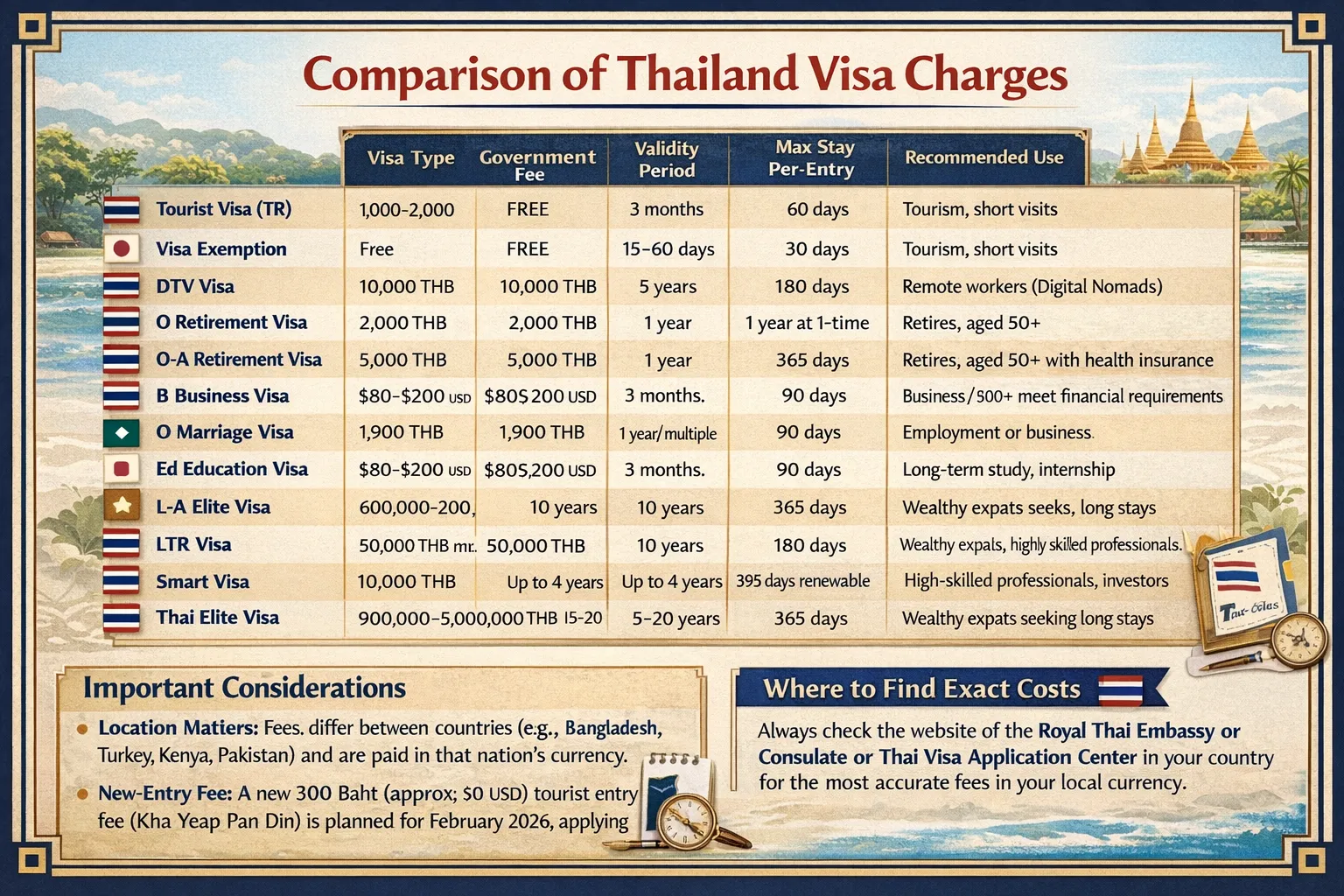
Thailand attracts over 35 million visitors annually, yet most travelers-from digital nomads to retirees-overpay for visas due to hidden costs and poor planning. The actual cost of staying in Thailand ranges from FREE to 5,000,000 THB depending on your duration, employment status, and visa category. This comprehensive guide reveals the exact government fees, agency markups, and compliance costs that separate savvy travelers from those wasting thousands of baht.
Whether you’re planning a two-week beach vacation or a decade-long retirement, understanding Thailand’s visa structure prevents costly mistakes. Many travelers pay 2-3x the necessary amount because they don’t know which visa offers genuine value-or they fail to account for mandatory hidden fees like re-entry permits, 90-day reporting fines, and insurance requirements.
This guide covers all 15+ visa types, real-world cost scenarios for each traveler type, and a decision framework to identify your optimal visa with 100% transparency on total cost of ownership.
Thailand Visa Cost Comparison Table
| Visa Type | Government Fee (THB) | Validity | Max Stay Per Entry | Best For | Annual Recurring Cost |
|---|---|---|---|---|---|
| Exemption | FREE | – | 60 days | Passport nationals | FREE |
| Visa on Arrival | 2,000 | 15 days | 60 days | Last-minute tourists | 1,900 (ext.) |
| Single Entry Tourist | 2,000 | 3 months | 60 days | Short trips | 1,900 (ext.) |
| Multiple Entry Tourist | 10,000 | 6 months | 60 days each | Frequent travelers | 1,900 (ext.) |
| DTV (Digital Nomad) | 10,000 | 5 years | 180 days | Remote workers | 1,900 (ext.) |
| ED (Education) | 2,000 | 90 days | 90 days | Students | 200 (ext.) |
| Non-B (Work) | 2,000 (single) / 5,000 (multiple) | 3 months / 1 year | 90 days | Employed expats | 5,000+ work permit |
| O-A (Retirement 1-yr) | 5,000 | 1 year | 90 days | Retirees 50+ | 1,900 (ext.) |
| O-X (Retirement 5-yr) | 10,000 | 5 years | 90 days | Long-term retirees | 1,900 (ext.) |
| LTR (Long-Term Resident) | 50,000 | 10 years | 90 days | Investors/professionals | 1,900 (ext.) |
| Thailand Elite (Bronze) | 650,000 | 5 years | 1 year | High-net-worth travelers | 0 (no renewal) |
| Thailand Elite (Gold) | 900,000 | 5 years | 1 year | Premium members | 0 (no renewal) |
| Thailand Elite (Platinum) | 1,500,000 | 10 years | 1 year | Ultra-premium | 0 (no renewal) |
Total Cost of Ownership (TCO) Breakdown
Your total visa cost isn’t just the government fee. Hidden expenses compound quickly, especially for multi-year stays. Here’s what you’ll actually spend:
Government Visa Fee
The base cost charged by Thai Immigration or embassies. Ranges from FREE (exemption) to 5,000,000 THB (Elite Reserve). Most tourists and short-term visitors pay 2,000–5,000 THB.
Agency & Service Fees
Using a visa agency (optional but common) adds 3,000–50,000 THB depending on complexity. DTV visas requiring course enrollment or letter-of-acceptance documentation often incur agency markup of 20,000–40,000 THB.
Real-world examples:
- Tourist visa via agency: +3,000–5,000 THB
- DTV via specialized agency: +20,000–40,000 THB
- Elite application processing: +5,000–15,000 THB
Extension Costs
Once inside Thailand, extending your stay costs 1,900 THB per extension. Most visas allow one extension; multiple-entry visas allow unlimited. A retiree on O-X visa extending annually: 1,900 THB × 5 years = 9,500 THB.
Re-Entry Permits
Mandatory if you plan to leave and re-enter Thailand. Without it, your visa is automatically cancelled.
- Single re-entry: 1,000 THB
- Multiple re-entry: 3,800 THB (valid indefinitely until cancelled)
Annual cost for someone leaving twice: 2,000 THB minimum.
Health Insurance
Required for some visas (e.g., O-A retirement, some Elite applications). Coverage typically 3,000–10,000 THB annually with 100,000 THB minimum coverage.
Bank Documents & Letters
Thai Immigration increasingly requires certified financial documentation:
- Bank solvency letter: 300–500 THB
- Account statement certification: 200–500 THB
- Affidavit for foreign income: 1,000–2,000 THB
One-time cost for retiree: ~2,000 THB.
90-Day Reporting & Compliance
Foreigners staying over 90 days must report their address every 90 days.
- Online (free): 0 THB
- In-person (free): 0 THB
- Late penalty: 2,000 THB (5,000 THB if caught by authorities)
- Agency service: 3,745–4,601 THB
Annual cost for diligent reporter: 0 THB. Cost for lazy reporter: 8,000–10,000 THB (4 late penalties).
Work Permit (if applicable)
Mandatory for any foreigners earning income in Thailand.
- Annual work permit: ~3,000 THB
- Visa fee separate: 2,000–5,000 THB
Total first-year cost for Non-B worker: 5,000–8,000 THB.
Document Translation & Certification
Embassies require foreign documents in English or Thai, certified by notary or embassy.
- Professional translation: 500–2,000 THB per document
- Embassy certification: 1,000–3,000 THB
- Typical retiree applicant: 4–6 documents = 3,000–8,000 THB
Tourist & Short-Stay Visa Charges
Visa Exemption (FREE)
Cost: 0 THB
Validity: One entry, 60-day stay
Eligibility: 93 countries including UK, USA, Australia, Canada, EU nations, Japan, South Korea, and others. Check [Link to official exemption list] to confirm your nationality.
Who Qualifies:
Nationals of designated countries arriving with a valid passport (6+ months validity) and return ticket. No application needed-arrival stamp grants exemption automatically.
Pros:
- Completely free entry and stay
- No advance planning required
- Immediate processing at any airport/border
- Can extend once for 30 additional days (1,900 THB fee)
Cons:
- Limited to 60 days (90 if extended)
- Only one entry; re-entry requires new visa or re-entry permit (1,000 THB)
- No work authorization
- Cannot change visa type without leaving Thailand
Extension Cost: 1,900 THB (extends 60-day stay to 90 days)
Best Use Case: Budget tourists, backpackers, and travelers staying under 60 days from eligible countries.
Visa on Arrival (VoA)
Cost: 2,000 THB (must be paid in Thai baht only)
Validity: 15 days
Stay Duration: Single entry, 60-day stay
Airport vs. eVOA:
- Airport VoA: Apply upon arrival at designated Thai airports. Line typically 30–90 minutes. Extra photos and forms may be required on-site.
- eVOA (electronic): Apply online 2–3 days before arrival via evisa.go.th. Fee remains 2,000 THB. Faster processing upon arrival (15–30 minutes).
Payment Rules:
VoA fees are strictly cash (Thai baht) at airports. Credit cards are NOT accepted. No exceptions. Nearest ATM available at all major airports charging 200 THB per withdrawal.
Pros:
- Convenient last-minute option
- Faster if you pre-apply for eVOA
- Single entry, 60-day stay
- Can extend once for 30 more days (1,900 THB)
Cons:
- Must carry 20,000 THB proof of funds
- Photos required (not always available at airport)
- Crowds and queues, especially peak seasons
- Not available to all nationalities (check eligibility)
Hidden Costs:
- ATM fee to withdraw 2,000 THB: +200 THB
- Photos if not pre-prepared: +50–200 THB
- Re-entry permit if leaving Thailand: +1,000 THB
Total Real Cost: 2,250–2,400 THB
Best Use Case: Last-minute tourists, nationals ineligible for visa exemption, workers arriving on emergency transfers.
Single Entry Tourist Visa
Cost: 2,000–2,600 THB (varies by embassy; typically 2,000 THB in Asia, up to 2,600 THB in Western countries)
Validity: 3 months
Stay Duration: Single entry, 60-day stay
Processing: 3–5 business days
Requirements:
- Valid passport (6+ months validity)
- One passport photo (4×6 cm)
- Completed TM.8 form
- Proof of funds (20,000 THB per person)
- Return ticket/onward travel proof
Pros:
- Standard tourist option worldwide
- Predictable timeline
- Can plan travel in advance
- Extendable to 90 days (1,900 THB)
Cons:
- Only one entry; re-entry requires new permit
- Must apply at embassy before travel
- Slightly higher than VoA if fees vary
- No work authorization
Extension Cost: 1,900 THB (extends to 90-day total)
Real-World Cost: 2,000 THB (visa) + 1,900 THB (if extending) = 3,900 THB maximum
Best Use Case: Organized tourists, travelers planning fixed trips, those wanting predictable timelines.
Multiple Entry Tourist Visa (METV)
Cost: 10,000 THB (standard); up to 6,500 USD in countries like Australia (due to reciprocal exchange rates)
Validity: 6 months
Stay Duration: Multiple entries, 60 days per stay
Processing: 3–5 business days
Advantages Over Single Entry:
- Enter Thailand up to 6 times within 6 months
- Each entry grants 60-day stay
- Maximum total 360 days if you stay full period and extend each entry
- Ideal for regional travelers visiting Laos, Cambodia, Vietnam between stays
Real Cost Scenario: Frequent visitor making 4 trips over 6 months
- METV: 10,000 THB
- Extensions (4 × 1,900 THB): 7,600 THB
- Total: 17,600 THB for 4 trips = 4,400 THB per trip
Compare to single-entry: 4 × 2,000 THB (visas) + 4 × 1,900 THB (extensions) = 15,600 THB
METV saves 1,000 THB for frequent visitors.
Best Use Case: Regional business travelers, language students doing periodic visa runs, volunteers rotating between countries.
Thailand E-Visa
Cost: 1,300–2,600 THB (processing fee online); varies by service tier
Validity: 3 months
Stay Duration: Single entry, 60-day stay
Processing Options:
- Standard: 3–5 business days (1,300 THB)
- Express: 1–2 business days (1,950 THB)
- Urgent: Same day (2,600 THB)
Advantages:
- Apply entirely online, no embassy visit required
- 24/7 application availability
- Approval within hours on urgent tier
- Acceptance at all major airports and most land borders
Cons:
- eVisa rejected less frequently but possible
- Requires clear, well-lit passport photos
- Email delivery to print; cannot use on phone
- Cannot extend inside Thailand beyond 30 days
Best Use Case: Remote workers, travelers in countries without Thai embassy, those needing fast processing.
Long-Term Visa Charges
DTV Visa (Destination Thailand Visa) – Digital Nomad
Government Fee: 10,000 THB
Validity: 5 years (multiple entry)
Maximum Stay Per Entry: 180 days (extendable once per entry for 180 more days)
Key Requirement: Proof of digital work, remote income, or enrollment in approved activities (Muay Thai, cooking, wellness)
5-Year Total Cost Breakdown:
- Government fee: 10,000 THB
- Agency/letter support: 0–40,000 THB (if obtaining letter of acceptance)
- Annual extensions: ~1,900 THB × 4 (optional) = 7,600 THB
- Health insurance: ~5,000 THB/year × 5 = 25,000 THB (optional but recommended)
- 90-day reporting: 0 THB (if online) or 2,000–5,000 THB (penalties if late)
No Agency Route (self-prepared documentation):
- Minimum 5-year cost: 10,000 THB (just visa fee)
- Realistic 5-year cost: 35,000–50,000 THB (with insurance and extensions)
With Agency (e.g., Muay Thai course enrollment):
- Government fee: 10,000 THB
- Agency/course: 30,000–100,000 THB (includes enrollment letter, visa support)
- Insurance (5 years): 25,000 THB
- Total with agency: 65,000–135,000 THB over 5 years (~13,000–27,000 THB/year)
Annual Breakdown (Agency Route):
- Year 1: 40,000–60,000 THB (upfront visa + enrollment)
- Years 2–5: 5,000–10,000 THB/year (insurance + optional extensions)
Eligibility:
- Remote work/digital income (bank statements showing consistent transfers, client contracts)
- OR enrollment in approved courses (Muay Thai, cooking, language, wellness)
- OR visa runs (combinations of tourist + extension visas)
Pros:
- Longest validity among “working” visas (5 years)
- Multiple entries; can stay 180+ days per entry
- No work permit required
- No employment contract needed
- Designed specifically for digital workers, entrepreneurs, travelers
Cons:
- Requires income verification or course enrollment
- Income requirements vary by embassy (~300,000–500,000 THB monthly income or equivalent savings)
- Agency fees add significantly to cost
- Not all embassies value self-employment equally
Real-World Example – Budget Digital Nomad:
- Apply directly to embassy with bank statements + work samples: 10,000 THB
- Annual extensions inside Thailand: 1,900 THB × 4 = 7,600 THB
- Basic travel insurance: 5,000 THB
- 90-day reporting: FREE (online)
5-year total: ~32,600 THB (~$950 USD) ✓ Best value for long-term remote workers
Real-World Example – Beginner with Course:
- Muay Thai enrollment + visa letter: 40,000 THB
- Government DTV fee: 10,000 THB
- Health insurance (5 years): 25,000 THB
- Extensions and compliance: 10,000 THB
5-year total: ~85,000 THB (~$2,500 USD)
Best Use Case: Digital nomads, remote employees, freelancers, content creators, entrepreneurs, Muay Thai enthusiasts.
[Link to DTV visa guide with step-by-step application]
LTR Visa (Long-Term Resident)
Government Fee: 50,000 THB (paid in Thailand; varies by embassy if applied abroad)
Validity: 10 years (multiple entry, renewable for another 10 years)
Maximum Stay Per Entry: 90 days (but you can stay indefinitely by doing 90-day reports)
Renewal: Must re-endorse annually; costs vary but typically 5,000–10,000 THB/year
5 Categories of LTR:
- Wealthy Global Citizen
- Requirement: USD 500,000 investment in Thailand OR USD 80,000/year income
- Best for: Investors, business owners, high-net-worth individuals
- Wealthy Pensioner
- Requirement: USD 250,000 investment OR USD 80,000/year income
- Best for: Retirees, rental income earners
- Remote Professional (Work-From-Thailand)
- Requirement: USD 80,000/year income (past 2 years) or USD 40,000 + Master’s degree
- Best for: Remote workers, digital professionals, corporate employees
- Highly-Skilled Professional
- Requirement: USD 80,000/year or USD 40,000 + specialized expertise
- Best for: Engineers, architects, specialized consultants
- Startup Founder
- Requirement: Company with USD 1 million+ Series A funding
- Best for: Tech entrepreneurs, startup CEOs
10-Year Total Cost Breakdown:
- Government fee: 50,000 THB
- Annual re-endorsement: ~5,000 THB × 10 = 50,000 THB
- Work permit (if working): ~3,000 THB × 10 = 30,000 THB (optional)
- Health insurance (recommended): ~5,000 THB/year × 10 = 50,000 THB
- Document certifications: ~2,000–5,000 THB (one-time)
Realistic 10-year cost: 127,000–200,000 THB (~$3,700–$6,000 USD)
Annual Cost Breakdown:
- Year 1: 60,000 THB (visa + re-endorsement + setup)
- Years 2–10: 8,000–15,000 THB/year (insurance, work permit, compliance)
Advantages Over DTV & Retirement Visas:
- Only visa allowing full legal work authorization without separate work permit
- Longest validity (10 years) among non-Elite options
- Income requirement lower than some tourist visas
- Family members eligible under same visa category
- Digital Work Permit available (3,000 THB/year) if you want Thai legal employment documentation
Cons:
- Income/investment documentation must be certified and translated
- Annual re-endorsement required (immigration office visit or agency)
- 50,000 THB upfront government fee (highest non-Elite visa)
- Stricter income verification than DTV
Cost Comparison: LTR vs. Retirement (O-X) vs. DTV Over 10 Years
| Visa | 10-Year Cost | Annual Average | Best For |
|---|---|---|---|
| LTR | ~150,000 THB | ~15,000 THB | Professionals, remote workers, investors |
| O-X Retirement | ~120,000 THB* | ~12,000 THB | Retirees 50+, pensioners |
| DTV | ~70,000–120,000 THB | ~7,000–12,000 THB | Digital nomads, flexibility seekers |
*Assumes no re-investment requirement changes
Real-World Example – Remote Professional:
- Applying from Europe with USD 85,000/year income
- LTR fee: 50,000 THB
- Annual re-endorsement: 5,000 THB × 10 = 50,000 THB
- Health insurance: 3,500 THB × 10 = 35,000 THB
- Work permit: 3,000 THB × 10 = 30,000 THB
- Total 10-year cost: 165,000 THB (~$4,850 USD)
Best Use Case: Remote professionals, business owners, investors, entrepreneurs, anyone earning USD 40,000+ annually.
[Link to LTR visa guide with detailed category breakdown]
Education Visa (ED)
Government Fee: 2,000 THB (standard) to 2,600 THB (varies by embassy)
Validity: 90 days (initial)
Stay Duration: 90 days per entry
Extension Duration: Up to 1 year (extension cost: 1,900 THB)
Extension Renewals: Multiple extensions possible for as long as enrolled in school
Requirements:
- Enrollment letter from recognized Thai educational institution
- Proof of funds: 20,000 THB per person, 40,000 THB per family
- Valid passport (6+ months validity)
- Passport photos (4×6 cm)
- Police clearance (some countries)
- Paid 50% of course fees or full payment
1-Year Cost Breakdown (Language Student):
- Visa fee (initial 90-day): 2,000 THB
- First extension: 1,900 THB
- Second extension: 1,900 THB
- Third extension: 1,900 THB
- Course fee (typical Thai language school): 15,000–25,000 THB for full-year program
- Total: 22,700–31,700 THB (~$650–$930 USD) per year
Types of Approved Schools:
- Thai language institutes (private, certified)
- Universities (undergraduate, graduate programs)
- Vocational schools (certified)
- International schools
- Music, art, dance academies (with MOE certification)
Advantages:
- Lowest visa cost for extended Thailand stay
- Legitimate education and cultural immersion
- Can combine with tourist activities
- School can assist with visa paperwork
- Allows 90-day reports to be submitted through school
Cons:
- Must maintain active enrollment
- Cannot work (even remote work technically violates terms)
- Limited to 90 days per entry + extension
- Requires legitimate schooling commitment
Common Pricing for Full-Year Enrollment:
- Thai language course: 15,000–25,000 THB
- University semester: 50,000–150,000 THB
- International school (high school): 400,000–800,000 THB/year
- Muay Thai training: 30,000–100,000 THB for full-year enrollment
Real-World Example – Thai Language Student:
- Annual tuition (language school): 20,000 THB
- Visa fees: 2,000 THB (initial) + 1,900 × 3 (extensions) = 7,700 THB
- Housing (outside visa cost): 5,000–10,000 THB/month
- Visa-only cost: 27,700 THB (~$810 USD)
Best Use Case: Students, cultural enthusiasts, language learners, researchers, gap-year travelers.
Retirement Visa (Non-Immigrant O-A / O-X)
Non-Immigrant O-A (1-Year Retirement Visa)
Cost: 2,000–5,000 THB depending on embassy and entry type
Validity: 1 year (single or multiple entry options)
Maximum Stay Per Entry: 90 days (must do 90-day reports every 90 days)
Financial Requirements (O-A):
- Option 1: 800,000 THB in Thai bank account (maintained throughout visa)
- Option 2: 65,000 THB monthly income (verified via embassy affidavit)
- Option 3: Combination of both (e.g., 400,000 THB + 32,500 THB/month)
Age Requirement: 50 years or older
1-Year Cost (O-A):
- Visa fee: 5,000 THB
- 90-day reporting: FREE (online) or 2,000 THB fine if late
- Extension (if staying beyond 1 year): 1,900 THB
- Health insurance (optional but recommended): 3,000–10,000 THB
Total realistic cost (1 year): 8,900–15,900 THB
Non-Immigrant O-X (5-Year Retirement Visa)
Cost: 10,000 THB
Validity: 5 years (multiple entry)
Maximum Stay Per Entry: 90 days
Renewable: Once, for another 5 years (total 10 years possible)
Financial Requirements (O-X):
- Option 1: 3,000,000 THB in Thai bank account
- Option 2: 1,800,000 THB in Thai bank + 1,200,000 THB annual income
- Option 3: 1,200,000 THB annual income alone (requires income affidavit from embassy)
- Health insurance: 3,000,000 THB minimum coverage
Age Requirement: 50+ (no upper age limit)
Eligibility by Country: Limited to 14 designated countries (US, UK, Australia, Japan, South Korea, Germany, France, Italy, Spain, Canada, Netherlands, Belgium, Denmark, Sweden). Check [Link to official list].
5-Year Cost (O-X):
- Initial visa: 10,000 THB
- Annual 90-day reporting: 0–2,000 THB (if online vs. late)
- Extensions (if needed): 1,900 THB each
- Health insurance (5 years): 5,000 THB × 5 = 25,000 THB
- 90-day report penalties (if you miss): 2,000 THB × worst case 4 times = 8,000 THB
Total realistic cost (5 years): 43,000–60,000 THB (~$1,250–$1,750 USD)
Annual Average: 8,600–12,000 THB
Comparison: O-A vs. O-X Over 5 Years
| Visa | 5-Year Cost | Annual Average | Financial Requirement |
|---|---|---|---|
| O-A (renewed 5 times) | 25,000–45,000 THB | 5,000–9,000 THB | 800,000 THB bank OR 65,000 THB/month |
| O-X (single application) | 35,000–60,000 THB | 7,000–12,000 THB | 3M THB bank OR 1.8M + 1.2M income |
O-A advantage: Lower financial barrier (800,000 THB vs. 3,000,000 THB). Ideal for modest pensioners.
O-X advantage: Longer validity reduces re-application paperwork. Better for those with stable finances.
Pros (Both O-A & O-X):
- Designed specifically for retirees
- Straightforward requirements once financial threshold met
- Widely recognized by Thai Immigration
- Extendable indefinitely (as long as requirements maintained)
- Family members eligible under category “O”
Cons:
- Must maintain financial deposit (cannot use bank funds for expenses)
- Age restriction (50+ only)
- O-X limited to 14 countries
- 90-day reporting mandatory (2,000 THB fine if late)
- Health insurance required for O-A
- Income documentation must be certified by embassy
Real-World Example – US Retiree (O-X)
- Bank deposit: 3,000,000 THB (one-time, locked for 5 years)
- Visa fee: 10,000 THB
- Annual health insurance: 5,000 THB × 5 = 25,000 THB
- 90-day reporting (online): FREE × 4 years + 1 miss = 2,000 THB fine
- Extension (if upgrading to new visa): 1,900 THB
- 5-year total: 38,900 THB (~$1,140 USD)
Real-World Example – UK Pensioner (O-A, renewed annually)
- Bank deposit: 800,000 THB
- Year 1 visa: 5,000 THB
- Years 2–5 renewals: 1,900 THB × 4 = 7,600 THB
- Health insurance (optional): 5,000 THB × 5 = 25,000 THB
- 5-year visa cost: 12,600 THB + deposits remain untouched
Best Use Case: Retirees 50+, pensioners, long-term travelers, families with stable income.
[Link to Retirement visa guide with financial planning tips]
Non-B Work Visa
Cost: 2,000 THB (single entry) / 5,000 THB (multiple entry, 1-year validity)
Validity: 3 months (single) / 1 year (multiple)
Stay Duration: 90 days per entry
Work Permit Required: Yes (separate application, ~3,000 THB annual cost)
Eligibility:
- Job offer from Thai registered company
- Employer sponsorship and work permit application to Ministry of Labor
- Non-Thai position (not reserved for Thai nationals)
- Employer must prove insufficient Thai workers available
- Minimum salary typically 35,000+ THB/month (varies by position)
First-Year Total Cost:
- Non-B visa: 5,000 THB (multiple-entry option recommended)
- Work permit application: ~3,000 THB
- Document translations and certifications: 2,000–3,000 THB
- Company sponsorship (sometimes charge admin fee): 0–5,000 THB
- Health insurance (often required by employer): 3,000–8,000 THB
Total first-year: 13,000–24,000 THB (~$380–$700 USD)
Subsequent Years: 8,000–12,000 THB (renewal of work permit + visa extension)
Required Documents:
- Valid passport (6+ months validity)
- Work permit from Ministry of Labor
- Company sponsorship letter
- Job contract
- Criminal record clearance
- Medical certificate (some employers require)
- Salary bank statements (3+ months)
- Educational qualifications
- Application form (TM.7)
Pros:
- Legitimate work authorization
- Salary documented for tax purposes
- Can sponsor family members (category “O” visa)
- Employer often handles visa paperwork
Cons:
- Tied to single employer
- Visa can be cancelled if you change jobs
- Requires employer sponsorship (power imbalance)
- Work permit processing adds 2–4 weeks
- Non-Thai job requirement can be challenging
- Ministry of Labor has strict foreign worker quotas
Real-World Example – IT Professional (Bangkok):
- Employer: Top tech company in Bangkok
- Salary: 80,000 THB/month
- Non-B visa: 5,000 THB
- Work permit: 3,000 THB
- Medical exam: 1,500 THB
- Translation/documents: 2,000 THB
- First-year total: 11,500 THB (~$335 USD)
- Subsequent years: 8,000 THB annually
Best Use Case: Corporate employees, IT professionals, English teachers, project managers, expats with employer sponsorship.
Thailand Elite Visa Prices (Thailand Privilege)
Thailand Elite (now rebranded as “Thailand Privilege”) offers luxury long-term residency with VIP benefits. It’s a membership program, not a traditional visa. Membership cost = visa cost (no additional visa fee to Thai Immigration).
Membership Tier Comparison
| Membership | Cost (THB) | Cost (USD) | Validity | Annual Fees | Privilege Points/Year | Best For |
|---|---|---|---|---|---|---|
| Bronze | 650,000 | ~$19,000 | 5 years | 0 | 0 | Budget luxury seekers |
| Gold | 900,000 | ~$26,500 | 5 years | 0 | 20 | Premium travelers |
| Platinum | 1,500,000 | ~$44,000 | 10 years | 0 | 35 | Long-term investors |
| Diamond | 2,500,000 | ~$73,500 | 15 years | 0 | 55 | Ultra-high-net-worth |
| Reserve | 5,000,000 | ~$147,000 | 20 years | 0 | 120 | Invitation only, elite class |
What’s Included in All Tiers:
Visa Benefits:
- Multiple-entry visa valid for membership duration
- Can stay up to 1 year per entry (vs. 90 days for other visas)
- Unrestricted 90-day reporting (automatic compliance)
- Can change address without notifying immigration
- Priority immigration queue at airports
VIP Services:
- Airport fast-track processing (dedicated lane)
- VIP lounge access (Bangkok, Phuket, Chiang Mai, Pattaya)
- Free domestic flights (Bangkok Airways, Diamond tier only)
- Concierge services (travel, dining reservations, healthcare)
- Invitation-only events
- Health check-ups (annual)
- Legal consultation services
Real Cost Breakdown (Example: Gold Tier)
5-Year Period:
- Membership fee: 900,000 THB (one-time payment)
- Privilege Points benefits (optional): 0–50,000 THB depending on redemptions
- Concierge services: typically covered, some premium upgrades available
- Total: 900,000–950,000 THB over 5 years
Annual Equivalent: 180,000–190,000 THB/year (~$5,300–$5,600 USD)
Compare to:
- Luxury 5-star hotel: 40,000–80,000 THB/month = 480,000–960,000 THB/year
- Tourist + extension visas + hotels: similar or higher
- Elite Gold = luxury residency at premium but justified cost
Privilege Points System (Gold & Above)
Elite members earn annual “Privilege Points” (like airline miles) redeemable for services:
Common Redemptions:
- Airport transfers: 30–50 points
- Hotel upgrades: 50–150 points
- Spa services: 20–100 points
- Dining discounts: 10–30 points
- Flight upgrades: 80–200 points
- Free Bangkok Airways domestic flight: 400–600 points (Diamond/Reserve only)
Gold example: 20 points/year × 5 years = 100 points
- Can redeem for 2–5 premium services
- Effectively saves 10,000–30,000 THB over membership period
Eligibility & Application:
Criteria:
- Valid passport with 6+ months validity
- Clean background check
- Financial proof (varies by tier, typically USD 20,000+ liquid assets required)
- Application form and supporting documents
Processing: 4–12 weeks depending on nationality and completeness
Family Additions:
- Additional family members: 500,000 THB flat fee (promotional, ends 2025)
- Without promotion: Same tier price (e.g., another 900,000 THB for Gold)
Competitive Analysis: Elite vs. Other Long-Term Visas
| Feature | Elite Gold | LTR Visa | DTV Visa |
|---|---|---|---|
| Cost (5 years) | 900,000 THB | 125,000 THB | 70,000 THB |
| Annual Equivalent | 180,000 THB | 25,000 THB | 14,000 THB |
| Visa Validity | 5 years | 10 years | 5 years |
| Work Authorized | No | Yes | No |
| VIP Services | Yes (extensive) | No | No |
| Stay per Entry | 1 year | 90 days | 180 days |
| 90-day Reporting | Automatic | Required | Required |
| Family Coverage | Extra cost | Included | Not included |
Verdict:
- Best value non-Elite: DTV ($14K/5yr) for freedom
- Best work authorization: LTR ($25K/5yr) for professionals
- Best luxury experience: Elite Gold ($180K/yr) for high-net-worth individuals
Best Use Case: High-net-worth individuals, business owners, luxury travelers, those prioritizing convenience over cost, executives with significant travel needs.
Hidden Fees Most People Miss
Thailand visa costs extend far beyond the official government fee. Here are the frequently overlooked expenses:
Agency Markup Fees
What it is: Visa agencies (legal intermediaries) charge commission to handle paperwork, submission, and follow-up.
Typical costs:
- Tourist visa via agency: 3,000–5,000 THB (vs. 2,000 THB DIY)
- DTV visa via agency: 20,000–50,000 THB (includes enrollment letter)
- Work visa via agency: 5,000–10,000 THB
- Elite membership via agent: 5,000–15,000 THB
- Retirement visa via agent: 3,000–8,000 THB
When necessary:
- You’re outside home country and can’t visit embassy
- You need expedited processing
- Complex visa (DTV with course enrollment, LTR with investment docs)
- Language barriers with embassy
How to avoid:
- Apply directly at embassy (saves ~50–70% of agency cost)
- Use official thaievisa.go.th for e-visas (no middleman)
- Plan ahead to avoid rush fees
Real example: Tourist traveling from Japan
- Direct embassy application: 2,000 THB + 1 hour at embassy
- Agency fee: 4,500 THB total
- Agency markup: +2,500 THB (125% more expensive)
Re-Entry Permit Costs
What it is: Mandatory permit if you leave Thailand and want to re-enter on the same visa. Without it, your visa is automatically cancelled upon departure.
Costs:
- Single re-entry permit: 1,000 THB (valid one time only)
- Multiple re-entry permit: 3,800 THB (valid indefinitely until cancelled)
Required for: All long-term visa holders planning to leave Thailand
Annual hidden cost calculation:
- Tourist staying 3 months + leaving: 1,000 THB (single permit)
- Digital nomad staying 1.5 years with 2 departures: 1,000 + 1,000 = 2,000 THB OR 3,800 THB once
- Retiree on O-X visa: 3,800 THB (do once, valid for entire 5 years)
Real example – Budget mistakes:
- DTV holder leaving Thailand without re-entry permit
- Visa cancelled upon departure
- Must apply for new DTV or different visa upon re-entry
- Cost of mistake: 10,000–20,000 THB + processing delays
Health Insurance Requirements
What it is: Some visas mandate minimum health insurance coverage, especially retirement visas.
Mandatory requirements:
- O-A visa: 100,000 THB minimum coverage (health insurance required)
- O-X visa: 3,000,000 THB minimum coverage
- Elite membership: Health check-up included
Typical annual costs:
- Basic travel insurance (95,000 THB coverage): 3,000–5,000 THB
- Comprehensive expat insurance (1M+ coverage): 8,000–15,000 THB
- Annual health check-up (required by some visas): 2,000–5,000 THB
5-year impact:
- Retiree on O-X: 5,000 THB/year × 5 = 25,000 THB
- Digital nomad on DTV (optional): 5,000 THB/year × 5 = 25,000 THB
Providers in Thailand:
- Thai insurance companies: Thai Health, Muang Thai, Viriyah Insurance
- International: Allianz, AXA, IMG Global
Bank Document & Letter Costs
What it is: Immigration increasingly requires certified financial documentation (bank solvency letters, income affidavits, account statements).
Typical fees:
- Bank solvency letter: 300–500 THB
- Account statement (certified): 200–500 THB
- Statement translation to English: 500–1,500 THB per document
- Embassy affidavit for foreign income: 1,000–2,000 THB (paid at embassy, usually waived)
- Notarization of documents: 500–2,000 THB depending on notary
One-time cost for retiree applying for O-X visa:
- 4–6 bank documents × 500 THB = 2,000–3,000 THB
- 2 income documents × 1,500 THB translation = 3,000 THB
- Total: 5,000–6,000 THB per application
Recurring cost: Not needed upon renewal if documents don’t change
Document Translation & Certification
What it is: Thai Immigration requires all foreign documents in English or Thai, certified by embassy, notary, or translator.
Typical costs:
- Professional translation: 500–2,000 THB per document per page
- Government/embassy certification: 1,000–3,000 THB
- Notary public services: 500–2,000 THB
- Apostille certification: 2,000–5,000 THB (for international documents)
Documents commonly requiring translation:
- Diploma/educational certificates
- Marriage certificate
- Divorce decree
- Birth certificate
- Police clearance
- Employment letter
- Bank statement
- Company incorporation documents
Typical case – Retiree applying for O-X:
- Marriage certificate: 1,500 THB translation + 1,000 THB certification
- Bank statement: 1,000 THB (if in English, minimal cost)
- Police clearance: 2,000 THB translation + 1,500 THB certification
- Medical certificate: 1,000 THB translation
- Total: 8,000–10,000 THB (~$235–$295 USD)
Cost-saving tip: Use embassy-recommended translators (cheaper than private agencies, often covered by embassy).
90-Day Reporting Fines
What it is: Foreigners on visas exceeding 90 days must report their address every 90 days. Missing deadlines triggers penalties.
Fee structure:
- On-time reporting: FREE (if done online or in person within deadline window)
- Late reporting (self-reported): 2,000 THB fine
- Caught by authorities without reporting: 5,000 THB fine
- Repeated violations: Risk of visa cancellation or deportation
Agency services (optional):
- Professional 90-day reporting service: 3,745–4,601 THB
- This is NOT required; purely for convenience
Real-world scenario:
- Retiree on O-X visa missing 90-day reports due to travel
- 5 years = 20 required reports
- Misses 3 reports (2,000 THB × 3) = 6,000 THB in fines
- 5-year cost of negligence: 6,000 THB (preventable)
How to avoid:
- Set phone reminders 60 days after each entry
- Do reports online (immigration.go.th) from home/smartphone
- If traveling, submit online before departure
- Keep copies of TM.47 confirmation slips
Work Permit Costs
What it is: Mandatory for any foreigner earning income in Thailand, whether employed or self-employed.
Costs:
- Initial work permit application: 3,000 THB
- Annual renewal: 3,000 THB
- Extensions/changes: 500–2,000 THB per change
Hidden costs:
- Medical examination (some employers require): 1,500–3,000 THB
- Document translations: 1,000–2,000 THB
- Agency processing fee (if not self-applied): 3,000–5,000 THB
5-year impact for employed expat:
- Annual work permit: 3,000 THB × 5 = 15,000 THB
- Renewals and changes: ~5,000 THB
- Medical exams: ~7,500 THB
- 5-year total: 27,500 THB (~$810 USD)
Visa Extension Inside Thailand
What it is: Short-term visa extensions at Thai Immigration office (different from re-entry permits).
Costs:
- Single-entry tourist visa extension: 1,900 THB (extends 60→90 days)
- Other visa extensions: 1,900 THB per extension
- ED visa extension: 1,900 THB per extension
Typical retiree’s annual extensions:
- O-A 1-year visa extended: 1,900 THB
- O-X 5-year visa extended (optional if staying longer than 5 years): 1,900 THB
Note: O-X visa does NOT require annual renewal like O-A does. If staying the full 5 years, you may only need one extension per 90-day period.
Real Cost Examples (Case Studies)
Budget Tourist (15 Days)
Scenario: Australian tourist, first visit, staying in Bangkok and Phuket
Visa Cost:
- Visa exemption (Australian passport): FREE
- (Alternatively: Visa on Arrival at airport = 2,000 THB)
Hidden costs:
- 90-day reporting: FREE (not applicable, under 90 days)
- Re-entry permit: Not needed (single entry only)
- Insurance: Optional (not mandatory for tourists)
Total Visa Cost: FREE to 2,000 THB
Practical budget breakdown (non-visa):
- Accommodation (hotel): 1,000–2,000 THB/night = 15,000–30,000 THB
- Food: 150–500 THB/meal = 3,000–7,500 THB
- Flights (internal Thailand): 1,500–3,000 THB per flight × 2 = 3,000–6,000 THB
- Activities: 500–2,000 THB/day = 7,500–30,000 THB
- Non-visa total: 28,500–73,500 THB
- Visa total: 0–2,000 THB
Best value visa: Exemption (if eligible) or VoA (if ineligible for exemption)
Digital Nomad (12 Months)
Scenario: American remote worker, stay Bangkok + Chiang Mai, one trip home mid-year
Visa Cost:
- DTV visa (self-applied, embassy route): 10,000 THB
- Annual extensions (1–2 per year): 1,900 THB × 2 = 3,800 THB
- Re-entry permit (for trip home): 1,000 THB
- Health insurance (optional): 5,000 THB × 1 = 5,000 THB
- 90-day reporting (online): FREE
- Document preparation (minimal): 500 THB
Total Year 1: 20,300 THB (~$595 USD)
Alternative – With Agency (Muay Thai course):
- DTV visa via agency: 10,000 THB (government) + 35,000 THB (agency) = 45,000 THB
- Muay Thai course: 30,000 THB (separate, not visa cost)
- Extensions: 3,800 THB
- Health insurance: 5,000 THB
- Total with course: 83,800 THB (~$2,460 USD)
- (But includes Muay Thai training = worth ~30,000 THB separately)
Efficiency tip: Self-apply for DTV using bank statements showing remote income. Skip agency fees.
Non-visa living costs (1 year):
- Apartment (Chiang Mai, shared): 8,000–12,000 THB/month = 96,000–144,000 THB
- Food/dining: 300–800 THB/day = 109,500–292,000 THB
- Co-working space (optional): 2,000–4,000 THB/month = 24,000–48,000 THB
- Travel/activities: 5,000–15,000 THB/month = 60,000–180,000 THB
- Non-visa total: 289,500–664,000 THB
- Visa total: 20,300 THB
Cost per month: ~24,000 THB all-in, visa is just 1.7% of total cost
Student (12 Months)
Scenario: German student, Thai language immersion course, full year
Visa Cost:
- ED visa (initial 90 days): 2,000 THB
- Extension (first 90 days): 1,900 THB
- Extension (second 90 days): 1,900 THB
- Extension (third 90 days): 1,900 THB
- 90-day reporting (online): FREE
- Course enrollment fee (Thai language, full year): 20,000 THB
- Tuition paid separately: included above
Total Visa Cost: 7,700 THB + 20,000 THB course = 27,700 THB (~$810 USD)
Non-visa living costs (1 year):
- Dorm/student housing: 5,000–8,000 THB/month = 60,000–96,000 THB
- Food (student budget): 150–300 THB/day = 54,750–109,500 THB
- Activities: 1,000–3,000 THB/month = 12,000–36,000 THB
- Non-visa total: 126,750–241,500 THB
- Visa+course total: 27,700 THB
Cost per month: ~13,000 THB all-in, one of the cheapest long-term options
ED Visa Advantage: Lowest visa cost for extended stay + legitimate educational value
Retiree (60+ Years Old, 5-Year Horizon)
Scenario: UK retiree, age 62, pension of £1,500/month, want stable residency
Option A: Non-Immigrant O-A (1-Year Renewable)
Visa Costs (5 years):
- Year 1 visa application: 5,000 THB
- Years 2–5 renewals: 1,900 THB × 4 = 7,600 THB
- 90-day reporting (online, all years): FREE
- Health insurance (required): 5,000 THB/year × 5 = 25,000 THB
- Re-entry permit (one-time, multiple): 3,800 THB
- Extension (if needed): 1,900 THB per extension × 2 = 3,800 THB
Total 5-Year Cost: 47,200 THB (~$1,385 USD)
Financial requirement (one-time):
- Bank deposit: 800,000 THB
- (Does NOT count as cost, just tied-up capital)
Option B: Non-Immigrant O-X (5-Year, Single Application)
Visa Costs (5 years):
- O-X visa application: 10,000 THB
- 90-day reporting (online): FREE
- Health insurance (3M+ coverage): 8,000 THB/year × 5 = 40,000 THB
- Extensions (if needed): 1,900 THB × 1 = 1,900 THB
- Re-entry permit (one-time, multiple): 3,800 THB
Total 5-Year Cost: 55,700 THB (~$1,635 USD)
Financial requirement (one-time):
- Bank deposit: 3,000,000 THB
- (Does NOT count as cost, just tied-up capital)
Comparison (O-A vs. O-X):
| Cost Category | O-A (5yr) | O-X (5yr) |
|---|---|---|
| Visa fees | 12,600 THB | 10,000 THB |
| Health insurance | 25,000 THB | 40,000 THB |
| Re-entry permits | 3,800 THB | 3,800 THB |
| Extensions | 3,800 THB | 1,900 THB |
| Total 5-Year | 47,200 THB | 55,700 THB |
| Annual Average | 9,440 THB | 11,140 THB |
Verdict: O-A is 15% cheaper over 5 years. O-X requires 3.75x higher bank deposit but offers longer validity.
Best choice for UK retiree: O-A visa (1-year renewals), assuming UK qualifies for O-X eligibility (it does).
Non-visa living costs (1 year, moderate lifestyle):
- Condo rental (near expat area): 12,000–18,000 THB/month = 144,000–216,000 THB
- Food/dining: 400–800 THB/day = 146,000–292,000 THB
- Utilities, WiFi: 3,000–5,000 THB/month = 36,000–60,000 THB
- Medical (insurance included above): covered
- Activities/golf/hobbies: 5,000–10,000 THB/month = 60,000–120,000 THB
- Non-visa total: 386,000–688,000 THB (~$11,300–$20,200 USD/year)
- Visa total: 9,440–11,140 THB (~$277–$327 USD/year)
Annual all-in retirement cost in Thailand: ~12,000–20,000 USD (visa + living)
Elite Member (5-Year Membership)
Scenario: High-net-worth entrepreneur from Singapore, gold tier membership
Visa Cost:
- Gold membership fee: 900,000 THB (one-time)
- Privilege Points (20/year × 5 years = 100 points): redeemable for ~20,000–50,000 THB in services
- Annual fees: 0 (no annual renewal)
- Health check-up (included): FREE
- 90-day reporting (automatic): FREE
- Extensions: 0 (already valid for 1 year per entry)
- Re-entry permit: Not needed due to automatic compliance
Total 5-Year Cost: 900,000 THB (or 850,000 THB after points redemption)
Annual equivalent: 180,000 THB/year (~$5,300/year)
What’s included:
- 5-year multiple-entry visa
- Up to 1 year stay per entry
- VIP airport fast-track (all Thai airports)
- Lounge access (Bangkok, Phuket, Chiang Mai)
- Priority line at immigration
- Concierge services (travel, dining, healthcare)
- Annual health check-up
- Legal consultation services
- 20 privilege points/year (upgradable to premium services)
Opportunity cost comparison:
- 5 years of 5-star luxury hotels: 50,000 THB/month = 3,000,000 THB (3.3x more expensive)
- 5 years of Middle Eastern luxury residency visa: typically 1–2 million+ THB
- Elite Gold = efficient luxury residency solution
Non-visa luxury living costs (assuming premium lifestyle, 1 year):
- Luxury penthouse (Thonglor/Asoke, Bangkok): 40,000–80,000 THB/month = 480,000–960,000 THB
- Fine dining: 800–2,000 THB/meal × 60 dinners = 48,000–120,000 THB
- Private club/golf: 20,000–40,000 THB/month = 240,000–480,000 THB
- Wellness/spa: 5,000–10,000 THB/month = 60,000–120,000 THB
- Staff/driver: 20,000–30,000 THB/month = 240,000–360,000 THB
- Non-visa total: 1,068,000–2,040,000 THB (~$31,400–$60,000/year)
- Visa total: 180,000 THB
Elite membership provides: Premium residency framework + services that would otherwise cost 100,000–200,000 THB annually
Visa Cost vs. Value Comparison
Understanding true value requires comparing visa cost, flexibility, and opportunity.
Cheapest Visas (Pure Cost Perspective)
| Rank | Visa | 1-Year Cost | Best For | Trade-Off |
|---|---|---|---|---|
| 1 | Exemption | FREE | Tourists, 60 days | Single entry only |
| 2 | Visa on Arrival | 2,000 THB | Last-minute entry | Must carry cash, photos |
| 3 | Tourist (single) | 2,000–3,900 THB | Planned short trips | Manual renewal |
| 4 | ED (Student) | 2,000–7,700 THB | Language students | Requires school enrollment |
| 5 | DTV | ~20,000 THB | Digital nomads | Requires income proof |
Best Value Visas (Cost + Flexibility)
| Visa | Cost (1-yr) | Validity | Stay per Entry | Work Authorized | Score |
|---|---|---|---|---|---|
| DTV | 20,000–40,000 THB | 5 years | 180 days | No | 9/10 |
| LTR | 50,000–80,000 THB (1st yr) | 10 years | Unlimited (90-day reports) | Yes | 9/10 |
| O-X (Retiree) | 10,000–20,000 THB (1st yr) | 5 years | Unlimited (90-day reports) | No | 8/10 |
| ED (Student) | 7,700–27,700 THB (1st yr) | Variable | 90–365 days | No | 7/10 |
| Tourist (Multiple) | 10,000–15,000 THB | 6 months | 60 days per entry | No | 6/10 |
| Elite (Gold) | 180,000 THB/yr (5-yr avg) | 5 years | 365 days | No | 8/10 (luxury premium) |
Worst Value Visas (High Cost, Limited Use)
| Visa | Cost | Why Not Recommended |
|---|---|---|
| Elite Bronze/Gold | 650,000–900,000 THB | Overkill for budget travelers, no work authorization |
| Tourist (Single, repeatedly) | 2,000 × multiple = 15,000+ THB | Inefficient for stays >3 months; pay more per day than DTV |
| O-A (1-Year Retirement, repeated) | 5,000 THB annually | O-X 5-year option often cheaper on annual basis |
| Non-B (without work permit) | 5,000 THB visa + 3,000 THB permit = 8,000 THB | High compliance burden for employed workers; tied to single employer |
Cost Per Day Comparison (Over Visa Validity Period)
| Visa | Total Cost | Duration | Cost/Day |
|---|---|---|---|
| Exemption | 0 THB | 60 days | 0 THB |
| DTV (5-year, self-applied) | 35,000 THB | 1,825 days | 19 THB/day |
| LTR (10-year, adjusted) | 150,000 THB | 3,650 days | 41 THB/day |
| ED (1-year full) | 27,700 THB | 365 days | 76 THB/day |
| O-X (5-year) | 55,700 THB | 1,825 days | 31 THB/day |
| Elite Gold (5-year) | 900,000 THB | 1,825 days | 493 THB/day |
Insight: DTV offers lowest daily cost for extended stays without employment. LTR wins for longest validity. Elite is premium lifestyle, not pure cost-efficient.
Official Payment Methods & Currency
Where Cash Payment is Mandatory
Thai Immigration (and many Thai embassies) require cash only for visa fees. Credit cards are NOT accepted at physical immigration offices.
Cash-only locations:
- Immigration Bureau (Chaengwattana, Bangkok)
- Provincial immigration offices (all provinces)
- Thai airports (Visa on Arrival counters)
- Border check-posts (Laos, Cambodia, Malaysia borders)
Exceptions (Card Payment Accepted):
- e-Visa online (thaievisa.go.th) – credit card only
- Elite/Privilege membership – bank transfer or credit card
- Some Thai embassies abroad (varies by location)
- Thailand Privilege Card membership – bank transfer or card
Currency Exchange Risks
Real scenario:
- USD tourist paying 60 USD for 2,000 THB Visa on Arrival
- Actual cost in USD: 60 USD (fair exchange)
- But if paying via credit card internationally:
- Card issuer marks up: +2–3% foreign transaction fee
- Bank exchange rate: +1–2% spread
- Total extra cost: 150–170 THB (3–5% markup)
Example – Avoiding FX Fees:
- Withdraw cash from Thai ATM before paying visa fee
- ATM fee: ~200 THB per withdrawal
- Bulk withdrawal (5,000 THB) = 200 THB fee = 4% cost
- BUT: Bank gets real-time exchange rate (vs. credit card 3–5% markup)
- Net savings: 1–2% on visa payments
Currency Considerations by Traveler Type
Tourist (short-stay):
- Carry 5,000–10,000 THB cash
- Withdraw from Thai ATM upon arrival
- Pay visa fees in cash (no card fees)
- Total cost optimization: 3–5% savings vs. credit card
Digital Nomad (1-year DTV):
- ATM withdrawals add up: 200 THB × 12 = 2,400 THB/year
- Consider Thailand bank account (eliminates ATM fees)
- Regional transfers via Wise or Revolut (2–3% fees vs. 4–5% credit card)
Expat (permanent):
- Open Thai bank account (monthly fee 0–300 THB, but access to domestic transfers)
- Wire money from home country (3–5 USD fee, better exchange rate)
- Use Thai-based payments for visa fees
Scam Warnings
Common visa fee scams:
- Fake eVisa websites
- Legitimate: thaievisa.go.th only
- Scam: “thaievisa-official.com” or similar (phishing sites)
- Red flag: Charging 50–100 USD for 1,300 THB visa
- Protection: Only use official government domain (.go.th)
- Airport VoA Unofficial Counters
- Scammers operate near official counter claiming “express lane”
- Charge 3,000–5,000 THB for 2,000 THB visa
- Red flag: Official counter clearly marked, no middleman needed
- Protection: Go directly to official Thai immigration VoA counter
- Fake Tourist Visa Offers
- Touts in Khao San Road, tourist areas offer “visas”
- Charge 5,000–10,000 THB but never submit
- Red flag: Legitimate visas require embassy submission, not street transactions
- Protection: Only work with registered visa agencies or embassies
- Currency Exchange Scams
- ATMs or moneychangers in tourist areas charging 10%+ markup
- Red flag: Exchange rates significantly worse than Google rate
- Protection: Use bank ATMs, avoid street moneychangers near tourist sites
- Visa Extension False Claims
- Agents claiming extensions at your hotel or apartment
- Charge fee but never submit paperwork
- Red flag: Immigration doesn’t do home visits; must go in person
- Protection: Extensions only at immigration office or authorized agencies
Verification checklist:
- ✓ Official government websites end in .go.th
- ✓ All visa fees exact amounts (2,000 THB, 5,000 THB, not 3,500 THB)
- ✓ Licensed agencies (check Thailand tourism board registry)
- ✓ Never pay upfront for services not immediately rendered
How to Apply & Pay (Step-by-Step)
E-Visa Application (Online)
Platform: thaievisa.go.th
Processing: 1–5 business days
Cost: 1,300–2,600 THB (depends on processing speed)
Step 1: Create Account
- Visit thaievisa.go.th
- Click “Register” (upper right)
- Enter email, password, security questions
- Verify email (link sent automatically)
- Select visa type (Tourist, Business, ED, etc.)
Step 2: Complete Application Form
- Passport details (number, issue/expiry)
- Personal information (full name, date of birth, nationality)
- Travel details (entry date, entry checkpoint: Suvarnabhumi, Phuket, Chiang Mai, etc.)
- Accommodation details (hotel/address where staying)
- Purpose of visit (tourism, business, education, etc.)
- Employment details (optional, required for work visas)
Step 3: Upload Documents
- Passport photo (high-res scan, color)
- Passport biodata page (color scan)
- Passport background page (color scan)
- Recent color photo (4×6 cm size, digital format)
Step 4: Review & Pay
- Review all information (check twice for accuracy)
- Pay via credit card (Visa, Mastercard)
- Receive payment confirmation
- Receive application reference number (save for immigration)
Step 5: Approval & Printing
- Check email for approval (usually 1–5 days)
- Download visa approval letter (PDF)
- Print in color (A4 or A3)
- Bring printout + passport to immigration officer at arrival
Approval Rates: 95%+
Common Rejection Reasons: Unclear photo, inconsistent passport info, previous overstay record
Cost Breakdown:
- Basic (3–5 days): 1,300 THB (~$38 USD)
- Express (1–2 days): 1,950 THB (~$57 USD)
- Urgent (same-day): 2,600 THB (~$76 USD)
Pro tip: Apply 3–7 days before travel for basic tier; costs 1/2 the urgent fee.
Embassy Visa Application (In-Person)
For: Tourist visa, work visa, retirement visa, LTR, DTV (if self-supporting)
Timeline: 3–10 business days
Cost: 2,000–50,000 THB depending on visa type
Key Thai Embassies Worldwide:
- Bangkok (Ministry of Foreign Affairs) – 02-643-5000
- New York (USA) – 212-744-8038
- London (UK) – 020-7589-2944
- Sydney (Australia) – 02-9241-3149
- Tokyo (Japan) – 03-5467-8000
Step 1: Determine Your Visa Type
- Check embassy website for eligibility
- Collect required documents (varies by visa type)
- Schedule appointment (some embassies now require pre-booking)
Step 2: Prepare Documentation
Standard documents (ALL visas):
- Valid passport (6+ months validity)
- Completed application form (TM.8 for tourist, TM.87 for retirement, etc.)
- Recent color photo (4×6 cm)
- Proof of funds (20,000 THB minimum)
- Return ticket or proof of onward travel
Specific documents by visa type:
- Tourist: Hotel booking, itinerary
- Work: Company sponsorship, work contract, company registration
- Retirement: Bank statements, medical certificate, police clearance
- Student: School enrollment letter, transcript
- DTV: Income proof, employment letter, or course enrollment
Step 3: Submit Application
- Arrive during office hours (usually 9 AM–12 PM for applications)
- Submit documents in order (check embassy checklist)
- Pay visa fee (cash, exact amount)
- Receive receipt with application number
- Note collection date and time
Step 4: Collect Visa
- Return on collection date
- Check visa details (name, validity, entry type)
- Verify no errors
Rejection Scenarios:
- Incomplete documentation
- Criminal record in Thailand
- Previous overstay
- Insufficient financial proof
- Employment-related requirements not met
Appeal Process: Resubmit corrected documents within 30 days (varies by embassy)
Cost by Embassy: US embassy charges 40 USD (~2,600 THB), Australian 90 AUD (~3,000 THB), others vary
Visa on Arrival at Airport
Location: Dedicated Visa on Arrival counter (usually near immigration)
Timeline: 30–90 minutes
Cost: 2,000 THB (cash only)
Eligibility: Not all nationalities; check list at immigration.go.th
Required Documents:
- Valid passport (6+ months validity)
- Completed TM.8 form (available at counter)
- Passport photo (4×6 cm; if not available, sold at counter for 50–200 THB)
- Proof of funds (20,000 THB per person, 40,000 family)
- Return ticket or proof of onward travel
Step-by-Step:
- Locate VoA counter at airport (clearly marked, separate from eVisa line)
- Take number/queue (busy hours: 2–4 hours wait)
- Fill out TM.8 form at counter (staff assist)
- Submit documents + passport
- Pay 2,000 THB (cash, Thai baht only)
- Receive sticker visa in passport
- Proceed to immigration control with stamped passport
Pro Tips:
- Arrive early in morning (fewer crowds)
- Pre-fill TM.8 form before arrival (download from immigration.go.th)
- Bring 2–3 passport photos (counters sometimes sell at markup)
- Carry exact change or use ATM before counter
Rejection Rate: ~5% (mostly due to insufficient documentation)
Immigration Office Extension Inside Thailand
For: Extending visa stay beyond initial validity
Location: Chaengwattana (Bangkok) or provincial immigration office
Timeline: 1–2 hours (in-person processing)
Cost: 1,900 THB per extension
Required Documents:
- Original passport
- TM.7 form (completed, available at immigration)
- Passport photocopy (biodata page + visa + entry stamp)
- Proof of funds (20,000 THB, not always checked but have available)
Step-by-Step:
- Visit immigration office (early morning, 8:30–11 AM, to avoid crowds)
- Pick up TM.7 form and instructions
- Complete form (staff assist if needed)
- Submit to correct counter (extension counter, not application counter)
- Pay 1,900 THB (cash)
- Receive receipt with extension stamp date
- Return on specified date to collect passport
Common Extensions:
- Tourist visa: 60 → 90 days (1,900 THB)
- ED visa: 90 → 180 days → 365 days (1,900 THB per extension)
- Retirement visas: Can extend indefinitely (1,900 THB per year)
Tips:
- Extensions are NOT automatic; submit within 7 days of expiry
- Late extension possible up to 7 days after expiry (no fine but less common)
- Some provinces more lenient than others
- English-speaking staff available at major offices (Bangkok, Chiang Mai, Phuket)
Elite/Thailand Privilege Membership Application
Online Platform: thailand-elite.com or thailand-privilege.com
Processing: 4–12 weeks
Cost: 650,000–5,000,000 THB (membership tier)
Step 1: Select Membership Tier
- Bronze: 650,000 THB (5 years)
- Gold: 900,000 THB (5 years)
- Platinum: 1,500,000 THB (10 years)
- Diamond: 2,500,000 THB (15 years)
- Reserve: 5,000,000 THB (20 years, invitation-only)
Step 2: Submit Application
- Complete online application form
- Upload documents:
- Passport (biodata page)
- High-resolution photo (headshot)
- Financial statement (shows net worth or liquid assets)
- Employment/business documentation
- Submit for background check
Step 3: Approval & Payment
- Background check (2–8 weeks)
- Receive approval notification
- Make payment via:
- Bank transfer (Thai baht)
- Credit card (Visa/Mastercard)
- Pay within 30 days of approval
Step 4: Visa Issuance
- Membership activated upon payment
- Official membership card issued (1–2 weeks)
- Visa granted automatically
- Can use visa for immediate travel/re-entry
Processing Timeline:
- Standard: 4–8 weeks
- Express: 2–4 weeks (additional fee ~50,000 THB)
- VIP (priority): 1–2 weeks (additional fee ~150,000 THB)
Approval Rate: 98%+ (only rejected for major criminal records or fraud)
Rejection Reasons:
- Laundered funds or suspicious financial sources
- Criminal record (serious crimes only)
- Previous Thai visa fraud
Visa Cost vs. Value Comparison
Decision Framework: Which Visa is Right for You?
Decision Tree:
Are you staying in Thailand less than 60 days?
- YES → Use Exemption (if eligible) or Visa on Arrival
- Cost: FREE or 2,000 THB
- Best if: First-time visitor, short holiday, beach weekend
- NO → Continue to next question
Are you a student or language learner?
- YES → ED Visa
- Cost: 2,000–7,700 THB for full year
- Best if: Taking legitimate courses, cultural immersion priority
- NO → Continue
Are you working for a Thai company or legally employed?
- YES → Non-B Visa + Work Permit
- Cost: 8,000–15,000 THB first year
- Best if: Corporate expat, stable employment
- NO → Continue
Are you 50+ looking for retirement residency?
- YES → Retirement Visa (O-A 1-year or O-X 5-year)
- Cost: 10,000–50,000 THB depending on frequency
- Best if: Pensioner, stable retirement income, long-term residency
- NO → Continue
Are you a digital nomad or remote worker?
- YES → DTV Visa
- Cost: 20,000–40,000 THB for 5 years
- Best if: Flexibility, multiple countries, freelance work
- NO → Continue
Are you a professional with USD 40,000+ annual income?
- YES → LTR Visa
- Cost: 50,000–80,000 THB for 10 years
- Best if: Legal work authorization, investor status, skilled professional
- NO → Continue
Are you high-net-worth seeking luxury, convenience, and maximum stay?
- YES → Thailand Elite (Privilege)
- Cost: 650,000–5,000,000 THB for 5–20 years
- Best if: Premium services, VIP access, family concierge
- NO → Return to earlier options or consult specialist
Visa Comparison by Use Case
Budget Travelers (Under 60 days)
| Visa | Cost | Validity | Best For |
|---|---|---|---|
| Exemption | FREE | 60 days | Eligible nationalities, single entry |
| Visa on Arrival | 2,000 THB | 15 days (can extend) | Ineligible for exemption |
| Tourist Single | 2,000 THB | 3 months | Planned trips, embassy availability |
Multi-Month Visitors (60–180 days)
| Visa | Cost | Validity | Best For |
|---|---|---|---|
| Tourist Multiple | 10,000 THB | 6 months | Frequent border runners, visa runs |
| DTV | 10,000 THB | 5 years | Digital workers, flexibility |
| ED (Student) | 2,000–7,700 THB | 90–365 days | Language students, legitimate learners |
Long-Term Residents (6+ months–10 years)
| Visa | Cost (1-yr avg) | Validity | Best For |
|---|---|---|---|
| DTV | 7,000–14,000 THB | 5 years | Digital nomads, remote workers |
| O-X (Retiree) | 11,140 THB | 5 years | Retirees 50+, pensioners |
| LTR | 25,000 THB | 10 years | Professionals, investors, work-authorized |
| Elite | 180,000 THB | 5 years | Luxury seekers, convenience premium |
Official Sources
All visa information in this guide sourced from Thai government authorities:
Thai Ministry of Foreign Affairs (MFA)
- Website: mfa.go.th
- Non-B Visa details: [Link to MFA Non-B page]
- Contact: 02-643-5000
- Information updated: 2022–2026
Thai Immigration Bureau
- Main office: Immigration Bureau, Government Center B, Chaengwattana Soi 7, Bangkok
- Website: immigration.go.th
- Fee schedule: bangkok.immigration.go.th/en/fee_en/
- Services: 90-day reporting, extensions, visa changes
- Hours: Monday–Friday, 8:30 AM–4:30 PM (except holidays)
- Contact: 02-141-9889
Thai e-Visa Portal
- Official platform: thaievisa.go.th
- Operated by: Thai Ministry of Foreign Affairs
- Visa types: Tourist, Business, Education, Medical, Transit
- Processing: 1–5 business days
- Security: Government SSL encryption, official .go.th domain
Board of Investment (BOI)
- LTR Visa information: boi.go.th
- Smart Visa details: available through BOI
- Contact: 02-553-8000
- Information: Investment-linked visa categories
Thailand Privilege Card Co., Ltd. (Official Elite Operator)
- Website: thailand-elite.com or thailand-privilege.com
- Membership: Bronze–Reserve tiers
- Contact: Available on official website
- Visa types: Tourist visa with privilege membership
VFS Global (Visa Facilitation Centers)
- Additional visa assistance locations worldwide
- Website: vfsglobal.com/thailand
- Services: Document authentication, courier services, visa submission
- Note: VFS is a service provider, not official Thai government
Thai Consulates & Embassies
- List of all Thai diplomatic missions: mfa.go.th/web/10.php
- Each embassy maintains own visa fee schedule (may vary by 10–30% due to local currency)
- Recommended: Verify visa fees directly with your local embassy before application
FAQ – Thailand Visa Charges (20+ Questions)
Basic Visa Questions
Q: Is Thailand visa free?
A: Partially. Citizens of 93 countries enjoy visa-free entry for 60 days (no fee, automatic upon arrival). However, this is NOT a blanket “free visa” but rather a diplomatic agreement allowing nationals of specific countries to enter without advance visa approval. Check your nationality on immigration.go.th’s exemption list. If not eligible, you’ll need to pay for visa on arrival (2,000 THB) or a tourist visa (2,000 THB).
Q: What is the cheapest visa to Thailand?
A: Visa exemption (FREE) for eligible nationalities. If ineligible, visa on arrival or tourist visa (both 2,000 THB) are cheapest. For extended stays (1+ year), the ED visa is cheapest at 7,700 THB total for a full year including all extensions.
Q: What is the most expensive visa in Thailand?
A: Thailand Privilege Reserve membership at 5,000,000 THB (20-year validity, invitation-only). Among publicly available visas, Diamond tier at 2,500,000 THB (15 years). If measuring annual average, Elite Gold at ~180,000 THB/year is priciest, but designed for ultra-high-net-worth individuals prioritizing luxury and convenience.
Q: How much does a visa on arrival cost in Thailand?
A: Exactly 2,000 THB. Payment must be in Thai baht cash only; credit cards not accepted at airport counters. eVOA (electronic) applies online and costs the same 2,000 THB fee. Total cost including ATM fee to withdraw baht: ~2,200 THB.
Q: Can I get a Thailand visa at the airport?
A: Yes, visa on arrival (VoA) available at all major Thai airports (Suvarnabhumi, Don Muang, Phuket, Chiang Mai, Pattaya, Hat Yai, Udon Thani). Processing: 30–90 minutes depending on queue. Requirements: valid passport (6+ months), one passport photo, proof of funds (20,000 THB), return ticket. Not all nationalities eligible; check immigration.go.th.
Q: Do I need a visa if I’m staying under 30 days?
A: Depends on nationality. Citizens of 93 visa-exempt countries can stay 60 days without visa. Citizens of non-exempt countries must obtain visa on arrival (2,000 THB) or tourist visa (2,000 THB). Even 1-day visitors from non-exempt countries need visa or exemption.
DTV Visa Questions
Q: How much does DTV visa cost?
A: Government fee is 10,000 THB. However, total cost depends on application method:
- Self-applied via embassy with bank statements: 10,000 THB only
- Via agency with course enrollment (Muay Thai, cooking): 10,000 THB government fee + 20,000–50,000 THB agency fee = 30,000–60,000 THB total
- With health insurance and extensions: 35,000–60,000 THB total for first year
Five-year reality: 35,000–80,000 THB for entire 5-year validity.
Q: Who qualifies for DTV visa?
A: Anyone with verifiable digital work/remote income OR enrolled in approved courses (Muay Thai, cooking, language, wellness). No employment contract needed. Requirements:
- Bank statements showing regular income transfers (300,000–500,000 THB threshold varies by embassy)
- Work samples or client contracts proving remote work
- OR course enrollment letter from approved school/training center
- Valid passport (6+ months validity)
Q: Can I extend DTV visa inside Thailand?
A: Yes. DTV can be extended once per entry at immigration office for 1,900 THB. This extends a 180-day entry to another 180 days (total 360 days possible per entry). After that, you must exit and re-enter to restart the 180-day clock. Alternatively, you can do “visa runs” (leave and re-enter on the same DTV) unlimited times for 5 years.
Q: Is DTV visa good for remote workers?
A: Yes, ideal. Specifically designed for digital nomads, freelancers, remote employees. Offers 5-year validity (longest non-elite visa), 180-day stay per entry, no work permit needed, reusable. Cost per year drops significantly over 5 years (~7,000–14,000 THB/year). Best value for people earning remote income.
Retirement Visa Questions
Q: How much does a Thailand retirement visa cost?
A: Depends on type:
- O-A (1-year): 5,000 THB initial + 1,900 THB per renewal
- O-X (5-year): 10,000 THB initial + 1,900 THB optional extensions
- Total 5-year cost: 47,200 THB (O-A renewable) vs. 55,700 THB (O-X single)
- Annual average: 9,400–11,100 THB
Plus mandatory health insurance: 3,000–8,000 THB/year
Q: What’s the age requirement for retirement visa?
A: Must be 50 years or older. No upper age limit. Age verified via passport at application.
Q: Can I work on a retirement visa?
A: No. Retirement visas (O-A, O-X) are explicitly for retirees with passive income (pensions, rental income, investments). Active employment requires work permit and work visa (Non-B). Remote work technically violates terms but rarely enforced unless you draw attention.
Q: How much do I need in the bank for O-A retirement visa?
A: Two options:
- 800,000 THB in Thai bank account (maintained 2+ months before application and throughout visa validity)
- 65,000 THB monthly income (verified via embassy affidavit, bank statements showing transfers, or pension documentation)
Bank amount does NOT need to be spent; it’s just proof of financial stability.
Q: Can I use my home country pension for retirement visa?
A: Yes. Pension income counts toward the 65,000 THB monthly requirement. You’ll need:
- Embassy affidavit from your home country embassy verifying pension
- Bank statements showing monthly pension deposits to Thai account
- Translated pension documentation
- Typically 2–3 months of proof required
Q: Is O-X retirement visa available to all nationalities?
A: No. Limited to 14 designated countries: USA, UK, Australia, Japan, South Korea, Germany, France, Italy, Spain, Canada, Netherlands, Belgium, Denmark, Sweden. Check official list at immigration.go.th. If your country not listed, use O-A (1-year renewable) instead.
Elite Visa Questions
Q: Is Thailand Elite visa worth it?
A: Depends on priorities:
- Worth it if: You value VIP airport fast-track, lounge access, concierge services, don’t want 90-day reporting hassle, expect to spend 900,000+ THB anyway on luxury hotels
- Not worth if: Budget traveler, value pure cost efficiency, willing to do 90-day reports, don’t need luxury services
Cost comparison (5 years):
- 5-star hotel residency: 50,000 THB/month × 60 months = 3,000,000 THB (3.3x Elite Gold)
- Elite Gold: 900,000 THB (includes services that would cost 100,000+ THB separately)
- Value: Comparable to luxury living, not budget option
Q: How much is Thailand Elite membership?
A: Depends on tier:
- Bronze: 650,000 THB (5 years)
- Gold: 900,000 THB (5 years)
- Platinum: 1,500,000 THB (10 years)
- Diamond: 2,500,000 THB (15 years)
- Reserve: 5,000,000 THB (20 years, invitation-only)
Annual equivalent: 130,000–250,000 THB/year depending on tier and duration.
Q: What’s included in Elite membership?
A:
- 5–20 year visa (depends on tier)
- Multiple-entry visa, 1 year stay per entry
- VIP airport fast-track (all Thai airports)
- VIP lounge access (Bangkok, Phuket, Chiang Mai, Pattaya)
- Automatic 90-day reporting compliance
- Concierge services (travel, dining, healthcare, legal)
- Annual health check-up
- Privilege Points (Gold & above) redeemable for upgrades
- Priority immigration processing
- Family member additions available (500,000 THB promotional rate)
Q: Can I work on Elite visa?
A: Not without work permit. Elite visa is classified as “Tourist” visa category, not work-authorized. If you need to work legally, you’d need separate work permit (requires work visa + employer sponsorship). However, remote work/self-employment from Thailand technically not enforced for Elite members.
Q: Is Elite membership refundable?
A: No. Membership fee is non-refundable under any circumstances. This is explicitly stated in terms. However, membership can be transferred to family members or new applicant in some cases (varies by policy).
Hidden Cost Questions
Q: What hidden costs should I expect with a Thai visa?
A: Beyond government fee, budget for:
- Re-entry permit: 1,000–3,800 THB (mandatory if leaving Thailand)
- 90-day reporting fines: 2,000–5,000 THB if late (preventable, free if on-time)
- Extensions: 1,900 THB per extension
- Health insurance: 3,000–10,000 THB/year (required for some visas)
- Bank documents: 2,000–5,000 THB for certifications/translations
- Agency fees: 3,000–50,000 THB (optional, depends on visa complexity)
- Work permit: 3,000 THB/year (if employed)
Total hidden cost estimate: 10,000–30,000 THB over first year on long-term visa.
Q: Do I need health insurance for a Thailand visa?
A: Mandatory for:
- O-A retirement: Yes, minimum 100,000 THB coverage
- O-X retirement: Yes, minimum 3,000,000 THB coverage
- Elite: Included (annual check-up)
Optional but recommended for:
- DTV: While not technically required, strongly advised (3,000–5,000 THB/year)
- LTR: Not mandatory but professional; many employers require
- Tourist/short-stay: Not required, but travel insurance recommended
Q: How much does 90-day reporting cost?
A: Reporting itself is FREE if done online (immigration.go.th/47) or in-person at immigration office. HOWEVER:
- Missed deadline fine: 2,000 THB
- Late fine if caught: 5,000 THB
- Agency service fee: 3,745–4,601 THB (optional convenience service)
Best practice: Report online for free within deadline window. Cost = 0 THB.
Nationality & Regional Questions
Q: Does visa cost differ by nationality?
A: Yes, for some visas:
- Embassy fees: Vary by location (USA charges more than India, Australian more than Thai citizen offices)
- Exemption: 93 countries exempt, others not
- O-X retirement: Limited to 14 countries
Government fees in Thailand are standardized (2,000 THB, 5,000 THB, 10,000 THB, etc.) but embassy fees worldwide can vary 10–50% based on currency and local regulations.
Q: Can I apply for Thailand visa in a third country?
A: Yes. Visa applications accepted at ANY Thai embassy worldwide, not just your home country. Many people apply while traveling in regional countries (e.g., apply at Thai embassy in Laos, Cambodia, Malaysia). Processing times and fees may vary slightly, but visa validity once issued is the same.
Q: Is visa cost the same in all Thai embassies?
A: Government fee is consistent (2,000 THB, 10,000 THB, etc.), but embassy service fees vary:
- Asian embassies: Usually lowest fees (2,000–2,600 THB equivalent)
- Western embassies: Higher due to currency conversion and local regulations (2,400–6,500 THB equivalent)
Example: DTV visa is 10,000 THB in Bangkok but charged as 35–40 USD in US embassy (≈ 3-4x more).
Application Timeline Questions
Q: How long does a Thailand visa take?
A: Depends on type:
- e-Visa: 1–5 business days (fastest 2,600 THB urgent option)
- Visa on Arrival: 30–90 minutes on-site
- Embassy Tourist Visa: 3–5 business days standard
- Work Visa (Non-B): 5–10 business days (includes Ministry of Labor approval)
- DTV: 5–15 business days (embassy dependent)
- Retirement Visa (O-X): 5–10 business days
- LTR: 4–8 weeks (more stringent background check)
- Elite: 4–12 weeks (background security clearance)
Q: Can I expedite a visa application?
A: Yes, with extra cost:
- e-Visa urgent: 2,600 THB (1-day processing vs. 1,300 THB for 3–5 days)
- Embassy express: Varies, typically +2,000–5,000 THB for 1–2 day processing
- Elite express: +50,000 THB for 2–4 week processing (vs. 4–8 weeks standard)
Not always recommended for cost-conscious travelers; plan ahead to use standard processing.
Real-Life Scenario Questions
Q: I’m a freelancer earning USD 3,000/month remote work. What’s the best visa?
A: DTV visa. Cost breakdown:
- Government fee: 10,000 THB
- Application via embassy with bank statements: No additional fees
- Health insurance (recommended): 5,000 THB/year
- Extensions (optional): 1,900 THB per extension
- Total year 1: ~20,000 THB (~$590 USD)
Alternative: Tourist visa + visa runs (more time-consuming, similar cost).
Q: I’m retired, 62 years old, have 800,000 THB saved. What visa?
A: Non-Immigrant O-A (1-year renewable). Cost:
- Visa fee: 5,000 THB
- Health insurance: 3,000–5,000 THB/year
- Extensions/renewals: 1,900 THB every 1–2 years
- Total year 1: ~10,000 THB
Your 800,000 THB deposit covers the financial requirement indefinitely. Annual visa renewal very affordable.
Q: I want to teach English at a school. What visa?
A: Non-B work visa + work permit. Cost:
- Non-B multiple-entry visa: 5,000 THB
- Work permit: 3,000 THB
- Medical exam: 1,500 THB
- Translation/documents: 2,000 THB
- Total year 1: ~11,500 THB
School typically sponsors and handles paperwork. Visa tied to employer; if you change schools, you need new work permit.
Q: I want to stay 6 months as a tourist, budget conscious. Best option?
A: Multiple-entry tourist visa. Cost:
- METV: 10,000 THB
- Valid 6 months, enter multiple times
- Extension (1,900 THB) if staying full 6 months beyond single entry
- Total: ~11,900 THB for full 6 months
Alternative: Repeated single-entry tourist visas + border runs (more time-consuming, similar cost).
Payment & Currency Questions
Q: What payment methods are accepted for Thai visa?
A:
- Immigration office: Cash (Thai baht) only
- e-Visa online: Credit card (Visa, Mastercard) only
- Embassy: Varies (cash preferred, some accept cards)
- Elite membership: Bank transfer or credit card
Plan accordingly: Most visa payments at immigration require cash.
Q: Can I pay visa fee with a credit card?
A: Online e-Visa: Yes (thaievisa.go.th). In-person at immigration: No. Embassy: Sometimes (varies by location). Always ask embassy about accepted payment methods in advance.
Q: What’s the best way to pay for visa to avoid currency fees?
A: Withdraw Thai baht from Thai ATM before paying visa fee. ATM fee (~200 THB per withdrawal) is often better rate than credit card foreign transaction fee (3–5% markup). For large amounts (1M+ for Elite), use bank transfer with best exchange rate.
Visa Fraud & Scam Questions
Q: Are visa agents worth paying for?
A: Sometimes. Agents are worth it when:
- Complex visa (DTV with course enrollment)
- Language barriers
- Tight timeline requiring expedited processing
- Outside home country with no embassy access
Agents NOT worth it for:
- Simple tourist visa (easy DIY, standardized forms)
- e-Visa (apply online yourself in 10 minutes)
- If you have 3+ weeks to apply
Cost-benefit: Save 3,000–10,000 THB by DIY if you have time.
Q: What are common visa scams in Thailand?
A:
- Fake eVisa websites charging 50–100 USD for 1,300 THB visa
- Red flag: Domain not .go.th
- Protection: Only use thaievisa.go.th
- Airport touts offering “express visas” at 5,000+ THB
- Red flag: Official counter is free to use directly
- Protection: Go directly to official counter, ignore street touts
- Fake visa letters claiming you’re approved without applying
- Red flag: No official reference number, unprofessional communication
- Protection: Always verify approval via official email from .go.th domain
- Currency exchange scams at tourist ATMs/moneychangers (10%+ markup)
- Red flag: Rate significantly worse than Google currency converter
- Protection: Use bank ATMs, avoid touristy areas
- Fake visa extensions at hotels where staff claim to extend your visa for you
- Red flag: Immigration doesn’t make house calls; you must go in person
- Protection: Only extend at official immigration office
Visa Denial & Overstay Questions
Q: What causes visa denial?
A:
- Criminal record in Thailand
- Previous overstay (stays on record indefinitely)
- Insufficient financial proof
- Inconsistent or false documents
- Employment history concerns (for work visas)
- Security issues flagged by Thai government
Denial rate: <5% for tourist visas, higher for work/LTR visas.
Q: Can I be deported for overstaying?
A: Yes. Overstay penalties:
- Fine: 500 THB per day, max 20,000 THB
- Departure delay: Blacklist from re-entry (1–10 years)
- Severe cases (long overstay): Deportation + lifetime ban
Q: How do I avoid overstaying accidentally?
A:
- Note visa expiry date clearly in passport or phone calendar
- Set phone reminder 10 days before expiry
- Apply for extension 7 days before deadline
- Keep copies of all visa/extension stamps
- Check passport regularly
Maximizing Visa Value
Thailand’s visa costs range from FREE (exemption) to 5,000,000 THB (Elite Reserve), but value depends entirely on your needs, timeline, and preferences.
Key Takeaways:
- For tourists (under 60 days): Use exemption or visa on arrival (~0–2,000 THB)
- For digital nomads (1–5 years): DTV visa delivers best value (~14,000 THB/year)
- For retirees (5+ years): Retirement O-X visa or LTR (~12,000–25,000 THB/year)
- For workers: Non-B visa + work permit (~8,000–15,000 THB/year)
- For luxury seekers: Elite membership (~180,000 THB/year for premium services)
Hidden cost management:
- Budget 10,000–30,000 THB annually for re-entry permits, extensions, insurance, and compliance
- Do 90-day reporting online (free) to avoid 2,000–5,000 THB fines
- Apply directly to embassies when possible (save 50% agency markup)
- Plan visa transitions during low seasons (fewer delays, faster processing)
Final recommendation: Choose your visa based on honest assessment of stay duration and income. Overcomplicating (e.g., pursuing Elite visa when DTV suffices) inflates costs without proportional benefit. Conversely, underestimating stay duration and repeatedly renewing tourist visas costs more than one strategic long-term visa.
Thailand rewards visa planning. A 15-minute research session selecting the right visa saves 50,000+ THB over multi-year stays.