
Importing into Thailand combines significant opportunities with complex regulatory requirements. Every commercial importer must register with Thai Customs, obtain a “paperless license” (customs card valid 3 years), and use the e-Customs system for electronic processing.
🇹🇭 Thailand Import Tax Calculator
2026 Edition – No More ฿1,500 Exemption
Tax structure is multi-layered: Import duties range from 0–80% on CIF value, plus 7% VAT (mandatory on all goods since July 2024, regardless of value), plus potential excise taxes on luxury items, alcohol, and tobacco. Proper documentation, product classification (using HS codes), and valuation determine your final landed cost.
Critical compliance areas: Medicines, food, and supplements require pre-import FDA licensing. Many items are banned outright (narcotics, counterfeit goods, vapes, CFCs), while others are restricted and require government permits. Violations result in duty surcharges (1.5% monthly), fines up to 200% of unpaid taxes, criminal penalties reaching 500,000 Baht, and potential imprisonment up to 10 years.
Tax optimization exists: Free Trade Agreements (FTAs) with China, Japan, ASEAN, and 20+ countries can reduce or eliminate duties. BOI-registered companies and SEZ-based businesses may qualify for import tax exemptions on machinery and raw materials.
Key Points
- ✅ All commercial importers must register and obtain a “paperless license” (customs card) valid for 3 years to access Thailand’s e-Customs system for electronic processing
- ✅ Imports face multiple taxes: import duties (0-80%), 7% VAT on all goods regardless of value (effective July 2024), and additional excise taxes on luxury items, alcohol, and tobacco
- ✅ Imports require multiple documents: import declarations, commercial invoices, bills of lading, certificates of origin, company registration, VAT certificates, and various authorizations for customs clearance
- ✅ Medicines, food, and supplementary products require prior licensing from the Food and Drug Administration (FDA)
- ✅ Many items are banned (narcotics, counterfeit goods, vapes, CFCs) or restricted (medicines, electronics, machinery), requiring special permits from relevant government agencies before import
- ✅ Violations result in duty surcharges of 1.5% monthly, fines up to 200% of unpaid taxes, criminal penalties up to 500,000 Baht, and imprisonment up to 10 years for serious offenses
- ✅ BOI Companies and SEZ-registered businesses may benefit from import tax exemptions on machinery and certain raw materials
- ✅ Free Trade Agreements (FTAs) with 25+ countries/regions can reduce or eliminate import duties on eligible goods
- ✅ E-Customs system requires digital certificate for identity verification; personal imports under 1,500 Baht previously exempted from VAT, but now subject to 7% VAT as of July 2024
- ✅ US tariff negotiations for 2026 may affect American product pricing; monitor official Thai-US trade updates
What are the Import Requirements in Thailand?
Importing into Thailand is regulated under the Customs Act of 2017 and Customs Tariff Decree of 2017, with oversight by the Department of Foreign Trade (DFT) and the Royal Thai Customs Department. The government’s approach balances three priorities: protecting local industries, ensuring safety standards, and aligning with international trade agreements like ASEAN Free Trade Area (AFTA) and the Regional Comprehensive Economic Partnership (RCEP).
Critical First Step: Obtaining Your Customs Card (Paperless License)
One of the most important requirements for any commercial importer in Thailand is obtaining an import/export license, commonly called a “customs card” or “paperless license.” This license is mandatory for accessing Thailand’s modern e-Customs system and is valid for three years from issuance.
Why it matters: Without a valid customs card, you cannot file import declarations electronically or clear goods through Thai Customs. The licensing requirement applies to all commercial entities – whether you’re a small business importing specialized equipment or a large company handling regular shipments.
E-Customs System Registration Process
Thailand’s import system operates through the e-Customs platform, which allows businesses to handle import and export transactions entirely online. The registration process involves:
- Company Registration: Register your company with the Thai Department of Commerce (if not already registered)
- Thai Customs Registration: Submit registration form with company documents to the Royal Thai Customs Department
- Paperless License Application: Apply for your customs card (valid 3 years) through the Customs Bureau
- Digital Certificate Issuance: Receive a digital certificate for secure identity verification and electronic transaction signing
- e-Customs Account Setup: Create your online account and access the e-Customs portal for import declarations
Processing time: Typically 5-10 business days for complete registration
Digital Certificate Requirement: All import declarations filed via e-Customs must be digitally signed. The Royal Thai Customs Department specifies accepted certificate authorities (CAs) for security purposes.
What Documents Do You Need for Customs Clearance?
Every import operation in Thailand requires a comprehensive set of documentation. Missing or incorrect documents are among the most common causes of import delays, fines, and shipment seizures.
Core Commercial Documents
Import Declaration: The official form (filed electronically via e-Customs) detailing all imported goods, their HS classification, declared value, origin, and intended use.
Bill of Lading (B/L) or Air Waybill (AWB): The shipping contract between shipper and carrier, serving as proof of shipment, receipt of goods, and document of title. Specifies vessel/flight, port of loading/discharge, and freight terms.
Commercial Invoice: Detailed record of the transaction between exporter and importer. Must include:
- Exporter and importer names and addresses
- Product descriptions and HS codes
- Quantity and unit prices
- Total invoice value
- Payment terms
- Currency
Packing List: Details contents of each package, including:
- Package numbers
- Product descriptions
- Quantities per package
- Gross and net weights
- Dimensions
Legal & Registration Documents
Company Registration Certificate: Issued by the Thai Department of Commerce; must be valid for at least three months at time of import declaration.
VAT Registration Certificate (Phor Phor 20): Proof of Value Added Tax registration with the Thai Revenue Department. Required for calculating VAT liability on imported goods.
Company Affidavit (Extract from Government Gazette): Recent copy (updated within 6 months) showing authorized signatories and company status.
Seal Registration (BAJ 3): Official corporate seal registration document from the Royal Thai Police, required for formal documentation signing.
Authorized Person Identification: Copy of passport or Thai National ID for authorized personnel handling customs transactions. This person must be named in company affidavit or power of attorney.
Power of Attorney: Legal authorization document granting customs broker or agent specific authority to represent you in customs matters. Must be notarized and certified.
Bank Documents: Copies of first page of company bank account and recent bank statement (within 1 month) demonstrating financial standing for duty payment capability.
Product-Specific Documentation
Certificates of Origin (if applicable): Documents verifying the country where goods were produced, essential for claiming preferential duty rates under Free Trade Agreements (FTAs). Format depends on agreement (e.g., ASEAN Form D, Japan JTEPA certificate).
Import Licenses (if applicable): For restricted categories (food, medicine, electronics, machinery) from relevant government agencies:
- Food: FDA Import License
- Medicines: Pharmaceutical Import License + registration
- Electronics/Machinery: Board of Investment (BOI) or specific ministry approval
Product-Specific Certifications:
- Food products: Ingredient list, nutrition facts, allergen information, lab test certificates
- Electronics: EMC compliance, safety certificates
- Chemicals: Safety data sheets (SDS), composition certificates
- Apparel: Care labels, composition disclosure
- Vehicles: Technical specifications, emission standards
Catalogues and Technical Specifications: Detailed product information helping Thai Customs officers accurately classify goods using the correct HS code.
Certificates of Free Sale (for medicines/food): Proof that the product is legally sold in the country of origin.
GMP (Good Manufacturing Practice) Certificates (for pharmaceuticals/food): Confirms manufacturing facilities meet international standards.
Red Line (High-Risk) Shipment Documentation
For products classified as “red line” (high-risk), customs may require:
- Additional certified test reports
- Independent inspection certificates
- Insurance policies
- Special government agency approvals
Examples include: luxury goods, used items, high-value electronics, restricted chemicals, biological products.
Pro Tip: Maintain organized digital and physical copies of all documents. Missing even one required document can delay your shipment 2-4 weeks and incur storage charges.
Understanding Import Taxes and Duties in Thailand
Thailand’s tax structure for imports is multi-layered, combining import duties, VAT, and sometimes excise taxes. Understanding how these calculations work is essential for accurate cost estimation and regulatory compliance.
Key Laws Governing Thailand Import Taxes
The primary legislation controlling import taxation includes:
- Customs Act of 2017: Sets import duty calculation methodology based on product type and value
- Customs Tariff Decree of 2017: Specifies detailed customs procedures and duty rates for all product categories
- Excise Tax Act of 1984: Applies special taxes to alcohol, tobacco, luxury goods, and petroleum products
- Value-Added Tax Act of 1992: Imposes 7% VAT at point of import
- Notification on Harmonized Tariff Nomenclature: Specifies which products fall under which HS codes
How Duty Rates Work in Thailand
Thailand applies either specific duty (fixed amount per unit) or ad valorem duty (percentage of value) – whichever generates higher revenue. Most imports use ad valorem duty, which ranges from 0% to 80% depending on the product category.
Products are classified using the Harmonized System (HS) Code, following the ASEAN Harmonized Tariff Nomenclature (AHTN 2022) standard. Each 6-digit HS code has a specific duty rate; 8-digit codes may have country-specific rates under FTA agreements.
Example HS Code Classifications:
- 19019090: Other preparations of cereals (flour, mixes)
- 22040090: Wine and other grape fermentations
- 27101100: Mineral oils: light distillates (gasoline)
- 85042290: Laptop computers, portable
- 87032090: Motorcycles with reciprocating internal combustion engine
VAT Rule Affects All Imports (Since July 2024)
Major Change: As of July 2024, Thailand implemented a significant new rule stating that ALL imported goods, regardless of value, are now subject to 7% VAT.
This replaced the previous exemption for low-value goods under 1,500 Baht. The change applies to all importers – individuals, small businesses, and large corporations. This affects:
- Personal parcels from AliExpress, Amazon, eBay
- Small business trial shipments
- Gifts and personal effects
- Business-to-business imports
The new rule increases duty revenue but affects import costs for all importers. Budget accordingly when calculating final landed costs.
Import Taxes in Thailand: What You’ll Actually Pay
VAT Calculation Methodology
The standard Value Added Tax (VAT) rate in Thailand is 7%. VAT is calculated on the CIF value (Cost, Insurance, and Freight), plus any applicable import duties and other charges.
CIF Valuation Formula:
- CIF Value = Product value + International shipping cost + Insurance
This CIF value becomes the base for both duty and VAT calculations.
Scenario 1: General Goods (Electronics, Clothing, Toys)
Assumptions:
- CIF Value: 10,000 Baht (e.g., laptop shipment from Singapore)
- Import Duty Rate: 10% (typical for electronics)
Calculation:
textImport Duty: 10,000 Baht × 10% = 1,000 Baht

VAT Base: CIF Value + Import Duty
         = 10,000 + 1,000 = 11,000 Baht

VAT Payable: 11,000 × 7% = 770 Baht

TOTAL TAXES & DUTIES = 1,000 + 770 = 1,770 Baht
Total Landed Cost = 10,000 + 1,770 = 11,770 Baht
Actual cost increase: 17.7%
Scenario 2: Vehicle Import (Japanese Car)
Assumptions:
- CIF Value: 1,000,000 Baht (used sedan from Japan)
- Import Duty Rate: 45% (standard passenger vehicles)
- No excise tax (passenger cars only; SUVs may vary)
Calculation:
textImport Duty: 1,000,000 × 45% = 450,000 Baht

VAT Base: 1,000,000 + 450,000 = 1,450,000 Baht

VAT Payable: 1,450,000 × 7% = 101,500 Baht

TOTAL TAXES & DUTIES = 450,000 + 101,500 = 551,500 Baht
Total Landed Cost = 1,000,000 + 551,500 = 1,551,500 Baht
Actual cost increase: 55.15%
Scenario 3: Alcohol/Wine Import (With Excise Tax)
Assumptions:
- CIF Value: US$200 (≈7,300 THB)
- Import Duty Rate: 60% (alcohol/wine)
- Excise Tax Rate: 30% (additional alcohol excise)
- Interior Tax: 10% (applied to excise)
- Processing Fee: 50 USD (customs clearance fee)
Calculation:
textStep 1 - Import Duty
Import Duty = 200 × 0.60 = 120 USD

Step 2 - Excise Tax Base
Base = CIF + Duty + Fee = 200 + 120 + 50 = 370 USD

Excise Tax = 370 × [0.30 ÷ (1 - (1.10 × 0.30))]
           = 370 × 0.4478 = 165.67 USD

Step 3 - Interior Tax on Excise
Interior Tax = 165.67 × 0.10 = 16.57 USD

Step 4 - VAT Base and Calculation
VAT Base = CIF + Duty + Fee + Excise + Interior
         = 200 + 120 + 50 + 165.67 + 16.57 = 552.24 USD

VAT Payable = 552.24 × 7% = 38.66 USD

TOTAL TAXES & DUTIES = 120 + 165.67 + 16.57 + 38.66 = 340.9 USD
Total Landed Cost = 200 + 340.9 = 540.9 USD (≈19,700 THB)
Actual cost increase: 170.45% (significant for imported alcohol)
Scenario 4: Second-Hand Goods (Used Tent from UK)
Assumptions:
- CIF Value: 5,000 Baht (used camping tent)
- Condition: Good used condition (less than 10% depreciation)
- Import Duty Rate: 15% (standard second-hand goods)
- No excise tax
Calculation:
textImport Duty: 5,000 × 15% = 750 Baht

VAT Base: 5,000 + 750 = 5,750 Baht

VAT Payable: 5,750 × 7% = 402.50 Baht

TOTAL TAXES & DUTIES = 750 + 402.50 = 1,152.50 Baht
Total Landed Cost = 5,000 + 1,152.50 = 6,152.50 Baht
Actual cost increase: 23.05%
Scenario 5: Food Product Import (Coffee from Vietnam)
Assumptions:
- CIF Value: 30,000 Baht (coffee bean shipment)
- Import Duty Rate: 12% (processed food products)
- No excise tax (coffee not on luxury/alcohol list)
Calculation:
textImport Duty: 30,000 × 12% = 3,600 Baht

VAT Base: 30,000 + 3,600 = 33,600 Baht

VAT Payable: 33,600 × 7% = 2,352 Baht

TOTAL TAXES & DUTIES = 3,600 + 2,352 = 5,952 Baht
Total Landed Cost = 30,000 + 5,952 = 35,952 Baht
Actual cost increase: 19.84%
Tariff Rates by Major Product Categories
Quick Reference Table
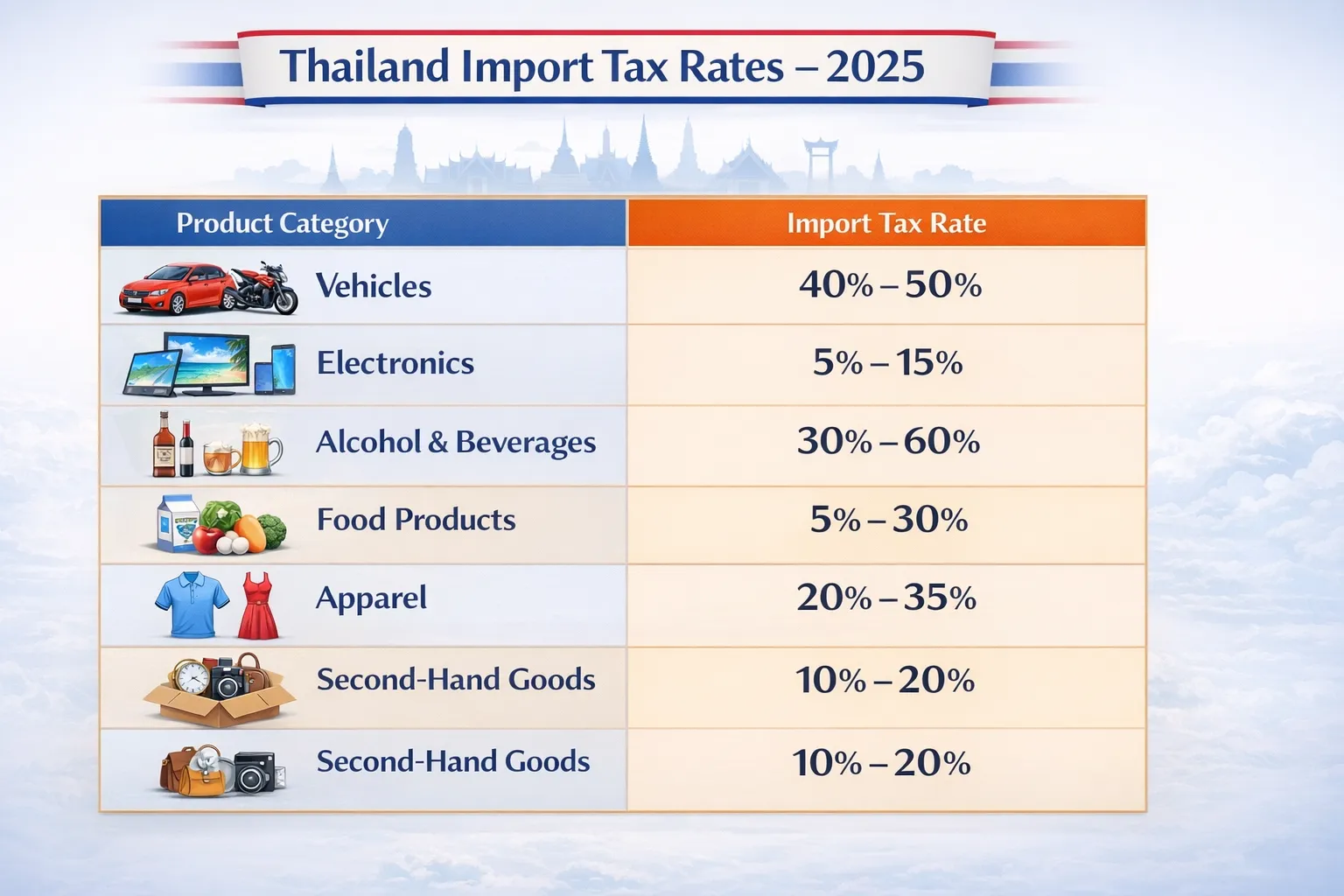
| Product Category | HS Code Range | Duty Rate | Excise Tax | Notes |
|---|---|---|---|---|
| Electronics | 84-85 | 5-15% | None | Lower rates for components; finished goods higher |
| Laptops/Computers | 8504-8517 | 5-10% | None | May qualify for FTA reduction (Japan, Singapore) |
| Motorcycles | 8703-8704 | 30-35% | None | New vehicles higher than used; engine size matters |
| Passenger Vehicles | 8704 | 40-50% | None | Used cars slightly lower; Japanese brands lower under JTEPA |
| Food Products | 01-21 | 5-25% | Variable | Higher for processed; lower for raw agricultural |
| Coffee | 0901 | 8-12% | None | Green coffee lower; roasted higher |
| Wine/Grape Products | 2204 | 30-60% | 30%+ | Excise tax stacks on top of duty |
| Spirits/Alcohol | 2207-2208 | 45-60% | 30%+ | Highest duty category; significant cost impact |
| Beer | 2203 | 35-40% | 25-30% | Excise applies; local production protected |
| Clothing/Apparel | 61-62 | 20-30% | None | Higher rates protect local textile industry |
| Footwear | 64 | 20-30% | None | Branded shoes often higher rates |
| Second-Hand Goods | Variable | 10-20% | None | Condition-based; damaged goods higher rates |
| Furniture | 94 | 15-25% | None | Wooden furniture higher; metal/plastic lower |
| Medical Equipment | 90 | 5-15% | None | Diagnostic equipment lower; surgical higher |
| Luxury Goods | Variable | 40-80% | 50%+ | Watches, jewelry, designer items; highest rates |
Note: Actual rates vary by specific HS code (6-8 digit classification). FTA agreements may reduce these rates to 0-5% for eligible products.
Free Trade Agreements (FTAs) and Duty Reductions
Thailand has signed the most extensive free trade agreement network in Southeast Asia, creating significant opportunities for duty reduction or elimination on eligible goods.
How FTAs Reduce Your Import Costs
When goods meet the Rules of Origin (ROO) outlined in an FTA, they qualify for preferential duty rates – often dramatically lower or zero.
Example: A laptop manufactured in Japan and imported under the Japan-Thailand Economic Partnership Agreement (JTEPA) might have:
- Normal duty: 10%
- JTEPA preferential rate: 0-3%
- Savings: 7% on the CIF value
For a 100,000 Baht shipment, this saves 7,000 Baht in duties immediately.
Thailand’s Key FTAs (2025-2026)
Multilateral Agreements (Highest Commercial Value)
- ASEAN Free Trade Area (AFTA) – Established 1992
- Partners: Brunei, Cambodia, Indonesia, Laos, Malaysia, Myanmar, Philippines, Singapore, Vietnam
- Coverage: Majority of goods; agriculture partially covered
- Rates: Many products at 0-5% duty
- ASEAN-China Free Trade Agreement (ACFTA) – Established 2005
- Reduced duties on machinery, electronics, textiles
- Strategic importance for Thailand-China bilateral trade
- Many products duty-free for ASEAN members
- Regional Comprehensive Economic Partnership (RCEP) – Effective 2022
- Partners: ASEAN 10 + China, Japan, South Korea, Australia, New Zealand
- Coverage: Tariff elimination on 90%+ of goods
- Most significant FTA for reducing import costs
- ASEAN-Japan Comprehensive Economic Partnership (AJCEP) – Established 2008
- Preferential rates on machinery, electronics, auto parts
- Japanese machinery often duty-free or very low rates
- Benefits many industrial imports
- ASEAN-Korea Free Trade Area (AKFTA) – Established 2007
- Electronics, machinery, chemicals
- Korean brands (Samsung, LG, Hyundai) often benefit
- ASEAN-Australia and New Zealand FTA (AANZFTA) – Established 2010
- Agricultural products, raw materials
- Lower duties on dairy, meat, wool
- Benefits food importers from both countries
Bilateral Agreements (Country-Specific Benefits)
- Japan-Thailand Economic Partnership Agreement (JTEPA) – Established 2007
- Impact: Significantly reduced duties on vehicles, machinery, electronics
- Vehicle Benefits: Used cars from Japan often 5-10% lower duty rates
- Machinery: Industrial equipment, auto parts duty-free or <5%
- Electronics: Computing equipment, semiconductors 0-5% rates
- Thailand-India Free Trade Agreement (AIFTA) – Established 2013
- Reduced duties on textiles, chemicals, agricultural products
- Textiles particularly benefit (from 30% to 15-20%)
- Dairy and agricultural products qualified
- Australia-Thailand Free Trade Agreement (TAFTA) – Established 2013
- Agricultural products, minerals
- Dairy, meat, wool get preferential treatment
- Thailand-Pakistan Free Trade Agreement – Established 2013
- Textiles, ceramics
- Agricultural products (rice, sugar)
- Thailand-European Free Trade Association (EFTA) FTA – Established 2013
- Chemicals, pharmaceuticals, machinery
- Swiss and Scandinavian products benefit
- Thailand-Turkey Free Trade Agreement – Established 2013
- Machinery, chemicals, textiles
- ASEAN-Canada Free Trade Agreement (ACTA) – New 2024
- Emerging opportunity for North American products
- Benefits machinery, food products, minerals
Total FTA Coverage: Thailand currently has preferential trade relationships with 60+ countries through bilateral and multilateral agreements.
Claiming FTA Benefits: Rules of Origin
To claim preferential duty rates, your goods must meet Rules of Origin (ROO) requirements. These typically specify:
- Local content: Minimum percentage of value added in FTA member countries
- Regional value content: Often 40-60% depending on product
- Country of origin: Where significant processing occurred
Required Documentation:
- Certificate of Origin (signed and dated)
- Supplier documentation proving component origins
- Processing records if goods underwent manufacturing
Common Mistake: Not providing proper Certificates of Origin causes goods to be assessed at standard duty rates rather than preferential rates.
Updated US Tariff Situation & 2026 Impact
Recent Developments (December 2025)
Thailand-US trade relations have entered a critical phase following several policy shifts in late 2025. The previously-announced August 1, 2025 deadline for US tariff negotiations has passed, with the following outcomes:
Current Status:
- General US Tariff: 10% on imports from most countries (excluding China) remains in effect
- Trump Administration Position: 90-day negotiation window announced; focus on bilateral trade balance
- Thailand’s Response: Expanded zero-duty privilege proposal to cover 90% of US imports; increased agricultural and energy product purchases
What This Means for Importers
Immediate Impact (2025-2026):
- US Product Pricing: American imports (corn, agricultural products, electronics, machinery) may face tariff adjustments
- Negotiation Uncertainty: Final resolution of US-Thailand tariff deal unclear; could favor either country
- Cost Planning: Budget 5-10% tariff premium on US goods until deal finalized
Potential 2026 Scenarios:
Scenario A – Favorable Deal for Thailand:
- Preferential rates on Thai exports to US
- Reciprocal zero or low tariffs on select US goods
- Particularly benefits: American agricultural imports (corn, soybeans), mechanical equipment
Scenario B – Maintained Status Quo:
- 10% general tariff continues on US imports
- No bilateral FTA agreement
- Importers pay standard 10% + VAT + duties
Scenario C – Escalated Tariffs:
- US imposes category-specific tariffs (technology, autos, etc.)
- Countertariffs on Thai exports
- Significant cost increase for US imports
Recommendation: Monitor official announcements from:
- Thailand’s Ministry of Commerce
- US International Trade Commission
- Royal Thai Embassy/US Embassy trade pages
Prohibited and Restricted Goods: What You Cannot Import
Understanding what goods are banned or restricted is critical. Attempting to import prohibited items can result in severe penalties – criminal charges, fines, and imprisonment.
Absolutely Prohibited Items
These items are completely banned from Thailand under all circumstances:
Narcotics & Controlled Substances:
- Marijuana, opium, cocaine, heroin, morphine, methamphetamine
- Medical prescriptions do NOT exempt these items
- Possession = automatic criminal charges
Intellectual Property Violations:
- Counterfeit goods (fake designer brands, watches, handbags)
- Pirated software, music, movies, books, CDs
- Fake diplomas, certificates
- Thailand strictly enforces TRIPS Agreement (Trade-Related Aspects of Intellectual Property Rights)
Offensive/Immoral Materials:
- Pornographic materials, obscene literature, explicit images
- Publications/items with improper Thai flag designs (cultural respect violation)
- Offensive religious materials
Currency & Official Documents:
- Counterfeit currency, bonds, coins
- Fake royal seals, official government seals
- Forged passports, visas, official stamps
Environmental Hazards:
- Household refrigerators/freezers using CFCs (chlorofluorocarbons)
- Ozone-depleting substances
- Certain pesticides banned internationally
Tobacco & Vaping Products:
- Electronic cigarettes (vapes), vape liquid, vape devices
- Heated tobacco products
- Any nicotine delivery device except traditional cigarettes (under strict quantity limits)
Other Explicitly Banned Items:
- Live endangered animals
- Ivory and protected wildlife products
- Hazardous chemical weapons
- Explosives, detonators, ammunition (civilian use restricted)
Restricted Goods Requiring Government Permits
Restricted goods are not entirely prohibited but require special permits and licenses from relevant government agencies:
Food & Agricultural Products
Required Approval: Food and Drug Administration (FDA) + Ministry of Public Health (MOPH)
Process:
- Apply for Import License via FDA e-Submission System
- Submit product registration for each item
- Receive Food Serial Number upon approval
- Apply for Thai-language label pre-approval (for “controlled foods”)
- Attach labels before shipment enters Thailand
Specifically Controlled Foods Requiring Extra Permits:
- Infant formula
- Health supplements with disease claims
- Novel foods
- Genetically modified (GM) products
- Products with additives requiring special approval
Label Requirements:
- Product name (Thai)
- Food serial number
- Importer/manufacturer name and address (Thai)
- Full ingredient list with percentages
- Allergen declarations
- Expiry/best-before date
- Storage instructions
- Nutrition facts (when required)
Pharmaceutical Products
Required Approvals: Thai FDA (Ministry of Public Health) + Import Facility License
Two-Step Process:
- Import Facility License:
- Register storage location with Thai FDA
- Facility must meet Good Distribution Practice (GDP) standards
- Valid for specific storage address
- Product Registration:
- Submit each drug product for FDA approval
- Requires: composition, packaging, samples, clinical data, GMP certificates
- Thai-language label approval
- For vaccines/biologics: Lot Release Certificate from Institute of Biological Products
Processing Timeline: 4-8 weeks typical
2025 Update: New Thailand National Single Window (Thai NSW) system requires electronic submissions through customs department for all controlled health products.
Medical Devices & Equipment
Required Approval: Thai FDA + Ministry of Public Health
Categories:
- Diagnostic equipment (lower approval burden)
- Surgical instruments (moderate requirements)
- Implantable devices (highest scrutiny)
- Home health equipment (CPAP machines, mobility aids)
Process: Register device model; submit technical specifications, safety data, GMP certificates.
Machinery & Electronics
Potentially Restricted:
- Industrial machinery (requires Board of Investment approval for certain types)
- High-specification electronics (some export-controlled items)
- Telecommunications equipment (frequency/standard compliance)
Requirements Vary: Not always restricted; depends on specific application and destination use.
Chemicals & Hazardous Materials
Required Approvals:
- Ministry of Industry (hazardous classification)
- Ministry of Public Health (public safety)
- Thai Industrial Standards (TIS) compliance
Process:
- Safety data sheets (SDS) in Thai
- Hazard classification per GHS (Global Harmonized System)
- Packaging compliance certification
- Transport regulations compliance
Live Animals & Plants
Required Approvals:
- Department of Livestock Development (animals)
- Department of Agriculture (plants)
Requirements:
- Health certificates from country of origin
- Vaccination/disease records (animals)
- Phytosanitary certificates (plants)
- Quarantine facilities may be required
Firearms & Weapons
Highly Restricted: Requires Police approval + Defense Ministry permission
Civilian import nearly impossible for most weapon categories.
Exception: Sporting equipment with proper documentation (very limited categories).
Food & Agricultural Product Import Process
Step 1: FDA Pre-Approval
Before shipping any food products to Thailand, you must obtain import approval from the Thai FDA.
Application Process:
- Register on FDA e-Submission System (https://efile.fda.moph.go.th/)
- Submit import license application with:
- Company registration (Thai business or foreign importer representative)
- Facility location details (warehouse/storage address)
- Product information (name, composition, origin)
- Intended use (retail, wholesale, food service)
- FDA reviews (typical 2-4 weeks)
- Upon approval: Food Serial Number issued
- Pre-approval of Thai-language labels for “controlled foods”
Food Serial Number: This unique identifier must appear on all product labels. Without it, goods are subject to seizure by Thai FDA.
Step 2: Facility & Storage Requirements
Your import/storage facility must meet:
- Permanent building (not temporary structure)
- Proper temperature control (if required for product type)
- Clear separation from non-food items
- Pest control systems
- Sanitation standards
- Trained personnel for food handling
Step 3: Thai-Language Labeling
Mandatory Information on Label:
- Product name (Thai language)
- Food serial number
- Name and address of importer/manufacturer (Thai)
- Country of origin
- Ingredient list (complete, with main ingredient percentages)
- Allergen declarations (8 major allergens: milk, eggs, peanuts, tree nuts, fish, shellfish, soy, sesame)
- Expiry date or “best before” date
- Storage instructions
- Weight/volume
- Net quantity
- Manufacturer/distributor contact information
For Certain Products:
- Nutrition facts label (calories, protein, fat, carbs, sodium, etc.)
- Guideline Daily Amounts (GDA) percentages
- Health warnings (if applicable)
- Instructions for use (if specialized)
Step 4: Specific Controls for “Controlled Foods”
Certain foods require pre-approval of label design before import:
- Infant formula
- Health supplements with health claims
- Fortified foods
- Novel foods (new to Thai market)
- Genetically modified products
- Products with additives requiring special approval
Process:
- Submit label mockup to FDA
- FDA approves or requests changes (1-2 weeks)
- Label must match approved design exactly
- Physical labels applied before goods enter Thailand
Step 5: Shipment & Clearance
- Goods must arrive with proper labeling already attached (FDA may reject goods without correct labels)
- Submit import declaration via e-Customs with FDA reference number
- Customs may conduct food safety inspection
- Upon clearance, goods are released for distribution
Timeline: Total process 4-8 weeks from initial application to goods clearance.
Cost: FDA application fee (~500-1,500 Baht) + label pre-approval (~300-500 Baht) + customs clearance fees.
Pharmaceutical Product Import Requirements
Step 1: Import Facility License
Before importing any medicine:
Requirements:
- Valid facility location (warehouse, clinic, hospital, pharmacy)
- Good Distribution Practice (GDP) compliance
- Registered owner (Thai individual or company)
Application:
- Submit facility details to Thai FDA
- FDA conducts facility inspection (verify storage, temperature control, security)
- License issued for 2 years (renewable)
- Must maintain FDA compliance records
Step 2: Individual Product Registration
Each pharmaceutical product requires separate registration and approval.
Required Documentation:
- Product composition and active ingredient list
- Formulation details and manufacturing process
- Packaging and labeling design (Thai language)
- Product samples (3-10 units)
- Clinical and safety data (if new to market)
- Certificate of Free Sale (proof legal in country of origin)
- Certificate of GMP Compliance (Good Manufacturing Practice)
Drug Categories & Requirements:
- Modern Medicines: Most stringent; requires full data
- Traditional Remedies: Specific documentation for traditional ingredients
- Veterinary Products: Additional animal safety data
- Cosmetics/Beauty Products: Different agency (if not medicinal claims)
Processing: 6-12 weeks typical for FDA review and approval.
Step 3: Label Approval (Thai Language)
All approved drugs must carry Thai-language labels clearly showing:
- Product name (Thai)
- Active ingredient(s) with strength
- Dosage instructions
- Usage guidelines (when to use, duration)
- Warnings and contraindications
- Storage conditions
- Expiry date
- Lot number
- Manufacturer and importer information
Step 4: Special Requirements for Vaccines & Biological Products
For vaccines and certain biological medicines:
- Institute of Biological Products Certificate: Lot Release Certificate required before sale/distribution
- Each batch requires verification
- Additional temperature control and transportation requirements
Step 5: 2025 Update – Thailand National Single Window (Thai NSW)
Effective 2025, all controlled health products must be processed through Thai NSW system:
- Electronic submission required (no paper applications)
- Permits issued electronically
- Integration with customs department
- Faster processing but requires digital compliance
Implementation: Importers must register on Thai NSW platform and file all applications electronically.
Common Import Mistakes That Cost Money
Mistake 1: Incorrect HS Code Classification
What Happens: Using wrong HS code leads to wrong duty rate applied.
Example: Classifying a laptop (HS 8504) as office equipment (HS 8516) might use 15% duty instead of 8%, costing 7% extra on entire shipment.
Impact:
- Customs charges incorrect duty
- Upon audit, surcharge of 1.5% monthly on unpaid taxes
- Penalties up to 200% of unpaid amount
- Possible shipment detention
Prevention:
- Use official Thai Customs HS code database
- Verify with customs broker
- Keep product specifications detailed (helps classification)
Mistake 2: Undervaluing Goods
What Happens: Declaring CIF value lower than actual cost to reduce duties.
Example: Declaring 50,000 Baht for goods actually worth 100,000 Baht.
Impact:
- Customs may reject valuation
- Goods revalued at fair market price
- Back duties + 1.5% monthly surcharge
- Fines up to 200% of unpaid duties
- Criminal investigation possible for deliberate fraud
Prevention:
- Use actual CIF values (cost + shipping + insurance)
- Keep invoices and receipts
- Documentation of valuation methodology
Mistake 3: Missing or Incorrect Certificates of Origin
What Happens: Goods eligible for FTA rates imported without proof of origin.
Example: Japanese machinery that qualifies for 0% duty under JTEPA imported without Certificate of Origin; assessed at standard 15% duty.
Impact:
- Lose FTA preferential rates entirely
- Pay full standard duty
- Difference non-recoverable (already paid)
- For valuable shipments, cost can be thousands of Baht
Prevention:
- Request Certificate of Origin from supplier before shipment
- Verify FTA eligibility beforehand
- Maintain chain of origin documentation
Mistake 4: Missing Food/Pharmacy Permits
What Happens: Food or medicine imported without FDA license/product registration.
Example: Importing infant formula without FDA pre-approval.
Impact:
- Seizure of entire shipment
- Goods destroyed or returned to origin
- Fine up to 100,000 Baht
- Banned from future food imports
- Criminal charges possible for repeat offenses
Prevention:
- Apply for FDA approval 6-8 weeks before shipment
- Verify food serial number received
- Get label pre-approval before labeling
Mistake 5: Improper Food Labeling
What Happens: Food arrives without proper Thai-language labels or with missing allergen information.
Example: Cereal product imported with English labels only; missing allergen declaration for tree nuts.
Impact:
- Goods seized by FDA
- Rejected at customs; cannot clear
- Cost of relabeling or destruction
- Cannot be sold until corrected
Prevention:
- Prepare labels in Thai BEFORE shipment
- Include all required information
- Allergen declarations mandatory
- Label mockup approved by FDA for “controlled foods”
Mistake 6: Incomplete Customs Documentation
What Happens: Missing power of attorney, VAT certificate, or company affidavit.
Example: Submitting import declaration without current VAT registration certificate.
Impact:
- Customs requests missing documents
- Shipment held 5-14 days
- Storage fees accrue (50-200 Baht/day)
- Potential penalty for late submission
Prevention:
- Prepare all documents 2 weeks before shipment arrival
- Checklist: POA, VAT cert, company affidavit, ID copy, bank statements
- Verify documents current (not expired)
Mistake 7: Vague/Inaccurate Product Descriptions
What Happens: Import declaration vague; goods arrive with unclear classification.
Example: Declaring “electronics equipment” without specifying laptops, phones, components, etc.
Impact:
- Customs conducts detailed inspection
- Delays 3-7 days
- Potential reclassification and additional duties
- Inspection fees (1,000-5,000 Baht)
Prevention:
- Detailed product descriptions in all documents
- Specific brand/model information
- Technical specifications where relevant
- Attach catalogues/product photos
Mistake 8: Shipping Used/Second-Hand Goods as New
What Happens: Used items declared as new to avoid second-hand duty rates.
Example: Used office furniture from US declared as “new furniture” to qualify for lower new goods rates.
Impact:
- Customs inspection reveals used condition
- Reclassification to second-hand rates (often +5-10% higher)
- Back duties + surcharge
- Penalties for misclassification
Prevention:
- Accurate condition declarations
- Appropriate second-hand duty rates from start
- Condition documentation (photos, certificates)
Mistake 9: Neglecting Excise Tax Obligations
What Happens: Importers forget excise tax when budgeting alcohol/luxury imports.
Example: Budgeting 30% duty for wine; forgetting 30% excise tax stacks on top.
Impact:
- Actual cost 60%+ (duty + excise + VAT + interior tax) instead of budgeted 30%
- Insufficient funds to clear goods
- Warehouse storage fees while gathering additional funds
- Cash flow disruption
Prevention:
- Use complete tax calculation (all scenarios above)
- Budget for excise tax on alcohol, tobacco, luxury goods
- Separate duty vs. excise in cost calculations
Mistake 10: Ignoring FTA Rules of Origin Requirements
What Happens: Claiming FTA rates on goods that don’t meet regional value content requirements.
Example: Electronics with 30% local content claiming RCEP zero-duty rate (requires minimum 40% regional content).
Impact:
- Customs audits FTA claim
- Goods reclassified to standard rates
- Back duties + surcharge
- Loss of import privileges in future
Prevention:
- Verify regional value content percentage
- Obtain supplier certification of origin compliance
- Maintain documentation of component origins
BOI Incentives for Importers
Thailand’s Board of Investment (BOI) offers significant tax incentives for certain types of businesses and product categories.
Who Qualifies for BOI Import Tax Exemptions?
Category 1: BOI-Registered Companies
Companies granted Board of Investment Promotion Status may qualify for:
- Duty exemption on imported machinery (manufacturing equipment)
- Duty exemption on raw materials (for export-oriented production)
- VAT exemption on imported inputs
- Corporate tax holidays (up to 8 years for certain industries)
Eligible Industries:
- Manufacturing with export focus
- High-technology production
- Agricultural processing
- Automotive manufacturing
- Electronics manufacturing
- Alternative energy production
- Medical device manufacturing
- Food processing
Requirements:
- Minimum capital investment (varies by industry)
- Employment requirements (10-50 employees typically)
- Local content percentage (varies)
- Goods primarily for export (or domestic if serving export industries)
Category 2: Special Economic Zones (SEZs)
Companies operating in Thailand’s Special Economic Zones receive:
- Duty exemption on machinery imports
- Duty exemption on raw materials
- VAT exemption
- 10-year corporate tax exemption (in some zones)
Major Thai SEZs:
- Rayong SEZ (Eastern region; manufacturing/logistics)
- Laem Chabang Port (Chachoengsao; manufacturing)
- Amata Nakorn (Rayong; industrial park)
- Thai-Japanese Economic Zones (multiple locations)
- Logistic Park Lat Krabang (Bangkok; distribution center)
Category 3: Alternative Energy Production
BOI provides incentives for importers of:
- Solar panel manufacturing equipment
- Wind turbine components
- Battery/energy storage systems
- Hydro turbines
- Biogas equipment
Incentive: Duty and VAT exemption on import of specialized machinery.
How to Apply for BOI Incentive
Step 1: Submit BOI Application with:
- Business plan and project details
- Capital investment amounts
- Employment projections
- Timeline
- List of equipment/machinery to import
Step 2: BOI Review (typically 2-4 months)
Step 3: Approval/Denial
Step 4: Once approved, import machinery with duty exemption documentation
Processing Time: 3-6 months typical from application to approval
Timeline: Early applications recommended; incentive approval often required before equipment procurement.
Calculating Your Final Landed Cost: The Complete Formula
Landed Cost = Product Cost + Shipping + Insurance + Import Duty + VAT + Excise Tax (if applicable) + Broker Fees + Inspection/Processing Fees
Quick Calculation Checklist
| Component | Formula | Notes |
|---|---|---|
| CIF Value | Product cost + International shipping + Insurance | Base for all duty calculations |
| Import Duty | CIF × Duty rate % | Depends on HS code |
| Duty Base | CIF + Import Duty | Used for VAT calculation |
| VAT | (CIF + Duty) × 7% | Mandatory since July 2024 |
| Excise Tax (if applicable) | Calculated per formula in scenarios above | Alcohol, tobacco, luxury goods only |
| Interior Tax (if applicable) | Excise × 10% | Stacks on excise tax |
| Customs Broker Fee | 500-2,000 Baht per shipment | Varies by complexity |
| Inspection Fee | 0-5,000 Baht | If random inspection occurs |
| Warehouse Storage | 50-200 Baht/day | If goods delayed in customs |
| Port/Terminal Handling | 500-2,000 Baht | Varies by port |
Example Final Calculation:
textLaptop from Singapore:
Product Cost: 20,000 Baht
International Shipping: 2,000 Baht
Insurance: 400 Baht
CIF Value: 22,400 Baht

Import Duty (10%): 2,240 Baht
Duty Base: 24,640 Baht
VAT (7%): 1,724.80 Baht

Customs Broker Fee: 1,000 Baht
Inspection Fee: 0 Baht (no random check)
Warehouse Storage: 0 Baht (cleared same day)

TOTAL LANDED COST: 29,364.80 Baht
Cost Increase: 47.4% above product cost
2026 Regulatory Updates & Changes to Watch
1. HS Code Nomenclature Update (2026)
Thailand will update to the latest ASEAN Harmonized Tariff Nomenclature (AHTN 2026) with new:
- Product categories (emerging tech: AI, biotech, EVs)
- Digital goods classifications
- Sustainability-focused categories
Impact: Product codes may change; verify correct codes when classification changes occur.
2. Thai NSW Expansion (2025-2026)
The Thailand National Single Window system continues expanding beyond health products:
- Likely to include food and agricultural products by 2026
- Additional controlled goods categories
- Fully electronic submission requirement
Action: Begin digital submission preparation now; paper applications may phase out.
3. EV Tax Incentives Expansion (2026)
Thailand is expanding electric vehicle tax incentives:
- Import duty reduction on EV components
- Excise tax reductions on battery imports
- Possible exemptions on EV charging equipment
Opportunity: If importing EV-related goods, monitor for new preferential rates.
4. Potential New US-Thailand FTA (2026)
Ongoing US-Thailand trade negotiations may result in:
- New bilateral FTA agreement
- Preferential rates on select US goods
- Tariff reductions on Thai exports to US
Watch for: Official Ministry of Commerce announcements on deal completion.
5. Enhanced Food Safety Requirements (2026)
Thai FDA may implement stricter controls:
- Additional allergen categories
- Enhanced traceability requirements
- Blockchain-based supply chain documentation
Preparation: Begin documenting supply chain now; verify allergen controls.
6. Potential Tariff Changes on Luxury Goods (2026)
Government may adjust luxury goods tariff rates as part of domestic economic policy:
- Could increase duties on watches, jewelry, designer goods (40-80% → potential increases)
- Could decrease rates on sustainable/eco-friendly luxury goods
Impact: Verify rates before large luxury goods imports.
How to Reduce Import Costs: Practical Strategies
Strategy 1: Use Free Trade Agreements (FTAs)
Action: Verify if your goods qualify under Thailand’s 25+ FTA agreements.
Savings: Often 5-20% duty reduction (or zero duty)
Cost: Certificate of Origin (~100-300 Baht per document)
ROI: For 100,000 Baht shipment at 10% duty = 10,000 Baht saved; cost recovers immediately.
Implementation:
- Verify product origin
- Request Certificate of Origin from supplier
- Claim preferential rate in import declaration
Strategy 2: Consolidate Shipments
Action: Instead of 10 small shipments, combine into 1-2 large shipments.
Savings:
- Reduce broker fees (one shipment vs. ten)
- Negotiate better shipping rates with consolidators
- Reduce inspection likelihood (fewer shipments = fewer inspections)
Potential Savings: 3-8% on total landed cost
Strategy 3: Accurate Valuation & Classification
Action: Work with customs broker to optimize HS code classification (legally).
Example: Some products have multiple valid HS codes; some have lower duty rates.
Potential Savings: 1-5% on duty (within legal bounds; never undervalue)
Strategy 4: Apply for BOI Status (If Eligible)
Action: Register BOI-promoted business to qualify for duty exemptions on machinery and raw materials.
Savings: 0-15% duty exemption on eligible imports
Cost: Application/registration fees (5,000-20,000 Baht)
ROI: For businesses with regular machinery imports, ROI achieved quickly.
Strategy 5: Plan Imports Around FTA Negotiations
Action: Monitor US-Thailand, EU-Thailand negotiations; time large imports around potential favorable deal closures.
Potential Savings: 5-10% if new FTA implemented
Timing: Follow Ministry of Commerce announcements.
Resources & Tools for Thai Import Compliance
Official Government Websites
- Royal Thai Customs Department
- Website: https://www.customs.go.th/
- HS Code Database: Search by product name or code
- Tariff Rates: Updated tariff schedules
- e-Customs System: Import declaration filing
- Thai FDA (Food and Drug Administration)
- Website: https://en.fda.moph.go.th/
- e-Submission System: Food import applications
- Product Registration: Pharmaceutical approval system
- Department of Foreign Trade (DFT)
- Website: https://www.dft.go.th/
- FTA Documentation: Certificate of Origin applications
- Trade Information: Current FTA status and benefits
- Board of Investment (BOI)
- Website: https://www.boi.go.th/
- Incentive Information: Industry-specific benefits
- Application Portal: BOI promotion status
- Thailand National Single Window (Thai NSW)
- Website: https://www.singlewindow.go.th/
- Electronic Submission System: Health products, controlled goods
Recommended Tools & Services
HS Code Lookup Tools:
- Royal Thai Customs HS Code Database (official)
- Tariff database tools (multiple free tools available)
Import Duty Calculators:
- Various third-party calculators available (verify accuracy)
- Manual calculation using formulas in this guide
Customs Brokers in Thailand:
- Assist with e-Customs filing
- Document preparation and verification
- Duty payment arrangement
- Typical fee: 500-3,000 Baht per shipment
Contact Information for Import Help
Thai Customs Hotline: Call or visit local customs office
FDA Inquiries: Contact FDA directly via website or phone
BOI Information: Visit BOI offices or call info line
Professional Consultation: Hire customs broker or import consultant
FAQ: Common Import Questions
Q: Can I import goods below 1,500 Baht without paying VAT?
A: No. As of July 2024, ALL imported goods are subject to 7% VAT, regardless of value. The previous exemption for goods under 1,500 Baht was eliminated.
Applies to: Personal parcels, gifts, AliExpress/Amazon orders, small business shipments.
Q: How long does customs clearance typically take?
A:
- Standard goods: 1-3 business days (most common)
- “Red line” goods: 3-7 business days (high-risk inspection)
- Food/Pharmacy: 3-5 business days (FDA inspection may add time)
Delays occur due to: Missing documents, incorrect classification, random inspections, weekend/holiday periods.
Q: What happens if I import prohibited goods?
A:
- Seizure of entire shipment
- Criminal investigation
- Fines 200,000-500,000 Baht
- Imprisonment up to 10 years (serious cases)
- Lifetime import ban possibility
Example: Importing vapes = automatic criminal charge (not just fine).
Q: Can I appeal if I disagree with the assessed duty rate?
A: Yes, through Thai Customs Appeal Process:
- Petition filing within 30 days of duty assessment
- Submit documentation supporting your valuation/classification
- Customs Bureau review (4-8 weeks)
- Possible adjustment or confirmation
Cost: Minimal; legal representation optional.
Success Rate: Moderate; depends on evidence quality.
Q: Do I need separate insurance for goods in transit?
A: Recommended but not mandatory. Insurance covers:
- Damage during shipping
- Loss or theft
- Natural disasters
Cost: Usually 0.5-2% of CIF value.
Note: Uninsured goods lost in transit = total loss to importer.
Q: Can I import goods consigned to someone else (gift)?
A:
- Personal gifts: Generally allowed (subject to restrictions)
- Commercial goods as gifts: Prohibited (customs classifies as commerce)
- Value limit: No official limit, but suspicious high-value “gifts” may be audited
VAT still applies to gifts since July 2024.
Q: How do I get a refund if I paid excess duty?
A:
- File refund claim with Thai Customs within 1 year of payment
- Submit documentation proving overpayment
- Customs Bureau investigates (2-4 months)
- If approved, refund issued (payment method varies)
Success requires: Clear documentation of error; supporting evidence.
Q: What’s the difference between CIF and FOB valuation?
A:
- CIF (Cost, Insurance, Freight): Product cost + international shipping + insurance
- FOB (Free on Board): Product cost only; no shipping/insurance
Thailand uses CIF for duty calculations. FOB prices from suppliers must be converted to CIF by adding shipping and insurance.
Q: Can I bring samples into Thailand without import duty?
A:
- Commercial samples: Generally require import license and may be subject to duty
- Personal samples: May qualify for temporary import exemption (ATA Carnet system) if used for non-commercial purposes
- Duration: ATA Carnet typically valid 1 year; goods must exit or be imported properly after use
Recommendation: Consult customs broker for specific case.
Q: What documents must I keep after import clearance?
A: Maintain for minimum 5 years:
- Import declarations
- Invoices and packing lists
- Bills of lading
- Certificates of origin
- Customs clearance documentation
- Duty payment receipts
- Broker correspondence
Why: Customs may audit imports; documentation needed to defend against additional duty claims.
Your Path to Successful Importing
Thailand offers tremendous opportunities for importers – growing economy, strategic location, extensive FTA network – but success requires understanding complex regulations, accurate classification, proper documentation, and compliance with safety standards.
Key Takeaways:
- Register early: Obtain customs card and set up e-Customs account before first shipment
- Classify correctly: Wrong HS code = wrong duty; verify before import
- Document thoroughly: Missing documents = delayed goods and storage fees
- Calculate completely: Include all taxes (duty, VAT, excise) in cost planning
- Use FTAs: Check eligibility for preferential rates; verify Rules of Origin
- Respect restrictions: Prohibited goods cause criminal liability; verify restrictions
- Plan ahead: Food and pharma imports need 6-8 week FDA approval; plan accordingly
Common Success Pattern:
- Consult customs broker on first import (investment: 1,000-3,000 Baht)
- Gather all required documents
- File properly via e-Customs
- Clear goods within 3-5 days
- Scale to regular imports with established process
Next Steps:
- Verify your product’s HS code
- Calculate complete landed cost including all taxes
- Check FTA eligibility and Rules of Origin
- Prepare all required documentation
- Consider hiring customs broker for first import
- File import declaration via e-Customs
- Prepare for duty payment upon notification
- Collect goods upon customs release
Questions? Consult:
- Customs broker (local expertise)
- Thai Customs website (official rules)
- Your trade association (industry guidance)
- Ministry of Commerce (policy questions)
Article Version: 2026 Complete Updated
Last Verified: December 27, 2025
Next Review: June 2026 (for tariff changes, new FTA developments)
Related Resources
- Thailand VAT Registration Guide 2025
- How to Obtain Thai FDA Food Import License
- Thailand FTA Benefits & Rules of Origin
- Guide to Thai Customs Penalties and Dispute Resolution
- Setting Up a Customs Card Account: Step-by-Step
- Thailand’s Harmonized System (HS Code) Database