
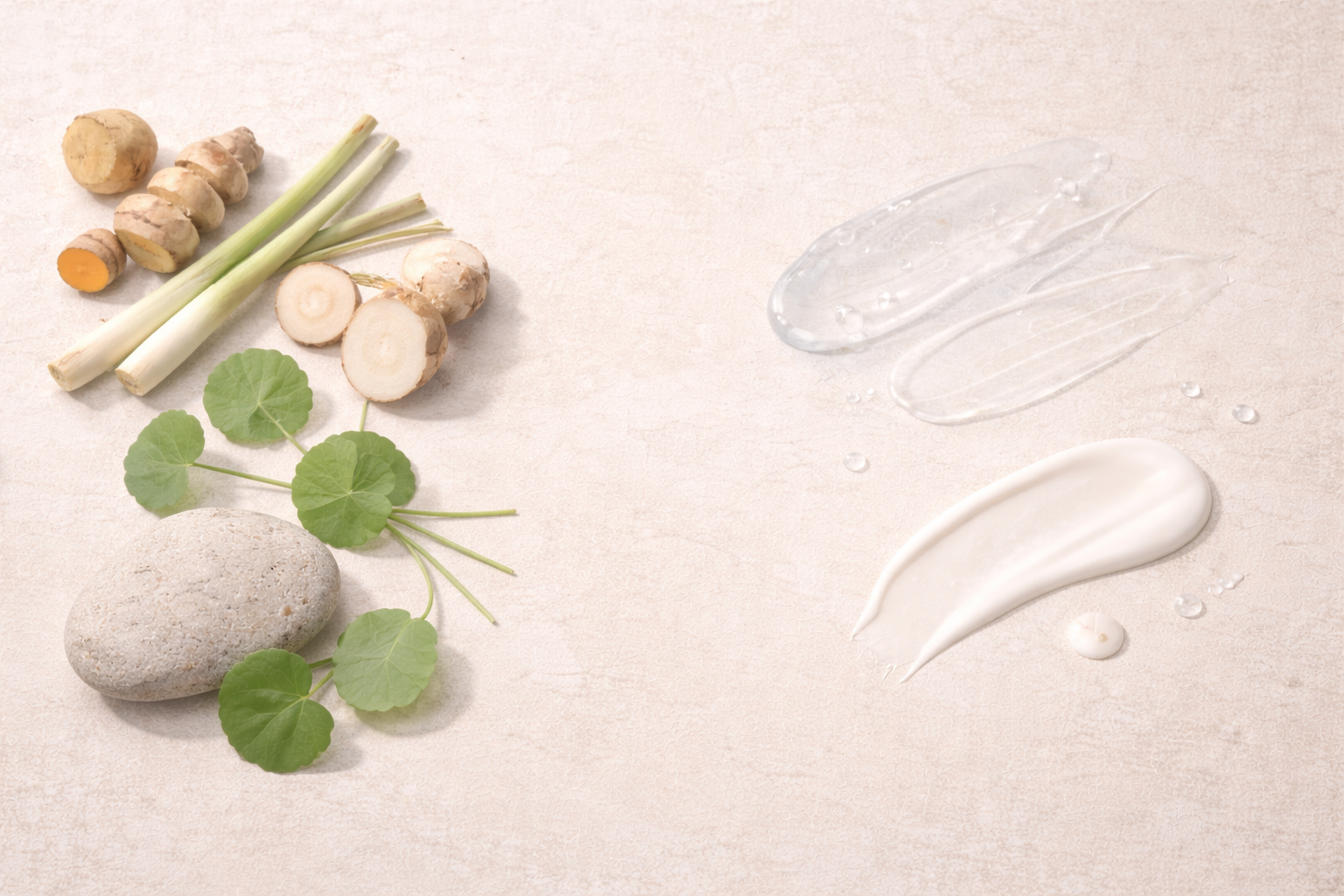
Thai skincare ingredients are often talked about in extremes. On one side, they’re framed as ancient herbal wisdom, mysterious and instinctive. On the other, as late adopters of Western or Korean cosmetic science. Both views miss the point.
Thai skincare is neither frozen in tradition nor chasing imported trends. It is a context-driven system shaped by climate, everyday health practices, and a pragmatic relationship with medicine. To understand its ingredients properly, you need to step away from marketing language and look at why certain ingredients exist in formulas at all.
This article is not about brands, miracle herbs, or product recommendations. It’s about ingredient logic-how traditional Thai ingredients evolved, how modern actives entered the ecosystem, and why the two coexist without conflict.
Why Thai Skincare Ingredients Are Often Misunderstood
“Herbal” ≠ primitive
In many Western beauty narratives, “herbal” implies something pre-scientific or less effective. In Thailand, herbal ingredients come from applied medical traditions, not folklore. Many plants used in skincare were first studied for digestion, inflammation, fever, or wound care-then adapted cautiously for topical use.
Traditional does not mean untested; it often means observed over generations, then refined.
“Modern” ≠ imported
There’s an assumption that effective actives-humectants, barrier-support ingredients, calming agents-arrived in Thailand only via K-beauty or Western dermatology. In reality, Thailand has long had a pharmacy-led culture, where formulations were practical, climate-aware, and often locally produced.
Modern actives didn’t replace tradition; they were integrated where they solved real problems.
The K-beauty / Western lens problem
K-beauty emphasizes layering, sensory luxury, and visible transformation. Western skincare often focuses on correction and anti-aging narratives. Thai skincare prioritizes something quieter:
Comfort, balance, and daily usability in heat and humidity.
When evaluated through the wrong lens, Thai ingredients can seem “basic” or “underpowered.” In context, they’re often precisely calibrated.
Traditional Thai Ingredients – Where They Come From
Thai traditional medicine as the foundation
Traditional Thai medicine (TTM) sits at the intersection of herbalism, Ayurveda, and local Southeast Asian practices. Its core concern is balance-especially heat, inflammation, and stagnation.
Importantly, TTM was never separated into “beauty” and “health.” Skin was treated as part of overall wellbeing.
Food, ritual, and daily use
Many traditional ingredients entered skincare not as cosmetics, but as:
- cooking ingredients
- compresses and poultices
- bathing additives
- post-illness or postpartum care
This matters because the intent was rarely aesthetic perfection. It was relief, cooling, cleanliness, and recovery.
Medicinal use vs cosmetic adaptation
A critical distinction often ignored in marketing:
- Medicinal use: higher concentration, short-term, targeted
- Cosmetic adaptation: diluted, stabilized, repeat-safe
Traditional Thai skincare doesn’t assume that “more is better.” In fact, restraint is a core principle.
Core Traditional Ingredients in Thai Skincare
Roots & rhizomes
These are often framed as “power ingredients,” but their real role is regulation, not transformation.
Common functions:
- gentle antimicrobial support
- reduction of surface inflammation
- sensory cooling or warming cues
Limitations:
They are rarely used at levels that dramatically alter pigmentation or structure. Their value lies in maintenance, not correction.
Leaves & botanical extracts
Leaf-based ingredients are central because they’re:
- lightweight
- water-compatible
- less occlusive in heat
They’re often used to:
- soothe irritation from sweat or friction
- support recovery after sun exposure
- reduce the sensation of heat on skin
Limitations:
Effects are subtle and cumulative. Expecting instant visible change misunderstands their role.
Oils & resins
Contrary to assumptions, traditional Thai skincare is not oil-heavy. Oils were used selectively:
- on the body rather than face
- in massage, not leave-on facial care
- for sealing, not treatment
Resins and aromatic oils were valued as much for sensory signaling (cooling, grounding) as for topical effect.
Cooling vs soothing logic
One of the most misunderstood concepts.
- Cooling refers to perceived temperature and inflammation relief
- Soothing refers to barrier comfort and irritation reduction
Traditional Thai ingredients often emphasize cooling first, because heat is the dominant environmental stressor.
How Modern Actives Entered Thai Skincare
Dermatology and clinical influence
Thailand has a strong dermatology culture, particularly around:
- acne
- pigmentation
- post-inflammatory sensitivity
This led to early adoption of clinically validated actives, but often at lower irritation thresholds than in Western formulas.
Pharmacy culture
Pharmacies in Thailand historically compounded products for everyday concerns. This normalized:
- functional gels
- simple ingredient lists
- pragmatic formulation choices
Modern actives didn’t arrive as luxury-they arrived as tools.
Climate-driven formulation needs
High heat and humidity impose hard limits:
- heavy occlusives feel uncomfortable
- strong actives increase irritation risk
- over-layering leads to congestion
Modern ingredients were selected not for trendiness, but for compatibility with sweat, oil, and frequent cleansing.
Modern Ingredients Commonly Used in Thai Formulas
Gels, humectants, barrier support
Thai formulations often prioritize:
- water-based gels
- lightweight humectants
- non-greasy barrier helpers
The goal is hydration without heaviness, comfort without shine.
Why lightweight actives dominate
In hot climates:
- irritation escalates faster
- compromised barrier shows sooner
- compliance matters more than intensity
An ingredient that works moderately but consistently is often superior to a strong one people stop using.
What is avoided in Thai climate
Less common in locally oriented formulas:
- heavy butters
- aggressive exfoliation blends
- strongly fragranced occlusives
This isn’t ideology-it’s lived experience.
Traditional vs Modern – Not a Conflict, a Layering Logic
How formulas combine both
Many Thai formulas quietly blend:
- a traditional cooling extract
- a modern hydration or barrier ingredient
Each does a different job. One signals comfort; the other ensures performance.
When tradition is symbolic
Some traditional ingredients remain for:
- cultural familiarity
- sensory expectation
- user trust
They may not be the primary active-and that’s okay.
When it’s functional
Others remain because they:
- reduce irritation
- support recovery
- make modern actives more tolerable
Tradition often acts as buffer, not centerpiece.
Ingredients That Work Best in Hot & Humid Climates
Key challenges:
- sweat dilution
- friction
- oil overproduction
- reactive skin
Effective ingredient strategies focus on:
- fast absorption
- low residue
- calming over stimulation
The priority is comfort over transformation. Skin that feels stable behaves better long-term.
Common Myths About Thai Skincare Ingredients
“All Thai skincare is herbal”
In reality, most formulas are hybrid. Purely herbal products exist, but they’re not the norm.
“Natural = safer”
Traditional Thai medicine never assumed this. Many plants are potent-and require caution.
“If it’s traditional, it must be weak”
Traditional ingredients weren’t designed to chase visible change. They were designed to prevent imbalance-a different metric of success.
FAQ
How do you know which skincare ingredients actually work?
By understanding what problem they were designed to solve, and under which conditions. Effectiveness is contextual, not universal.
Are Thai skincare ingredients effective?
Yes-when used as intended. Many excel at maintaining comfort, reducing irritation, and supporting daily skin function in heat.
Why do Thai people use herbal products?
Because they’re familiar, accessible, and aligned with daily life-not because they believe in miracles.
Is Thai skincare evidence-based?
Increasingly so. Traditional ingredients are often used alongside modern actives, not instead of them.
Final Perspective – Understanding Thai Ingredients Correctly
Thai skincare is not “exotic beauty.”
It’s not a museum of ancient secrets.
And it’s not a diluted version of K-beauty or Western dermatology.
It is context-specific formulation logic.
Ingredients make sense when you consider:
- climate
- daily habits
- medical culture
- expectations of comfort
Evaluated outside this environment, Thai skincare can seem understated. Within it, the logic is precise.
Understanding Thai ingredients correctly means letting go of hype-and paying attention to why restraint, balance, and practicality matter.