
Key Highlights
- The Thai O visa is designed for foreign nationals who wish to stay in Thailand with their Thai family members.
- It is a non-immigrant visa perfect for long-term family stays, offering more stability than a tourist visa.
- Your visa application requires specific required documents, including proof of relationship and financial stability.
- The entire process, from application to approval, is now handled online through the e-Visa system.
- Processing time is generally quick, but it’s important to have all your paperwork in order to avoid delays.
- You can apply to extend your stay directly in Thailand through the local immigration bureau.
Introduction
Planning a long-term stay in Thailand to be with your family? The Thai O visa could be the perfect solution for you. This non-immigrant visa is specifically designed for individuals who are dependents or immediate family members of Thai citizens or foreign nationals legally residing in the country. Navigating the visa application process can seem daunting, but this guide will walk you through the steps, from understanding the requirements to submitting your forms to the immigration bureau.
Understanding the Thai O Visa for Family Stays
The Thai O visa is a non-immigrant visa, meaning it does not lead directly to permanent residency but allows for extended stays. It’s a popular choice for those with a Thai spouse or other immediate family members, providing a legal way to live together in Thailand without the need for frequent visa runs.
This visa category helps you stay connected with your loved ones. Whether you’re a parent, child, or spouse, the O visa acknowledges the importance of keeping your immediate family together. Let’s look closer at who qualifies and what this visa allows you to do.
Who Qualifies for a Thai O Visa?
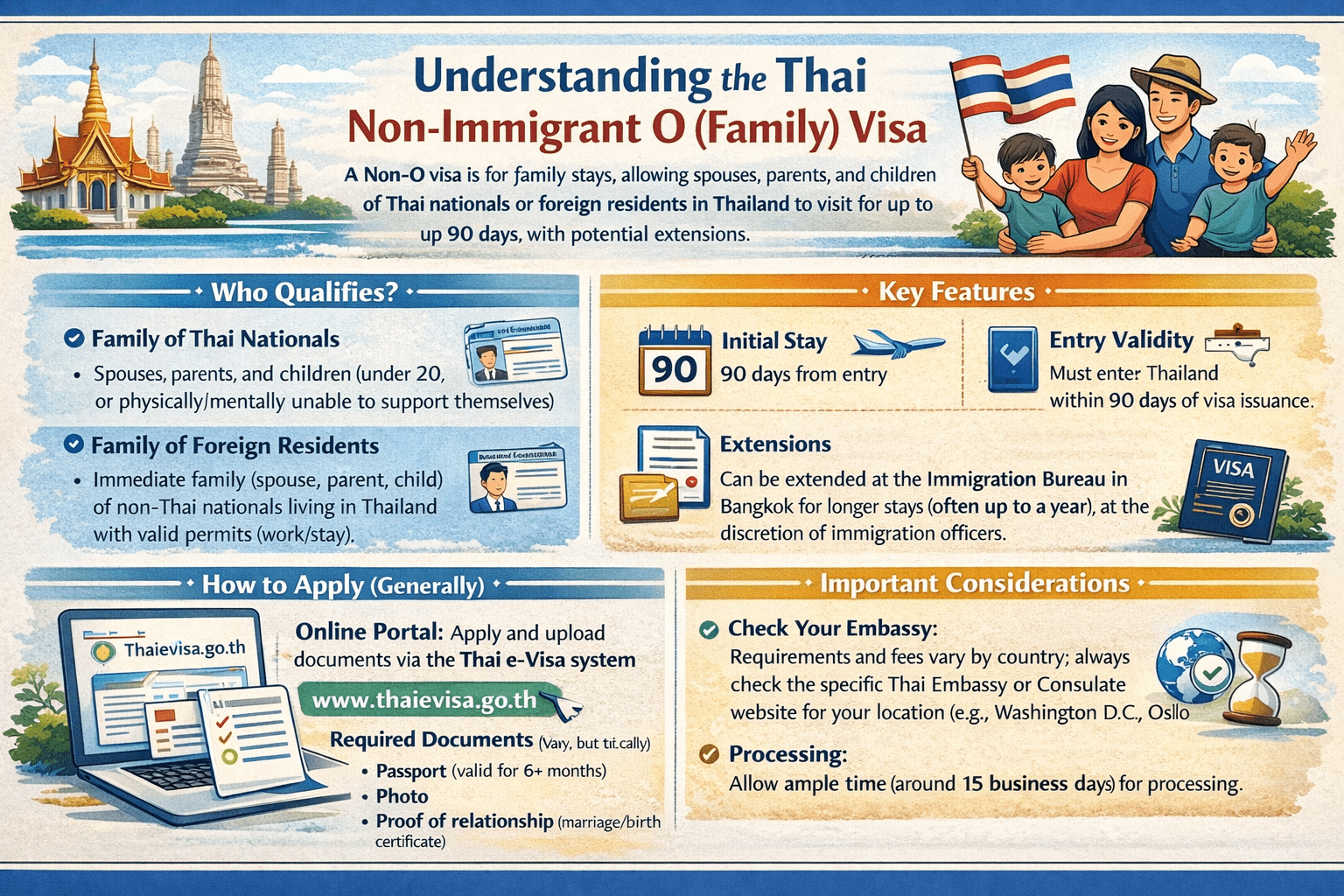
Are you eligible for a Thai O visa? This visa is primarily for foreign nationals who have direct family ties in Thailand. If you are the spouse, child (under 20), or parent of a Thai citizen, you likely qualify. You can also apply if you are a dependent of a foreign national who holds a valid work permit or long-term visa in Thailand.
The key to a successful application is providing clear proof of your connection to your Thai family members. This involves submitting official documents that validate your relationship. For example, if you are married to a Thai citizen, you must present your official marriage certificate as part of your application.
To apply, you will need to gather your personal details and those of your family member in Thailand. The application process begins with demonstrating this family connection through documents like a marriage certificate or birth certificate. This proof of relationship is the foundation of your eligibility and the first step in your visa journey.
Purpose and Main Uses of the Thai O Visa
The main purpose of this type of visa is to facilitate family unity. It allows you to legally reside in Thailand for an initial period of 90 days, with the primary goal of being with your family. Unlike a tourist visa, the Thai O visa is specifically intended for longer stays and recognizes your official family status within the country.
While there are different categories under the “O” visa umbrella, including one for retirement, the family-based O visa is distinct. Its primary uses are centered on family life. Some of these include:
- Living with your Thai spouse.
- Caring for your Thai parents or being cared for by them.
- Raising your children who are Thai citizens.
- Accompanying a spouse who has a work permit in Thailand.
One of the significant advantages of this Thai visa is the option for an extension of stay. After your initial 90-day entry, you can apply for a one-year extension at a local immigration office in Thailand, provided you continue to meet the requirements. This makes it a practical choice for long-term residency.
Different Types of Thai O Visas Explained
The “O” in Thai visa stands for “Other,” and this category covers several purposes. While this guide focuses on family stays, it’s helpful to know that visa type O also includes categories for retirement, volunteering, and other specific situations. The Thai immigration bureau oversees the rules for each of these sub-categories.
Each type of O visa has its own set of specific requirements and is designed for a different kind of long-term visitor. Understanding these differences will help you confirm you’re applying for the correct Thai visa. Now, let’s explore the family and retirement categories in more detail.
O Visa for Visiting Family Members
Yes, you can absolutely apply for an O visa to bring your family to Thailand, or to join them if they are already there. This visa is specifically for foreign nationals who are immediate relatives of a Thai citizen or a foreigner legally working or residing in Thailand. This includes being a Thai spouse or the legal guardian of a Thai child.
To prove your familial relationship, you must provide official documentation. For a spouse, a marriage certificate is essential. For a child, a birth certificate showing the parents’ names is required. These documents are the cornerstone of your application and must be legally recognized.
Once approved, the visa grants you an initial stay permit of 90 days. This allows you to enter Thailand and settle in with your family. If you plan to stay longer, you can apply for an extension from within the country before your initial 90-day permit expires, transitioning you to a more stable long-term stay.
Retirement and Other Special Categories under the O Visa
The Non-Immigrant O visa is indeed a popular pathway for retirement in Thailand, often referred to as a retirement visa. To qualify for this category, you must be 50 years of age or older and meet specific financial requirements. This visa allows for a long stay in the kingdom, making it an attractive option for those wishing to spend their golden years in Thailand.
However, it’s crucial to understand that this visa does not grant a valid work permit. Like the family-based O visa, the retirement visa is strictly for residing in Thailand, and any form of employment is prohibited. The purpose is to allow you to enjoy the country without engaging in the local job market.
While the family-based O visa and the retirement O visa fall under the same “O” category, their eligibility criteria and required documents differ. The retirement option focuses on age and financial self-sufficiency, whereas the family option is based on proven relationships with Thai citizens or legal residents.
Key Eligibility Criteria and Financial Requirements
Meeting the eligibility criteria is a critical part of your Thai O visa application, especially the financial requirements. The Thai government needs assurance that you can support yourself and your family without becoming a financial burden. This is often demonstrated through a family bank statement or proof of monthly income.
For many applicants, this involves showing a certain amount of funds in a Thai bank account. The specific amount can vary depending on your situation, such as whether you are applying as a spouse or a retiree. Let’s break down what you’ll need to show.
Financial Proof for Spouses and Dependents
If you are married to a Thai citizen, the financial requirements are designed to be straightforward. You must demonstrate that you and your spouse have a combined income or savings to support your household. This is a key part of the application, alongside your proof of relationship.
The Thai immigration authorities provide clear options for meeting these financial requirements. You typically need to show one of the following:
- A combined monthly income of at least 40,000 THB.
- A deposit of at least 400,000 THB in a Thai bank account, held for at least two months prior to the application.
- A combination of income and savings that meets the required threshold.
This proof is usually submitted in the form of a family bank statement or official income letters. Ensuring these documents are up-to-date and clearly show the required funds is essential for a smooth approval process. The goal is to verify your financial stability as a couple.
Other Important Eligibility Conditions
Beyond finances, there are other important conditions to meet. While health insurance is mandatory for certain long-stay visas like the O-A retirement visa, it is not always a strict requirement for the standard family-based O visa. However, having it is highly recommended and may be requested by some consulates.
The most critical factor for a successful application is having all your required documents in perfect order. Any missing or incorrect paperwork can lead to significant delays in the processing time or even an outright rejection of your application. This includes having proper translations and notarizations where necessary.
To ensure a smooth process, create a checklist of all the papers you need. This will include your passport, photos, application form, proof of relationship, and financial evidence. Being meticulously prepared is the best way to navigate the application process efficiently and avoid unnecessary stress.
Essential Documents for the Thai O Visa Application
Gathering the correct documents is arguably the most important step in your Thai O visa application. The required documents serve as evidence that you meet all the eligibility criteria. For family-based applications, this always includes proof of your relationship, such as a marriage certificate or a child’s birth certificate.
You will also need to provide a copy of passports for both yourself and your Thai family member, along with other supporting paperwork. Having a complete and organized set of documents will make the submission process much smoother. Below is a checklist to help you prepare.
Checklist of Required Papers and Supporting Documentation
Preparing your paperwork thoroughly is key to a successful visa application. You will need to submit your completed application form along with various supporting materials. Since the process is now online, you’ll need to scan and upload these documents, usually in PDF format.
Here is a general checklist of what you’ll need. Always confirm the specific requirements with the Royal Thai Embassy or consulate where you are applying, as they can vary slightly.
- A completed visa application form.
- Your current passport with at least six months of validity.
- A recent, passport-sized photograph of the applicant.
- Proof of relationship (e.g., marriage or birth certificate).
- Copy of your Thai family member’s ID card and passport.
- Financial evidence as required for your category.
Remember that any documents not in English or Thai must be accompanied by certified translations. Submitting a complete file with all the necessary information from the start is the best way to ensure your application is processed without any issues.
Step-by-Step Guide to the Application Process
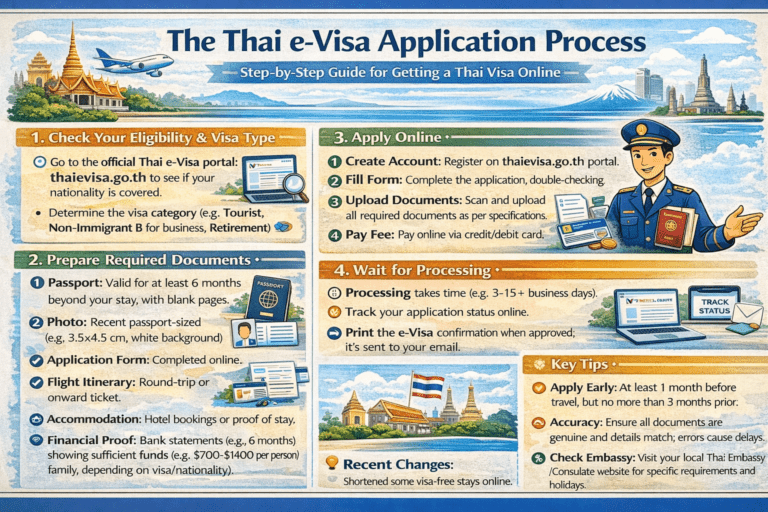
The process for getting a Thailand visa has been modernized and is now more streamlined than ever before. The visa application for the O visa is done entirely online through the official Thai e-Visa website, which means you can complete it from the comfort of your home. You no longer need to visit a Thai embassy in person to submit your paperwork.
This digital process makes things more convenient, but it also means you need to be careful with your online submission. Understanding where to apply and what to expect in terms of timing will help you plan your move effectively.
Where and How to Submit Your Application
You can submit your Thai O visa application online through the official Thai e-Visa portal managed by the Ministry of Foreign Affairs. You no longer need to go to a physical immigration office or embassy for the initial submission. You will need to create an account on the website to begin your application.
The process is generally as follows:
- Visit the official Thai e-Visa website (thaievisa.go.th).
- Create a personal account.
- Select the Royal Thai Embassy or consulate that serves your country of residence.
- Fill out the application form and upload all your required documents in the specified format.
Once you have filled in all the information and uploaded your documents, you will pay the visa fee online and submit the application. The embassy you selected will then review your file. It’s a convenient, centralized system that eliminates the need for in-person appointments for your initial application.
Expected Processing Time and Fees
Once you submit your application, the processing time can vary. Generally, you can expect a decision within 3 to 10 business days, provided all your documents are correct and complete. However, applications from certain nationalities or those with missing information can take longer, sometimes up to a few months. It’s wise to apply at least a month before your planned travel date.
The visa application fee also varies depending on the type of entry you are applying for. The fee is non-refundable, even if your application is rejected, so be sure your paperwork is in order.
Here are the typical fees, though they may change, so always check the embassy website.
| Visa Type | Entry Type | Approximate Fee (EUR) |
|---|---|---|
| O Visa | Single | €70 |
| O Visa | Multiple | €175 |
You will pay this fee online as part of the e-Visa submission process. After approval, the e-Visa will be sent to your email, and you can download it from your account on the portal.
Duration of Stay and Extension Options
Understanding the duration of your visa is crucial for planning your life in Thailand. The Thai O visa has an initial validity period that allows you to enter the country. Once you arrive, you are granted a specific period of stay. The visa is typically valid for 90 days from the date of issuance.
This initial stay is just the beginning for many. One of the main benefits of the O visa is the ability to apply for an extension of stay without leaving Thailand. This allows for a more stable and long-term living arrangement. Let’s look at the specifics of the validity and extension process.
Validity Period of the Thai O Visa
It’s important to distinguish between the visa’s validity period and your permitted length of stay. The visa type O is generally issued with a validity period of 90 days. This means you have 90 days from the date it’s issued to enter Thailand. If you don’t enter within this window, the visa expires and becomes void.
Upon entering Thailand, the immigration officer will stamp your passport, granting you a permit to stay for up to 90 days. This 90-day countdown starts from your date of entry, not the date the visa was issued. This is the initial period you are allowed to stay in the country on this visa.
So, to answer the question directly: you can initially stay in Thailand for up to 90 days with an O visa. If your goal is to stay longer than 90 days, you will need to apply for an extension before your initial stay permit expires.
How to Extend Your O Visa While Staying in Thailand
Yes, you can and should extend your O visa if you plan to stay longer than 90 days. The process for an extension of stay is done within Thailand at a local immigration bureau office. This is a huge convenience as it means you don’t have to leave the country.
To apply for an extension, you will need to provide updated documents that prove you still meet the visa requirements. This typically includes:
- Proof that your family relationship is still valid (e.g., updated family registration).
- Evidence that you still meet the financial criteria.
It is crucial to apply for your new stay permit before your current one expires. The decision to grant an extension is at the discretion of the immigration officer. If approved, you can receive an extension for up to one year, which you can then renew annually as long as you continue to meet the conditions.
Comparing the Thai O Visa with the O-A Visa
When exploring long-stay options in Thailand, you will likely come across both the Thai O visa and the O-A visa. While both are types of non-immigrant visas and can be used for retirement, they are not the same. The visa type O is a broader category, while the O-A is specifically a long-stay retirement visa.
Understanding the differences between these two is key to choosing the right path for your situation. The eligibility, requirements, and benefits of each Thai visa are tailored to different needs. Let’s compare them side-by-side.
Key Differences in Eligibility and Purpose
The main difference between the Non-Immigrant O and O-A visas lies in their purpose and initial duration. The O visa is a multi-purpose visa for family, short-term retirement, or volunteering, typically granting a 90-day stay initially. The O-A visa, on the other hand, is exclusively for long-term retirees and grants a one-year stay from the outset.
The eligibility and required documents also differ. For instance, mandatory health insurance is a strict requirement for the O-A visa, while it is not always required for the family-based O visa. The O-A visa also has more stringent financial proof requirements that must be maintained.
Here’s a simple comparison:
| Feature | Non-Immigrant O Visa | Non-Immigrant O-A Visa |
|---|---|---|
| Primary Purpose | Family reunion, short-term retirement, volunteering | Long-term retirement only (age 50+) |
| Initial Stay | 90 days | 1 year |
| Health Insurance | Not always mandatory (but recommended) | Mandatory, with specific coverage amounts |
| Financial Proof | Varies by sub-category (e.g., 400,000 THB for spouse) | 800,000 THB in a bank or 65,000 THB monthly income |
Choosing the Right Visa for Your Situation
Choosing the right visa depends entirely on your personal circumstances. If your primary reason for coming to Thailand is to live with your Thai spouse or dependent children, the Non-Immigrant O visa based on family ties is the correct choice. It requires clear proof of relationship and is designed specifically for this purpose.
If you are over 50 and planning to retire in Thailand for a year or more, the O-A visa is likely the more appropriate option, provided you can meet its higher financial and health insurance requirements. It offers the convenience of a one-year stay from the beginning. Don’t make the mistake of using a tourist visa for long-term family stays, as this can lead to immigration issues.
Ultimately, review your situation carefully. Do you have a Thai family connection? If yes, the O visa is for you. Are you retiring and meet the age and financial criteria for a long-stay retirement visa? Then the O-A might be a better fit. Always check the official Thai visa page for the most current details before you apply.
Conclusion
In summary, the Thai O Visa serves as an excellent option for families wishing to stay in Thailand together. Understanding its various types, eligibility criteria, and application process can make a significant difference in your experience. Whether you are visiting family members or looking into retirement options, being well-informed helps you navigate the complexities of visa applications with ease. Don’t forget to keep all necessary documents in check to ensure a smooth application process. If you’re ready to take the next step in planning your family stay in Thailand, consider reaching out for expert assistance. Your adventure awaits!
Frequently Asked Questions
Is the Thai O Visa suitable for retirees?
Yes, the Thai O visa can be used as a retirement visa for those aged 50 and over. It starts with a 90-day validity period and can be extended for a year inside Thailand. You must meet financial criteria, such as showing a specific monthly income, as determined by the Thai immigration bureau.
Can I apply for an O visa to bring my family to Thailand?
Absolutely. The O visa is designed for joining Thai family members. Your visa application will require required documents that serve as proof of relationship, such as a marriage or birth certificate. The processing time is usually quick if your paperwork is in order.
What is the processing time for a Thai O Visa from the United States?
The processing time for a Thai O visa applied for from the United States is typically between 3 to 10 business days after you submit your application and visa application fee through the Thai embassy’s online portal. However, it can take longer, so it is best to apply well in advance.