
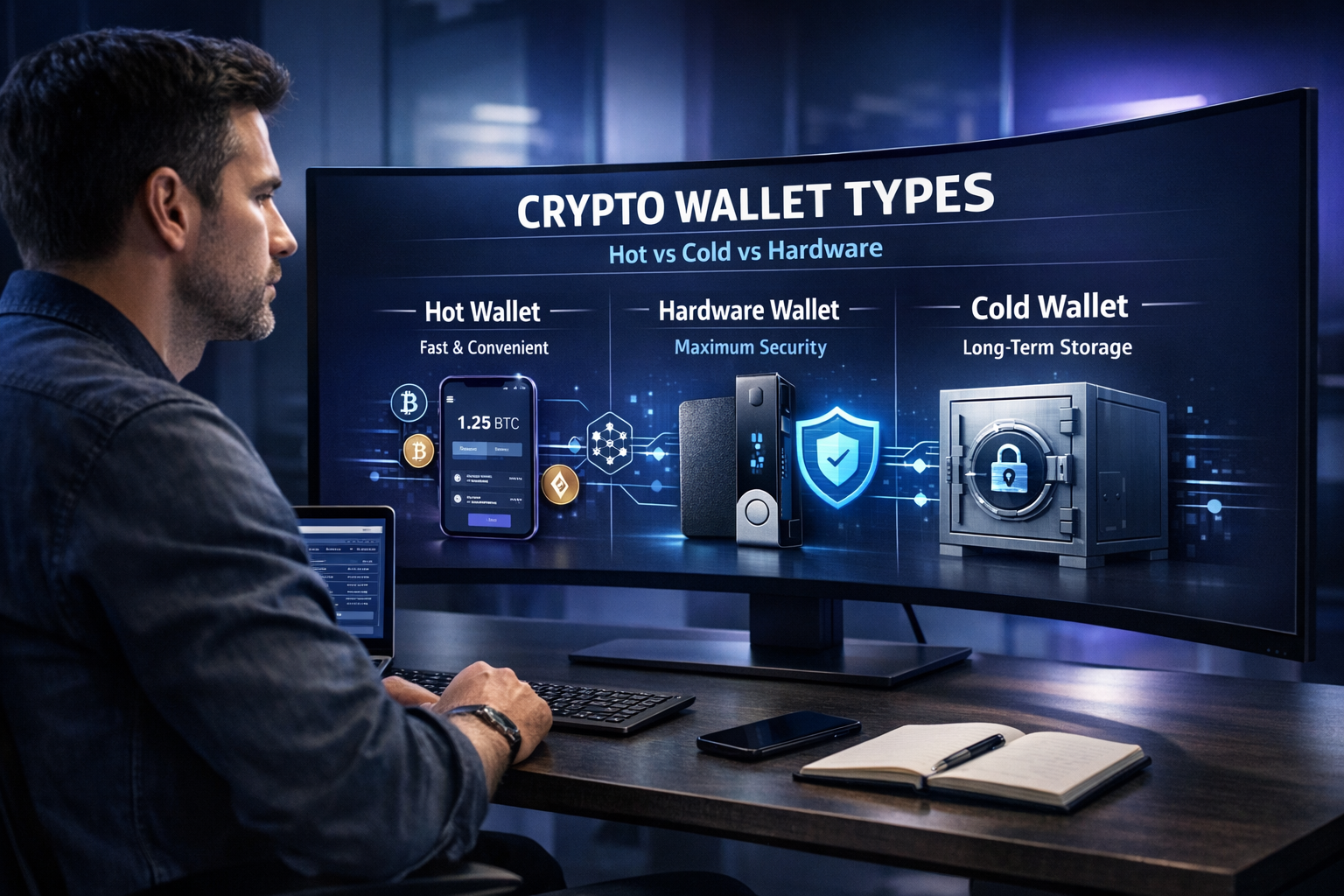
A crypto wallet is the tool that lets a person hold, send, and receive cryptocurrencies by managing the cryptographic keys that control coins on a blockchain. Unlike a physical wallet, a crypto wallet does not actually store coins but manages private keys and public addresses that reference balances recorded on distributed ledgers. Because whoever controls the private key controls the funds, understanding wallet types, architectures, and security practices is central to safe participation in the crypto ecosystem.
This guide provides an end‑to‑end view of crypto wallets explained for both beginners and advanced users, covering wallet concepts, hot versus cold storage, custodial and non‑custodial models, modern wallet technologies, selection frameworks, practical setups, and security checklists. It is designed as a pillar resource that can serve as a reference when choosing, using, and securing any type of crypto wallet.
Key takeaways
- A crypto wallet controls private keys and public addresses, enabling interaction with blockchains without actually holding coins itself.
- Hot wallets are connected to the internet and optimized for convenience, while cold wallets are offline and optimized for security and long‑term cold storage.
- Custodial wallets delegate key management to a third party such as an exchange, whereas non‑custodial wallets give the user full control—and full responsibility—for private keys.
- Modern wallet architectures include HD wallets (BIP32/39/44), multisignature schemes, MPC wallets, smart contract wallets, and account abstraction wallets that can add recovery, automation, and policy controls.
- The “best” crypto wallet depends on use case: small daily balances favor hot wallets, while large long‑term holdings belong on hardware wallets or similarly hardened cold wallets.
- Most real‑world losses result from phishing, malware, fake wallet apps, poor backups, and unsafe approvals—not from broken cryptography—so disciplined wallet security practices are critical.
What is a crypto wallet?
A crypto wallet is software or hardware that stores and uses the cryptographic keys needed to interact with a blockchain network. Each wallet manages at least one private key—a secret number that proves ownership—and derives one or more public keys and public addresses where others can send funds.
The public address is analogous to an account number that can safely be shared to receive payments, while the private key is similar to a master password that must never be exposed. When funds are “in” a wallet, what actually exists is a set of unspent outputs or account balances recorded on the blockchain that are spendable by whoever can produce valid signatures with the corresponding private keys.
Most modern non‑custodial wallets implement hierarchical deterministic (HD) standards such as BIP39, BIP32, and BIP44, allowing many keys and addresses to be derived from a single seed phrase backup. This means that writing down a 12‑ or 24‑word seed phrase can be enough to restore the entire wallet on compatible software or hardware devices.
Private keys and seed phrases
A private key is a large random number used to sign transactions and prove control over associated funds. Because private keys are difficult for humans to handle directly, BIP39 defines human‑readable seed phrases (mnemonics) that encode the entropy needed to deterministically derive the wallet’s master key.
From this seed, BIP32 and BIP44 define how wallets derive a tree of child keys and addresses for multiple accounts and multiple blockchains, all from the same backup. As a result, the seed phrase effectively becomes the master secret for the entire crypto wallet, making its protection the single most important aspect of wallet security.
Public addresses and blockchain interaction
Public keys derived from private keys can be transformed into addresses according to each blockchain’s rules, for example Bitcoin’s base58 addresses or Ethereum’s hex addresses. When someone sends crypto to an address, the network records that transfer on‑chain, and any wallet that tracks the relevant keys can detect the updated balance by scanning blockchain data.
To spend funds, the wallet creates a transaction referencing previous outputs or account balances and signs it with the private key, producing a digital signature that nodes can verify without ever seeing the key itself. This cryptographic model enables non‑repudiation and permissionless transfers, but also means that losing access to private keys typically results in permanent loss of access to the associated assets.
How crypto wallets work
1. Key and seed generation
When a new non‑custodial wallet is created, the software or hardware generates sufficient random entropy and runs it through BIP39 to produce a seed phrase and a binary seed value. The seed is then used by BIP32 to derive a master extended private key and chain code, from which a tree of child keys can be deterministically generated.
BIP44 standardizes derivation paths such as m / purpose' / coin_type' / account' / change / address_index, allowing different wallets to reconstruct the same accounts and addresses from the same seed phrase across multiple coins. This standardized derivation is what makes it practical for a user to back up one seed and restore a crypto wallet across many devices and applications.
2. Building and signing transactions
To send funds, the wallet constructs a transaction that specifies inputs (the coins or balances being spent), outputs (destination addresses and amounts), and metadata such as fees. In UTXO systems like Bitcoin, this involves selecting unspent transaction outputs, while in account‑based systems like Ethereum it updates balances and may include calls to smart contracts.
The wallet then uses the relevant private key to create a digital signature over the transaction data, proving that the transaction was authorized by the key holder. In hardware wallets, keys remain on the secure device: the host computer sends an unsigned transaction to the device, the hardware signs internally, and returns only the signature, keeping the private key isolated.
3. Broadcasting and blockchain verification
Once signed, the transaction is broadcast to the peer‑to‑peer network, where nodes validate its syntax, signatures, and compliance with consensus rules. Miners or validators then include the transaction in a block; once confirmed, the blockchain’s global state reflects the new balances, and any wallet watching the relevant addresses will update its displayed holdings accordingly.
From the user’s perspective, this process can be compared to online banking: a wallet is like a secure banking app that can generate account numbers, authorize transfers, and check balances, while the blockchain is the shared ledger that all participants trust. The crucial difference is that there is no central bank or support line—control of keys equals control of funds.
Main types of crypto wallets
Crypto wallets are commonly categorized along three axes: hot versus cold, custodial versus non‑custodial, and software versus hardware form factors. These dimensions interact, but the hot wallet and cold wallet distinction is particularly important for risk management.
Hot wallets are software wallets connected to the internet, such as browser extensions or mobile apps, which prioritize ease of use and are ideal for frequent transactions. Cold wallets operate offline—often using hardware wallets or paper wallets—and are optimized for security and long‑term storage.
Hot vs cold wallets at a glance
| Aspect | Hot wallet | Cold wallet |
|---|---|---|
| Connection | Always or mostly online (phone, browser, desktop) | Offline by default; only connected briefly or via air‑gapped flows |
| Typical forms | Mobile wallets, web wallets, desktop wallets, exchange apps | Hardware wallets, paper wallets, air‑gapped devices |
| Security profile | Higher exposure to malware, phishing, and compromised devices | Much lower online attack surface; risk shifts to physical loss and backup failures |
| Convenience | Instant access for spending, trading, DeFi | Less convenient; extra steps to move funds |
| Best for | Daily spending, active trading, DeFi interactions | Long‑term holdings, savings, treasury funds |
Hot wallets are not inherently unsafe, but keeping large balances in them increases the consequences of a device compromise or signed malicious transaction. Cold wallets reduce online risks dramatically but require disciplined backup and recovery practices to avoid losing access.
Hot wallets
Hot wallets are crypto wallets that run on internet‑connected devices, offering fast access to funds and integration with exchanges and decentralized applications. They include mobile wallets, web wallets, and desktop wallets, all of which are considered software wallets.
Mobile wallets
Mobile wallets are smartphone apps that store keys on the device and let users send, receive, and swap crypto directly from iOS or Android. Popular examples include Trust Wallet, Coinbase Wallet, Phantom, and various exchange apps that combine wallet and trading functionality.
Because phones are always online and commonly used for browsing and messaging, mobile wallets face significant phishing and malware exposure, but modern operating systems and secure enclaves can mitigate some risks when combined with good practices. Mobile wallets are ideal for small to moderate balances used in everyday payments or DeFi, particularly when paired with a hardware wallet for larger holdings.
Web wallets
Web wallets are accessed via a browser, either as hosted interfaces on an exchange or as browser extension wallets such as MetaMask. Exchange web wallets are typically custodial wallets where the service controls the keys, while non‑custodial web wallets store encrypted keys locally in the browser and sign transactions client‑side.
Browser extension wallets are the primary gateway for interacting with Ethereum and EVM‑compatible DeFi protocols, NFTs, and dApps, but they inherit all the security weaknesses of the underlying browser and operating system. Using hardware wallet integrations and carefully verifying URLs, permissions, and transaction data significantly reduces risk when relying on web wallets.
Desktop wallets
Desktop wallets are applications installed on a computer, such as Electrum for Bitcoin or multi‑asset wallets like Exodus and Atomic Wallet. They may offer advanced features like coin control, multisignature support, and integration with hardware wallets, making them appealing to power users.
Because desktops are often used for general web browsing and software installation, they can be exposed to keyloggers or malware that targets wallet data. Segregating a dedicated machine or user profile for crypto, regularly updating software, and pairing desktop wallets with hardware wallets are standard recommendations to improve wallet security.
Advantages, risks, and use cases
Hot wallets excel at usability: they are free or low‑cost, easy to set up, and provide immediate access to funds with intuitive interfaces. They are well suited for:
- Everyday spending and small purchases
- Active trading and arbitrage
- DeFi interactions (lending, staking, liquidity provision)
- NFT minting and marketplace activity
The main risks are device compromise, phishing attacks that trick users into revealing seed phrases or signing malicious transactions, and over‑exposure of funds in online environments. As a rule of thumb, only funds a person is comfortable treating like cash in a physical wallet should stay in hot wallets, with larger amounts moved to cold wallets.
Cold wallets
Cold wallets are crypto wallets that keep private keys offline, drastically reducing the attack surface for remote hackers. Hardware wallets and, to a lesser extent, paper wallets are the most common forms of cold storage.
Hardware wallets
A hardware wallet is a dedicated physical device that stores private keys in secure hardware and signs transactions without exposing the keys to internet‑connected computers or phones. Devices like Ledger and Trezor support thousands of assets and are widely regarded as the gold standard for self‑custody of significant holdings.
When used correctly, hardware wallets ensure that even if the connected computer has malware, the attacker cannot read the private keys and must still trick the user into confirming a malicious transaction on the device screen. This isolation makes hardware wallets ideal for long‑term storage and for securing the signing keys behind large DeFi or institutional positions.
Paper wallets and other cold storage
Paper wallets are generated by creating keys offline and printing or writing the private key and address on paper, sometimes encoded as QR codes. While they offer strong protection against online hacks if generated securely on an air‑gapped system, they are fragile: paper can be lost, stolen, water‑damaged, or destroyed in a fire.
In practice, most experts now recommend hardware wallets or other specialized cold storage solutions (such as steel backups for seed phrases or institutional‑grade custody) over pure paper wallets, especially for non‑technical users. All of these approaches fall under cold storage because keys remain offline except when used for carefully controlled signing operations.
Advantages and security benefits
Cold wallets minimize the risk of remote compromise by keeping private keys off internet‑connected devices, rendering common malware and browser‑based attacks ineffective. They are especially valuable against large‑scale exchange hacks or supply‑chain attacks on software wallets.
The trade‑off is convenience: using cold wallets often requires additional steps, such as connecting a hardware wallet and confirming details on‑device, but this friction is a feature for high‑value transactions. For large balances or long‑term holdings, the reduction in attack surface often outweighs the operational overhead, making hardware wallets and other cold wallets the default recommendation for serious investors.
Custodial vs non‑custodial wallets
Beyond hot versus cold, a critical distinction is whether a wallet is custodial or non‑custodial, which determines who controls the private keys.
Custodial wallets are managed by a third party—typically exchanges or specialized custodians—that hold keys on behalf of users and provide account‑style access via passwords and two‑factor authentication. Non‑custodial wallets, in contrast, give users direct control of private keys or seed phrases; the provider cannot access or freeze the funds.
Custodial vs non‑custodial at a glance
| Criterion | Custodial wallets | Non‑custodial wallets |
|---|---|---|
| Key control | Third party holds private keys | User holds private keys or seed phrase |
| Recovery options | Provider can often reset access via KYC, email, or support | Recovery depends on user’s seed phrase and backups |
| Regulatory status | Often subject to KYC/AML and licensing | Generally software tools; user bears compliance duties |
| Risk profile | Exposure to exchange hacks, insolvency, and withdrawal freezes | Exposure to self‑custody errors (lost keys, phishing, poor backups) |
| Convenience | Simple onboarding, familiar login model | More steps to secure and back up, but greater sovereignty |
Custodial wallets are attractive for beginners because they resemble online banking and remove the burden of managing keys, but history shows that exchange failures and hacks can result in users losing access or facing long recovery processes. Non‑custodial wallets eliminate counterparty risk at the cost of requiring users to implement robust wallet security practices and accept that there is no support line if a seed phrase is lost.
In practice, many users adopt a hybrid model: custodial wallets for trading and on‑ramp/off‑ramp functions, and non‑custodial wallets—often combined with hardware wallets—for savings and DeFi activity.
Advanced wallet technologies
As the ecosystem has matured, new wallet architectures have emerged to address usability, security, and governance requirements that go beyond basic single‑key wallets.
HD wallets (hierarchical deterministic)
Hierarchical deterministic (HD) wallets use a single master seed phrase to deterministically derive a tree of keys and addresses according to BIP32, BIP39, and BIP44. This approach allows users to manage many accounts and coins with one backup, while enabling privacy‑preserving practices such as using a new address for each payment without tracking multiple keys manually.
HD wallets are now the default design in hardware wallets and many software wallets, providing interoperability across vendors and simplifying recovery from device loss or migration. The main risk is that if the seed phrase is compromised, all derived addresses are exposed, reinforcing the need for secure, offline seed storage.
Multisignature wallets
Multisignature (multisig) wallets require multiple independent signatures to authorize a transaction, for example 2‑of‑3 or 3‑of‑5 keys. On Bitcoin, this is implemented at the script level, while on Ethereum and other smart‑contract platforms, multisig is usually implemented as a smart contract wallet such as Safe (formerly Gnosis Safe).
Multisig wallets are popular with businesses, DAOs, and treasuries because they eliminate single points of failure: no single compromised key or rogue operator can unilaterally move funds if the policy requires multiple approvals. Trade‑offs include more complex setup, potential coordination delays, and the need for clear operational procedures to avoid deadlock if signers lose keys.
MPC wallets
Multi‑party computation (MPC) wallets replace a single private key with multiple cryptographic shares held by different devices or entities that collaboratively produce a signature without ever reconstructing the full key. Threshold signature schemes allow a subset of shares (for example t‑of‑n) to sign, providing resilience if some devices are offline or lost.
MPC wallets offer strong security guarantees by removing obvious single points of failure and can enable flexible recovery and policy enforcement, which is why they are increasingly used by institutions and high‑net‑worth individuals. However, MPC solutions introduce reliance on specialized cryptographic infrastructure and, in some cases, service providers whose downtime or compromise can affect availability, so vetting implementations and vendors is important.
Smart contract wallets
Smart contract wallets are deployed as smart contracts on programmable blockchains like Ethereum rather than being tied to a single externally owned account (EOA) private key. They can encode spending limits, multi‑factor authentication, time locks, and recovery mechanisms directly in code, offering richer security features than basic EOAs.
Frameworks such as Safe and other contract wallet systems use on‑chain logic to manage owners, modules, and policies, often pairing with hardware wallets or MPC for key management. While smart contract wallets can mitigate some human errors and support organization‑level governance, they rely on correct contract implementation and incur additional gas costs.
Account abstraction wallets
Account abstraction, standardized on Ethereum via ERC‑4337 and related proposals, allows smart contract wallets to function as first‑class accounts that can initiate transactions and pay gas, effectively merging EOAs and contract accounts. Account abstraction wallets can support features such as social recovery, Web2‑style authentication, batched transactions, and gas sponsorship through paymasters.
By moving signature verification and policy logic into programmable accounts, account abstraction wallets aim to make blockchain usage safer and more user‑friendly, especially for mainstream users who expect email‑like recovery flows instead of irreversible key loss. The trade‑offs involve higher complexity, potentially higher gas costs, and reliance on new infrastructure components such as bundlers and paymasters, which must themselves be secured.
How to choose the right crypto wallet
Selecting the best crypto wallet depends on a user’s objectives, risk tolerance, transaction frequency, and technical comfort. A structured approach segments users by profile and maps them to appropriate combinations of hot wallets, hardware wallets, and custodial services.
Beginners
Beginners benefit from simple onboarding, clear recovery options, and interfaces that resemble traditional finance. A pragmatic path is to start with a reputable custodial wallet or exchange account for small amounts, then progress to a user‑friendly non‑custodial hot wallet once basic concepts like seed phrases and transaction fees are understood.
Good starting points include custodial exchange apps combined with educational resources, followed by mobile non‑custodial wallets such as Coinbase Wallet or Trust Wallet for users ready to manage their own keys. The key is to keep balances small until processes for backing up and restoring wallets are practiced.
Active traders
Active traders prioritize speed, liquidity, and integration with centralized and decentralized venues. For spot and derivatives trading on centralized exchanges, custodial wallets on reputable exchanges are often necessary, but traders should minimize idle balances and move profits to self‑custody regularly.
For on‑chain trading, browser‑based hot wallets like MetaMask or multi‑chain wallets paired with a hardware wallet provide a good balance between usability and security. Traders typically maintain several hot wallets for different strategies and use cold wallets or multisig setups as treasuries that rarely connect to dApps.
DeFi and NFT users
DeFi and NFT users need hot wallets that integrate seamlessly with dApps, support multiple networks, and offer robust permission controls. Browser extension wallets such as MetaMask or mobile wallets with built‑in dApp browsers are the primary tools in this segment.
Best practice is to treat DeFi‑connected wallets as hot wallets with limited balances, using hardware wallets or separate cold wallets for long‑term holdings and periodically sweeping profits out of high‑risk environments. Power users may adopt smart contract wallets or account abstraction wallets for added safeguards like daily spending limits and social recovery.
Long‑term holders
Long‑term holders (HODLers) focus on capital preservation over convenience. For this group, hardware wallets or other cold storage solutions are the primary recommendation, with redundant offline backups of seed phrases stored in separate secure locations.
Some long‑term holders complement hardware wallets with multisig or MPC solutions to protect against single‑device failure or coercion, especially when holdings are large. Interaction with hot wallets is minimized: funds are moved infrequently, and cold wallets rarely connect directly to dApps.
High‑net‑worth individuals and institutions
High‑net‑worth individuals, funds, and corporate treasuries require governance, auditability, and resilience beyond typical retail setups. Multisig wallets, MPC solutions, or institutional custodians with strong controls are common, often combined with hardware security modules (HSMs) and policy‑driven workflows.
For these users, the optimal design is often a layered architecture: MPC or multisig at the treasury level, hardware wallets for signers, monitored hot wallets for operational needs, and segregation of duties across teams or service providers.
Best crypto wallets by category
The market offers many reputable wallets; the best choices by category typically include Ledger and Trezor for hardware wallets, MetaMask, Trust Wallet, and Coinbase Wallet for non‑custodial hot wallets, and major exchanges’ custodial wallets for on‑ramp and trading.
Representative wallets and characteristics
This table is illustrative rather than exhaustive; features and supported assets evolve rapidly, so users should always consult official documentation before making decisions.
Crypto wallet security best practices
Robust wallet security depends more on user behavior and threat modeling than on any specific app choice. The following checklist consolidates widely recommended practices from security‑focused guides and institutional custody research.
Seed phrase and key management
- Generate seed phrases only within trusted wallet software or hardware devices, never on random websites.
- Store the seed phrase offline in at least two secure, geographically separated locations (paper or metal backups), avoiding cloud storage, screenshots, or email.
- Consider adding a BIP39 passphrase (often called a “25th word”) for advanced users who can reliably remember or store it separately, as it creates an additional secret needed to derive the wallet.
- Periodically test recovery using a spare device or test wallet to ensure backups work before relying on them for large sums.
Device and account hygiene
- Keep operating systems, browsers, and wallet software up to date to benefit from security patches.
- Use a password manager and unique, strong passwords for email, exchanges, and any services connected to crypto activities.
- Enable app‑based two‑factor authentication (2FA) rather than SMS for exchange and account logins, and protect 2FA backup codes offline.
- Use dedicated browser profiles or even separate devices for crypto activity to limit cross‑contamination from everyday browsing and random extensions.
Phishing and social engineering defenses
- Bookmark official wallet and exchange URLs; access them only via bookmarks or trusted apps, not search ads or random links.
- Never enter a seed phrase or private key into any website or share it with anyone claiming to be support; legitimate services will never ask for it.
- Treat unsolicited messages on email, social media, or messaging apps that discuss urgent security issues, giveaways, or support interventions as suspicious by default.
- Verify transaction details, recipient addresses, and token approvals inside the wallet or hardware device screen before confirming.
Hardware wallet usage
- Purchase hardware wallets only from official vendors or authorized resellers to avoid tampered devices.
- Initialize the device from scratch and ensure it generates the seed phrase on‑device; never accept pre‑printed seed phrases.
- Set a strong PIN and, where supported, use an additional passphrase for sensitive holdings.
- Treat the device as replaceable but the seed as irreplaceable: focus on safeguarding backups rather than hiding the device itself.
Multi‑wallet architecture
- Segment funds across multiple wallets: for example, a hot wallet for daily use, a mid‑term wallet for medium balances, and a deep cold wallet for long‑term savings.
- Avoid connecting high‑value cold wallets directly to arbitrary dApps; instead, move funds through intermediate wallets to limit exposure.
- For large or shared treasuries, use multisig or MPC to require multiple approvals or devices for outgoing transfers.
How users lose access—and how to prevent it
Common ways users lose access to wallets include losing or destroying the only copy of a seed phrase, forgetting a passphrase, falling for phishing attacks that steal seeds, and signing malicious approvals that let attackers drain tokens. To mitigate these risks, users should maintain redundant, well‑documented backups, practice restoring wallets before holding major funds, and adopt conservative signing practices where any unfamiliar prompt is treated as unsafe until proven otherwise.
Common crypto wallet risks
Crypto wallets face both technical and human‑factor risks that can lead to partial or total loss of funds. Understanding these threats helps users design appropriate defenses.
Phishing
Phishing campaigns impersonate wallets, exchanges, or support staff to trick users into entering seed phrases, private keys, or signing malicious transactions. Typical vectors include fake websites with look‑alike domains, search engine ads that lead to cloned interfaces, social media scams, and direct messages with urgent warnings.
Because blockchain transactions are irreversible, once an attacker obtains a seed phrase or a powerful approval, they can rapidly drain funds, often across multiple chains. Anti‑phishing practices—bookmarks, hardware wallet verification, and never typing a seed phrase into a website—are therefore foundational.
Malware and keyloggers
Malware on a computer or phone can read keystrokes, clipboard contents, or wallet files, capturing private keys, seeds, or transaction data. Specialized clipboard‑hijacking malware replaces copied addresses with attacker‑controlled ones, causing funds to be sent to the wrong destination unless the user carefully checks addresses before confirmation.
Using hardware wallets, maintaining updated antivirus and operating systems, and limiting software installation on crypto devices significantly reduces these risks.
Fake wallet apps and extensions
Attackers publish fake wallet apps or browser extensions that mimic popular brands but steal keys or route transactions through malicious infrastructure. These may appear in app stores or as side‑loaded APKs on Android.
Users should install wallet software only from official websites or verified app store links and double‑check publisher information and download counts before trusting any wallet.
Exchange hacks and custodial failures
History shows that centralized exchanges and custodial services can suffer hacks, insider theft, mismanagement, or regulatory interventions that freeze or seize assets. When using custodial wallets, users are exposed to the provider’s operational security and legal environment.
Keeping only necessary trading capital on exchanges and promptly withdrawing long‑term holdings to non‑custodial wallets is a widely endorsed approach to mitigating custodial risk.
Setting up your first crypto wallet
For a beginner setting up a first crypto wallet, a structured process helps avoid early mistakes while building good habits.
Step‑by‑step guide
- Define the primary purpose. Decide whether the wallet will be used mainly for holding, trading, or DeFi/NFT activity; this informs the choice between a hot wallet, hardware wallet, or a mix.
- Choose a wallet type and brand. For small experimentation, a reputable non‑custodial mobile wallet or browser wallet such as Coinbase Wallet, Trust Wallet, or MetaMask is often suitable, while larger planned investments justify starting with a hardware wallet such as Ledger or Trezor.
- Download or buy from official sources. Use official websites or app stores linked from the provider’s domain, and purchase hardware only from authorized sellers.
- Create the wallet and record the seed phrase. Follow the app or device instructions, write down the seed phrase clearly on paper or metal, and verify it in a quiet, private environment with no cameras or screens capturing it.
- Enable available security features. Set strong PINs, passwords, biometric locks, and optional passphrases; on exchanges, enable app‑based 2FA and withdrawal protections.
- Test with a small transaction. Receive a small amount of crypto, then send part of it to another address or back to the exchange to confirm that sending, receiving, and fee handling work as expected.
- Practice recovery. On a spare device or using a test wallet, simulate loss by restoring from the seed phrase to ensure backups are correct before entrusting significant funds.
Following these steps builds muscle memory and reduces the likelihood of critical mistakes when larger amounts are involved.
Advanced security strategy: multi‑wallet architecture
More advanced users and anyone holding non‑trivial sums can benefit from a layered wallet architecture that separates daily activity from long‑term storage.
Example architecture
- Spending hot wallet. A mobile or browser hot wallet with small balances for everyday payments, gas fees, and experimental DeFi or NFT activity.
- Trading wallet. Custodial exchange accounts or on‑chain hot wallets dedicated to active trading, with strict risk limits and frequent profit extraction to safer wallets.
- Cold wallet for savings. A hardware wallet or similar cold storage solution holding long‑term investments, with seed phrase backups stored securely offline and minimal interaction with dApps.
- Treasury / vault. For very large holdings or shared treasuries, a multisig or MPC wallet that enforces multiple approvals and policy checks before large transfers, often operated across multiple devices or organizations.
This segmentation limits the blast radius of any single compromise: a phishing attack against a hot wallet cannot directly drain deep cold holdings, and an exchange failure impacts only the capital intentionally left on the platform.
Frequently asked questions
What is the safest crypto wallet?
For most individuals, the safest crypto wallet is typically a reputable hardware wallet used with strong offline seed backups and cautious signing practices. For very large or institutional holdings, multisig or MPC‑based custody combined with hardware security and clear operational procedures often offers the strongest protection against both external attacks and insider threats.
What is the best wallet for beginners?
The best wallet for beginners is usually a simple, well‑documented non‑custodial mobile wallet or browser wallet from a major provider, ideally paired with small starting amounts. Some users may start with custodial wallets on leading exchanges for ease of use, then transition to self‑custody wallets like Coinbase Wallet, Trust Wallet, or MetaMask once they are comfortable handling seed phrases.
Can I use multiple wallets?
Yes, using multiple wallets is not only possible but recommended as part of a sound security architecture. Maintaining separate hot wallets for spending and DeFi, plus cold wallets or vaults for savings, reduces risk by ensuring that no single compromise exposes all funds.
What happens if I lose access to my wallet?
If a user loses access to a non‑custodial wallet but still has the correct seed phrase and any required passphrase, funds can be restored on compatible software or hardware using that backup. If both the seed phrase and any passphrase are lost or destroyed and there is no other backup, the loss is typically irreversible because no central authority can reset keys on a public blockchain.
Are exchange wallets safe?
Exchange wallets are convenient and often employ strong internal security with a mix of hot and cold storage, but they are custodial wallets that expose users to counterparty, regulatory, and systemic risks. Best practice is to treat exchanges primarily as trading venues and on‑ramps/off‑ramps, keeping only necessary working capital on them and withdrawing long‑term holdings to non‑custodial wallets under the user’s control.
Conclusion
Crypto wallets sit at the heart of the digital asset ecosystem, serving as the interface between users and blockchains by managing the keys that control funds. Understanding the differences between hot and cold wallets, custodial and non‑custodial models, and emerging architectures like HD wallets, multisig, MPC, and account abstraction is essential for making informed security and usability trade‑offs.
By combining appropriate wallet types—hot wallets for convenience, hardware wallets and other cold wallets for long‑term security, and advanced technologies where warranted—with disciplined operational practices, users can dramatically reduce their risk of loss while benefiting from the flexibility of digital assets. The most effective strategy is not a single perfect crypto wallet, but an architecture and set of habits that align wallet choices with real‑world needs, threat models, and the irreplaceable nature of private keys.