
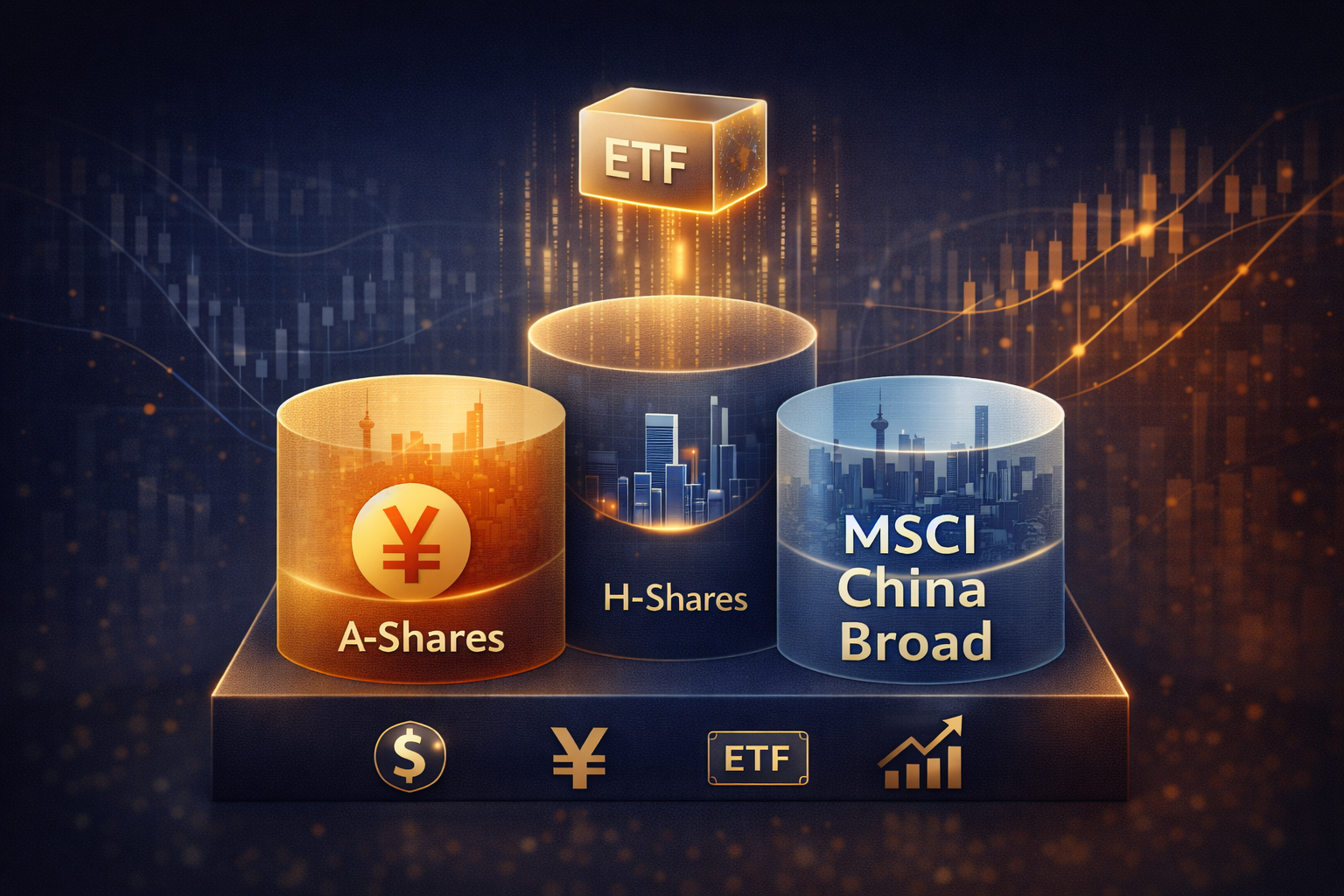
MSCI China ETFs track baskets of Chinese companies selected according to MSCI’s index methodology, which determines whether investors get mainland onshore stocks (A-shares), Hong Kong-listed shares (H-shares), or a mix of both. The choice of index dramatically affects returns and volatility: A-share indices expose you to mainland China’s economy with lower correlation to global markets, while broader MSCI China indices include offshore listings with higher liquidity but different company overlap. Beyond the expense ratio you see advertised, real costs include trading spreads, dividend withholding taxes, and tracking difference-the actual performance gap between your ETF and its benchmark-which often matters more than the headline fee.
Before choosing an MSCI China ETF, check:
- Which index it tracks (A-shares only, H-shares, or blended?)
- Total Expense Ratio (TER) vs. actual tracking difference
- Bid-ask spread and trading volume (tighter spreads = lower entry/exit costs)
- Whether Stock Connect quota limitations affect A-share access
- Your home country’s tax treaties with China for dividend withholding
What Is the MSCI China Index Family?
MSCI maintains over 240 indices covering China’s equity market across different share classes, regions, and strategies. Understanding the architecture is critical because “MSCI China” is not one index-it’s a family, and variants can move differently.
The Core Indices
MSCI China A Index: Tracks only A-shares-RMB-denominated stocks listed on Shanghai and Shenzhen Stock Exchanges. Accessible to foreign investors via the Stock Connect program (Northbound trading), which allows daily quotas. This index targets 65% representation across industry groups and automatically includes the largest 25 securities. As of 2024 data, it holds approximately 440 constituents and requires free float above 15% for general inclusion. It’s designed primarily for domestic investors but increasingly used globally.
MSCI China Index: The broadest “catch-all” index. Combines A-shares (included at 5% of free-float-adjusted market cap to maintain a balanced approach), H-shares (Chinese companies traded in Hong Kong), B-shares, Red Chips, P Chips, and US-listed ADRs. Covers roughly 85% of the China equity universe. This is the flagship index for investors seeking comprehensive China exposure across all accessible share classes.
MSCI China H Index: Captures Chinese companies incorporated on the mainland but listed on Hong Kong’s Stock Exchange. These are typically large, established, foreign-facing businesses (Alibaba, Tencent, major banks). H-shares have higher liquidity than A-shares and no daily quota restrictions, but exclude smaller, domestically-focused mainland companies.
MSCI China All Shares Stock Connect Select Index: A mid-point index that includes A-shares (only if Stock Connect-eligible), H-shares, B-shares, Red Chips, P Chips, and foreign listings. Designed for investors wanting broad access while respecting onshore market-access rules.
Why the Differences Matter
Two “MSCI China” indices can have completely different sector weightings and concentration. The MSCI China A Index, for example, has historically lower weight in finance and higher weight in technology and consumer sectors compared to the broader MSCI China Index (which includes H-shares, where major banks dominate). This means sector bets, volatility profiles, and correlation to global markets can diverge significantly. An investor in MSCI China A gets more growth-company exposure; an investor in MSCI China gets more value and finance exposure.
Historical data (through September 2024) shows MSCI China A shares declined 7.9% annually over three years, while broader MSCI China indices performed differently due to H-share composition. But over 20 years, MSCI China A achieved 7.5% annualized returns, competitive with global markets-and with low correlation to them, providing genuine diversification.
What Investors Actually Buy When They Buy an MSCI China ETF
When you purchase a China ETF, you’re not just buying “Chinese stocks.” You’re gaining exposure to specific share classes with different characteristics, tax treatments, and access rules.
Share Class Breakdown
A-Shares (Onshore): RMB-denominated, listed Shanghai/Shenzhen. Reserved historically for domestic investors; now open to foreigners via Stock Connect (daily quota limit, currently suspended for new onshore individual investors from January 2024 onwards for new accounts in some jurisdictions). Key traits: lower valuations, high retail ownership, less liquid, higher volatility, no dividends on some state-owned enterprises. Foreign investors cannot trade them directly; must use ETFs or approved funds.
H-Shares: Chinese companies incorporated on mainland, listed Hong Kong Stock Exchange. Examples: China Construction Bank, Industrial and Commercial Bank of China (ICBC), Alibaba, Tencent (via pre-arranged structure). No quota limits. Highly liquid, foreign-owned, international governance, major index component for MSCI China.
Red Chips: Hong Kong-incorporated companies with mainland-focused business. Listed in Hong Kong. Bridge between onshore and offshore markets.
P-Chips: Offshore-incorporated companies (founders/executives are mainland Chinese). Listed Hong Kong. Examples: Alibaba, Baidu (ADR-converted). Pure offshore play.
B-Shares / ADRs: Largely obsolete. B-shares were Shanghai/Shenzhen-listed but foreign-currency denominated; few remain. ADRs (American Depositary Receipts) were US-listed but largely withdrawn post-delisting risk (2021–2023). Some Chinese companies still have US listings but in smaller numbers.
What MSCI China All Shares Looks Like (by weight, as of MSCI data)
- China A: 59.8%
- China H: 17.6%
- P Chips: 8.4%
- Red Chips: 9.3%
- B-shares: 0.9%
- US-listed: 3.9%
- Singapore-listed: 0.1%
Sector and Concentration
A-share indices tilt consumer, healthcare, technology (especially small-cap growth). H-share indices tilt financial services, energy, property. This shapes volatility: A-shares are more cyclical, H-shares more defensive. A single holding (Alibaba, Tencent) can represent 3–10% of broad indices, creating concentration risk. The MSCI A Index, being more granular, has lower single-stock risk.
Common Misconceptions
“China GDP growth = index returns.” GDP tracks economic size; equity returns track corporate profit growth and valuation re-rating. A growing economy with declining profit margins = poor stock returns. A-shares have underperformed global averages in recent years despite China’s large GDP.
“All China indices are the same.” No. MSCI China and MSCI China A have very different constituent overlap (~50%), sector weights, and volatility.
“The index automatically rebalances my portfolio.” Indices are held static (for MSCI: annual May review, quarterly reviews Feb/Aug/Nov). Your ETF rebalances mechanically on those dates. Lag is built in.
“Dividend yield shown is what you’ll receive.” Dividends to foreign investors are subject to withholding tax (typically 10% on China dividends). The index may show a gross dividend; you receive net of withholding. This is a major source of tracking difference.
MSCI China ETFs and Funds Universe
Below is a reference table of major ETFs tracking MSCI China and related indices. Note: This is not exhaustive; check your brokerage platform for the full list. Verify all details on the fund issuer’s official factsheet, as details change.
| Fund / ETF Name | Ticker | Listing Region | Index Tracked | Expense Ratio | Best For | AUM (approx.) |
|---|---|---|---|---|---|---|
| iShares MSCI China ETF | MCHI | US (NASDAQ) | MSCI China Index | 0.59% | Broad China exposure, liquid, large fund | ~$8B |
| iShares MSCI China A UCITS ETF | CNYA | Europe (LSE, Xetra, Euronext) | MSCI China A Index | ~0.60%–0.70% | A-share exposure, UCITS-regulated, multi-currency | ~€150M+ |
| Invesco MSCI China All Shares Stock Connect UCITS ETF | MCHN | Europe (Xetra, LSE, SIX) | MSCI China All Shares Stock Connect Select | 0.35% | Broad + A-share access, low fee, UCITS | ~€91M |
| Invesco MSCI China Technology All Shares Stock Connect UCITS ETF | ICNT | Europe (Xetra, etc.) | MSCI China Technology (All Shares) | 0.45%–0.50% | Tech tilt, A-share + H-share, sector play | ~€129M |
| KraneShares MSCI China A 50 Connect UCITS ETF | KBA | Europe (various) | MSCI China A 50 Connect (largest A-shares) | 0.40% | Large-cap A-share focus, liquid | ~€2M |
| Global X MSCI China ETF | – | Hong Kong | MSCI China Index | Not specified | Hong Kong-listed, broad China | – |
| Satrix MSCI China ETF | – | South Africa | MSCI China Index | 0.63% | South African investor focus | – |
| iShares China Large-Cap ETF | FXI | US (NYSE) | FTSE China 50 (not MSCI) | 0.73–0.74% | H-shares only, does not track MSCI | ~$6.8B |
How to use this table: The “Index Tracked” column is critical. MCHI and CNYA track very different indices; MCHI includes all share classes, CNYA is A-only. Fee differences (0.35% vs. 0.70%) compound significantly over time. AUM reflects liquidity-larger funds typically have tighter bid-ask spreads.
To verify and compare:
- Visit the fund issuer’s website (BlackRock iShares, Invesco, KraneShares, etc.).
- Download the current factsheet (updated quarterly).
- Check the fund’s “Tracking Difference” line for the last 1, 3, and 5 years-this beats the expense ratio for understanding real costs.
- Check the “Bid-Ask Spread” on your brokerage platform on the day you plan to buy.
Fees That Matter More Than the Headline Expense Ratio
Investors often focus on the expense ratio (ER)-the annual management fee-but ER is only one piece of the real cost. A fund advertised as “0.59% ER” might cost you 1.0%+ per year in real economic drag.
The True Cost Stack
1. Expense Ratio (0.35%–0.78% for China ETFs)
This is explicit and disclosed. But it’s not the full cost.
2. Tracking Difference (typically –0.05% to –0.30% per year)
This is the actual performance gap between the ETF and its index. It includes:
- Dividend withholding tax leakage: China levies 10% withholding tax on dividends to foreign investors. The MSCI index methodology typically assumes gross returns; your ETF receives net. This gap compounds. A 2% gross dividend yield becomes 1.8% net-a 0.2% annual drag.
- Cash drag: ETFs hold small cash balances (0–5%) for daily flows. Indices assume 100% invested. In low-interest-rate years, this cost is small; in high-rate years (like 2023–2024), it can reduce returns by 0.1–0.2%.
- Rebalancing friction: Index rebalancing (quarterly for MSCI) requires selling winners and buying losers. Transaction costs and market timing slippage erode 0.05–0.10% per rebalancing cycle.
- FX conversion: For unhedged ETFs in CNH (offshore RMB), there’s a small conversion spread when the fund converts RMB dividends back to USD/EUR.
Example: An ETF with a 0.59% ER might show a –0.15% tracking difference over three years, meaning real annual drag of 0.74%, not 0.59%.
3. Bid-Ask Spread (one-time cost per trade)
The difference between the price you pay (ask) and the price you’d receive if selling immediately (bid). Liquid ETFs (MCHI, large UCITS) have spreads of 0.01–0.03%. Smaller ETFs can have 0.05–0.20% spreads. On a $10,000 order, a 0.05% spread costs you $5; a 0.20% spread costs $20. This cost disappears if you hold for years, but it’s a real hit on entry.
4. Withholding Taxes (embedded in tracking difference, but worth calling out)
You don’t see this as a line item, but foreign investors on China dividends pay 10% withholding tax. If the fund receives a 2.5% dividend yield, you effectively get 2.25% (after withholding). Domestic investors in mainland China pay 0% or lower rates, creating a persistent tax drag for offshore ETF holders.
How to Find and Use Tracking Difference
Most fund factsheets now include a “Tracking Difference” table showing 1-year, 3-year, and 5-year performance gaps.
- A negative number means the fund underperformed (expected due to fees/taxes).
- A slightly positive number (rare but possible) suggests the fund is using securities lending or tax optimization to offset costs.
- Look for consistency: a fund with –0.10% every year is more predictable than one with –0.05% one year and –0.25% the next.
Pro tip: Compare tracking difference, not just ER, when choosing between two similar funds. A 0.35% ER fund with a –0.50% tracking difference is worse than a 0.70% ER fund with a –0.10% tracking difference.
MSCI China vs MSCI China A – The Single Most Important Choice
This decision shapes your entire China exposure. It is not a fine-tuning choice; it’s foundational.
Plain English: What You’re Choosing
MSCI China (Broad Index):
- Includes A-shares (at 5% of free-float market cap), H-shares, B-shares, Red Chips, P Chips, US/Singapore listings.
- Dominated by Hong Kong-listed companies and offshore holdings.
- Top holdings: Alibaba, Tencent, major state-owned banks (ICBC, CCB, ABC).
- Sectors: Financial services, energy, property, consumer.
- Liquidity: Very high (Hong Kong exchange, ADRs).
- Accessibility: Foreign investors can buy anytime, no quota.
- Valuation: Historically trades at lower P/E and P/B than A-shares (H-share discount).
MSCI China A (Onshore-Only):
- Only RMB-denominated shares on Shanghai/Shenzhen Stock Exchanges.
- Accessed via Stock Connect (Northbound) with daily quota.
- Smaller companies, growth-tilted, less international exposure.
- Top holdings: Industrial banks, telecoms, tech (but smaller-cap tech than H-shares).
- Sectors: Technology, consumer, healthcare, small-cap growth.
- Liquidity: Lower than H-shares, subject to quota suspension.
- Valuation: Historically trades at premium to H-shares (A-H premium).
Volatility and Market-Access Implications
| Dimension | MSCI China | MSCI China A |
|---|---|---|
| 3-year volatility | ~18–22% | ~22–26% |
| Correlation to MSCI ACWI | ~0.60 | ~0.35 |
| Daily quota risk | None | Yes, can suspend |
| Onshore political risk | Lower (offshore holdings) | Higher (100% onshore) |
| Growth tilt | Lower (value-heavy) | Higher (growth-heavy) |
| Dividend yield | 2.5–3.5% | 1.5–2.5% |
When Each Makes Sense
Choose MSCI China if:
- You want a broad, liquid, low-friction China bet.
- You’re seeking diversification within your portfolio (H-shares have lower correlation to US equities).
- You want blue-chip, multinational-exposed Chinese companies.
- You are concerned about Stock Connect quota limitations.
- You want to replicate a common global EM allocation (China is ~3–4% of MSCI EM; MSCI China is the standard).
Choose MSCI China A if:
- You believe in mainland China’s economic recovery and want pure onshore exposure.
- You accept higher volatility for higher growth potential.
- You want to capture small-cap and mid-cap Chinese companies not in H-share indices.
- You believe A-shares are undervalued relative to fundamentals (current 20-year average P/B of 1.6x is historically low).
- You can tolerate quota suspension risk (Stock Connect can be halted for regulatory or market stability reasons).
Historical Behavior
Over the past 20 years (2004–2024), MSCI China A returned ~7.5% annualized versus MSCI ACWI at ~9.1%. But the path differs dramatically: A-shares often move sideways while H-shares rally (2017), or vice versa (2020–2021 tech crackdown in mainland). This divergence is your clue that the two are not interchangeable.
MSCI China ETF Profiles by Investor Type
Broad China Exposure Seeker
Profile: You want exposure to China’s economy, diversified across sectors and company sizes. You’re not making a tactical bet on A-shares vs. H-shares.
Recommended index: MSCI China Index
Best ETFs:
- iShares MSCI China ETF (MCHI) – Largest, most liquid, 0.59% ER. $8B AUM means tight spreads. Tracks the full MSCI China.
- Invesco MSCI China All Shares Stock Connect UCITS (MCHN) – Lower 0.35% ER, includes both A and H, better for European investors. €91M AUM, liquid on European exchanges.
Why: Broad mandate, low ER, high liquidity, lowest trading costs.
Mainland A-Shares Focus
Profile: You want pure onshore exposure, betting on China’s domestic consumption and tech growth.
Recommended index: MSCI China A Index or MSCI China A 50 Connect (if you want just the largest A-shares).
Best ETFs:
- iShares MSCI China A UCITS ETF (CNYA) – Tracks full MSCI China A, multi-currency, UCITS-regulated, available on multiple European exchanges.
- KraneShares MSCI China A 50 Connect UCITS ETF (KBA) – Narrower focus (top 50 A-shares), 0.40% ER, lighter portfolio, lower cost. Good if you want to avoid the long tail of A-shares.
Why: Direct mainland exposure, sector tilt toward growth, lower correlation to global markets.
Caveat: Stock Connect quota risk. On several occasions (2015, 2020), the Northbound quota was suspended for days or weeks during market stress. Your ability to buy/sell is not guaranteed intraday.
Sector-Tilt Investor (Consumer / Tech)
Profile: You want China exposure but specifically tilted to Internet, AI, or domestic consumer brands (which skew A-shares), or semiconductors/tech (which skew H-shares and ADRs).
Recommended index: MSCI China Technology All Shares Stock Connect Select (or custom tech indices)
Best ETFs:
- Invesco MSCI China Technology All Shares Stock Connect UCITS ETF (ICNT) – Explicit tech tilt, ~€129M, 0.45–0.50% ER.
- KraneShares CSI China Internet ETF (KWEB, on US markets) – Not MSCI-based, but concentrated on internet/AI companies. Higher volatility, higher growth.
Why: Sector focus, concentrated exposure, captures growth narratives.
Risk: Sector concentration. Tech can underperform for years; it’s a bet, not broad diversification.
Europe / UCITS-Constrained Investor
Profile: You’re a European investor, pension fund, or institution. UCITS regulations require ETF product structure, and you may need euro-denominated versions.
Recommended indices: MSCI China, MSCI China A, or MSCI China All Shares Stock Connect Select (all have UCITS options)
Best ETFs:
- iShares MSCI China A UCITS ETF (CNYA) – Available on LSE, Xetra, Euronext, Bolsa, etc. in USD, EUR, GBP.
- Invesco MSCI China All Shares Stock Connect UCITS (MCHN) – Lowest ER (0.35%), broad mandate.
- Franklin FTSE China UCITS ETF – 0.19% ER (cheapest option), but FTSE-indexed, not MSCI.
Why: UCITS compliance, multi-currency options, broader distribution.
Risks and Constraints Specific to MSCI China Exposure
Regulatory and Geopolitical Headline Risk
China’s government controls markets through policy, not just competition. Regulatory moves can be sudden:
- Tech crackdowns: 2020–2022 saw billions in market cap erased after antitrust and data-security regulations.
- Property sector restrictions: Limits on developer leverage (2021–present) depressed Evergrande and peers.
- Stimulus/Counter-stimulus: Policy reversals can drive 10–20% swings in months.
These are inherent to the market. An ETF cannot shield you, but diversification (MSCI China’s breadth) reduces single-sector risk more than a concentrated portfolio.
Market Structure: Stock Connect Quota and Suspension Risk
A-share access depends on the Stock Connect program. Key constraints:
- Daily quota: RMB 1 billion per day (Northbound). If the quota fills, no more buys for that day.
- Suspension risk: During market stress (2015 devaluation, 2020 COVID panic), authorities suspend or restrict Stock Connect. Your ETF cannot rebalance or buy dips.
- Recalling stocks: Regulators can remove stocks from Stock Connect eligibility if they breach risk thresholds. Your fund must sell.
Implication for you: MSCI China A indices may face tracking slippage during crises when they can’t buy quota-constrained stocks. MSCI China (H-shares) has no quota, so it’s more liquid in a crisis.
Currency and Liquidity Considerations
- CNH vs. CNY: Offshore RMB (CNH) trades at a small discount to onshore RMB (CNY) during capital-control periods. MSCI China A indices use CNH rates; you may see FX drag during stress.
- Liquidity ladder: H-shares are very liquid (Hong Kong exchange). A-shares are less liquid (especially mid-caps). Smaller ETF (€2M AUM) may have wider spreads and slower fills than large ETFs (€100M+).
- Currency hedging: Most MSCI China ETFs are unhedged (direct RMB/USD or RMB/EUR exposure). If you want USD hedging, check the factsheet for currency-hedged share classes (less common).
Mitigation: Use large, established ETFs (MCHI, CNYA, MCHN). Check bid-ask spreads before trading. Avoid ETFs with <€10M AUM.
FAQs
What is an MSCI China ETF?
An MSCI China ETF is an exchange-traded fund that tracks one of MSCI’s indices of Chinese companies. It holds a basket of stocks (A-shares, H-shares, or both, depending on the index) and aims to replicate the index’s returns. You buy and sell the ETF on a stock exchange like a regular stock, but your money buys proportional exposure to all index constituents. Costs include the annual expense ratio, trading spreads, and tracking difference.
What is the expense ratio of an ETF in China?
Expense ratios for MSCI China ETFs range from 0.19% (Franklin FTSE China UCITS, a low-cost outlier) to 0.78% (some small or specialized funds). Most major ETFs fall in the 0.35%–0.70% range. The ER is the only transparent cost; tracking difference (the real performance gap) is what matters over time and often exceeds the ER due to taxes, dividends, and rebalancing friction.
What is the difference between MSCI China and MSCI China A?
MSCI China is a broad index covering A-shares (5% of float), H-shares, B-shares, Red Chips, P Chips, and offshore listings. It reflects the full China investment universe but is dominated by Hong Kong-listed companies and offshore-accessible stocks.
MSCI China A includes only onshore RMB shares listed on Shanghai and Shenzhen. It is more growth-tilted, more volatile, and subject to Stock Connect quota limits, but offers pure mainland exposure and lower correlation to global markets.
The two indices have ~50% constituent overlap and diverge significantly in sector weights and performance over time. They are not interchangeable.
What is the best China ETF to buy?
There is no single “best”-it depends on your goals. Use this framework:
- Choose your index first: MSCI China (broad, liquid, H-heavy) or MSCI China A (onshore, growth, quota risk)?
- Within that index, choose the lowest-cost, most-liquid ETF:
- Broad MSCI China: MCHI (US) or MCHN (Europe)
- MSCI China A: CNYA (Europe, UCITS) or KBA (smaller, lower fee)
- Check tracking difference (not just ER) over 3 years on the factsheet.
- Check bid-ask spread on your brokerage the day you plan to buy.
- Avoid: Small funds (<€10M AUM), unproven providers, or specialized thematic indices unless you’re making a deliberate sector bet.
Do not buy based on past 1-year performance or marketing. Index choice matters far more than fund selection within an index.
Final Takeaway
10 Investor Rules of Thumb
- Index first, ETF second. Your choice of MSCI China (broad) vs. MSCI China A (onshore) is 10x more important than your choice of fund provider. Get the index right; fund selection is fine-tuning.
- Track the tracking difference, not the ER. A 0.35% ER fund with –0.10% average tracking difference (real cost: 0.45%) is cheaper than a 0.70% ER fund with a 0% tracking difference (real cost: 0.70%).
- A-shares and H-shares are not the same. They have different constituents, sectors, valuations, and volatility. Diversifying across both (via MSCI China All Shares) is reasonable; picking one because it’s cheaper is naive.
- Liquidity matters for your wallet. A €2M fund may have a 0.15% wider bid-ask spread than a €100M fund. On $10,000, that’s a $15 difference right now, but it compounds over a 20-year hold. Favor funds with >€50M AUM (Europe) or >$1B AUM (US).
- Stock Connect quota is real. A-share access can be suspended for hours or days during market stress. If you cannot tolerate being locked out for a week, choose MSCI China (H-shares) instead of MSCI China A.
- Withholding taxes are baked in. You won’t see a line item, but expect 0.10–0.20% per year of dividend leakage due to 10% foreign withholding tax on China dividends. Domestic investors don’t pay this; you do.
- Currency hedging is optional and often not worth it. Most MSCI China ETFs are unhedged (you get RMB/CNH exposure). Hedging to USD or EUR adds 0.05–0.15% per year and removes currency upside if the RMB appreciates. For long-term US/EUR investors, unhedged is standard.
- Rebalancing frictions are small but consistent. Quarterly index rebalancing (MSCI standard) costs 0.05–0.10% per cycle. Over 10 years, this is ~0.50–1.0%. Not huge, but real. You cannot eliminate it, but larger funds execute cheaper rebalances.
- Valuation matters, but don’t catch a falling knife. A-shares are historically cheap (P/B of 1.6x, below 10-year average). But “cheap” can get cheaper. Do not buy just because valuations look low. A long-term view (5+ years) helps.
- Diversify across China and the rest of the world; don’t go all-in. MSCI China (all variants) should be 1–5% of a global portfolio, not 20%+. China’s correlation to global markets is low (good for diversification), but country-specific risk is real. Own MSCI China as a satellite, not as a core bet.
Neutral Disclaimer
This guide is educational and does not constitute investment advice. MSCI China ETFs involve emerging market risk, regulatory risk, liquidity risk, and currency risk. Past performance does not guarantee future results. The information here reflects methodology and historical data as of February 2026; consult current fund factsheets, prospectuses, and a financial advisor before investing. Index methodologies and fund offerings change; verify all details before placing trades.