
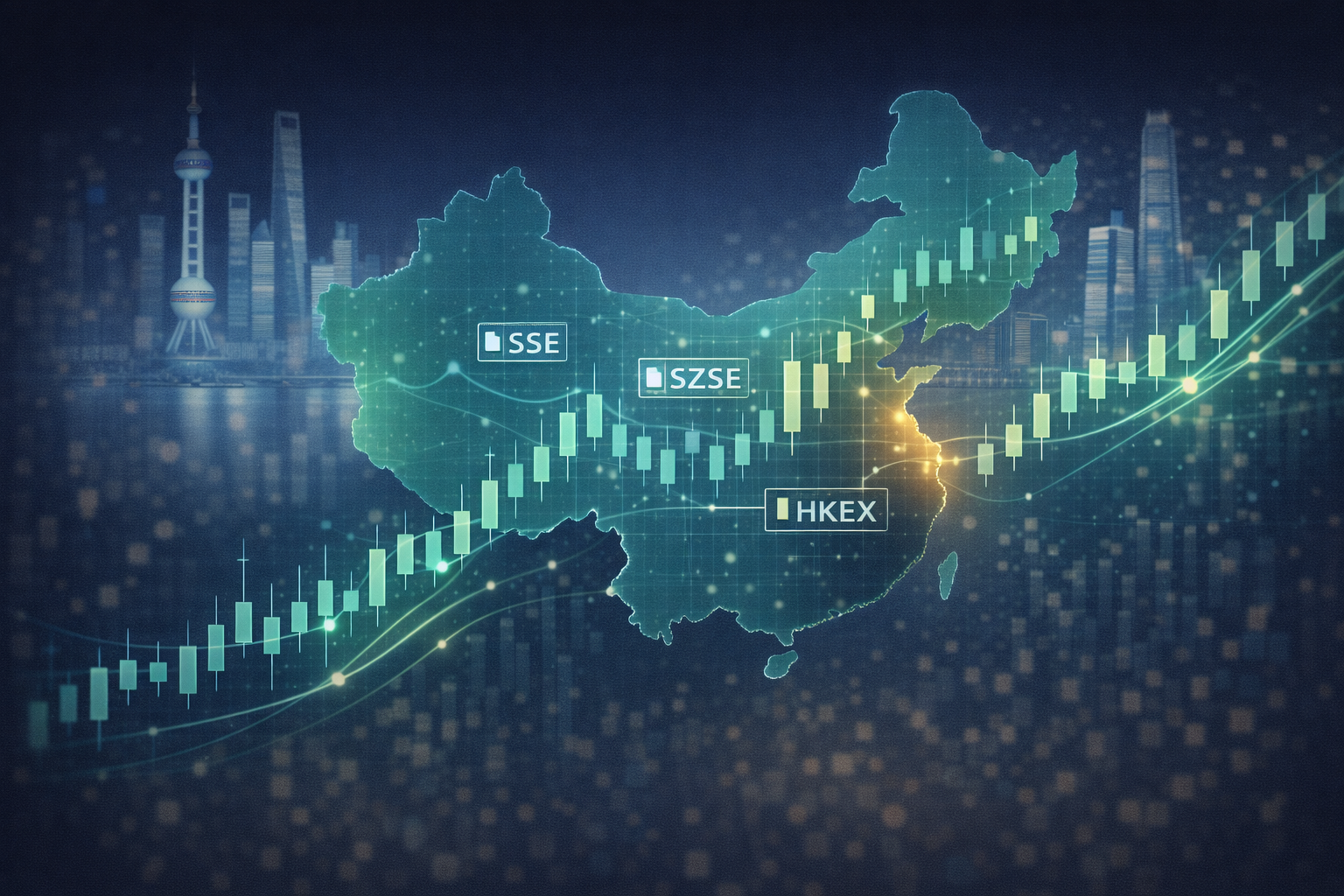
China’s equity market is one of the world’s largest capital markets by market capitalization, yet it remains structurally segmented and often misunderstood by international investors. This guide provides a comprehensive overview of how China’s equity market works, the key indices that track its performance, and the frameworks needed to interpret returns meaningfully. You’ll learn how China’s market divides into distinct segments (Mainland A-shares, Hong Kong H-shares, and overseas listings), why the same company can trade at different prices in different venues, and what economic and policy factors typically drive equity performance in 2026. Rather than predicting future returns, this guide equips you with the tools to conduct your own analysis and understand the major scenario frameworks that market participants use when assessing China equities.
Quick Answer
China’s equity market is a major but segmented capital market where the same company may trade on three different exchanges-mainland China’s Shanghai and Shenzhen exchanges (A-shares, trading in CNY), Hong Kong (H-shares, trading in HKD), and overseas (ADRs, trading in USD/EUR). The three largest benchmarks are the CSI 300 Index (300 largest mainland-listed stocks; comparable to S&P 500), the Shanghai Composite Index (all Shanghai exchange-listed stocks), and the Hang Seng Index (Hong Kong blue-chips, majority of which are Chinese). To interpret performance correctly, investors must distinguish between price returns (stock gains only) and total returns (including dividends), account for currency effects (especially RMB strength/weakness), and recognize that strong GDP growth does not automatically translate to stock outperformance-valuations, earnings cycles, and policy shifts often matter more. In 2026, key outlook drivers include China’s shift toward innovation-led growth, property-sector health, US-China trade dynamics, and whether consumption can offset slowing investment.
How China’s Equity Market Is Structured
The Main Venues: Mainland vs Hong Kong vs Overseas
China’s equity market is not a single market; it is a collection of interconnected but distinct venues with different regulation, access routes, and investor bases. Understanding which venue a company trades on is essential, because the same company often trades at different prices depending on where it is listed.
Mainland China (Shanghai and Shenzhen Stock Exchanges). The Shanghai Stock Exchange (SSE) and Shenzhen Stock Exchange (SZSE) are the primary domestic equity markets. Together, they host over 5,000 listed companies and approximately $12 trillion in market capitalization. Trading is conducted in Chinese Yuan (RMB) and regulated by the China Securities Regulatory Commission (CSRC). Historically, mainland exchanges were closed to foreign investors, but since 2014, international investors have gained limited access through the Stock Connect program, which allows cross-border trading through Hong Kong brokers within specific daily quota limits.
Hong Kong (Hong Kong Stock Exchange – HKEX). The Hong Kong Stock Exchange lists approximately 2,500 companies, including many Chinese mainland firms. Stocks are traded in Hong Kong Dollars (HKD) and are freely accessible to international investors. The Hong Kong market is regulated by the Hong Kong Securities and Futures Commission (SFC) but follows international listing standards closer to those of developed markets. About 134 Chinese mainland companies are listed only in Hong Kong (or additionally in Hong Kong). The Hang Seng Index, which tracks 80 blue-chip firms (most of Chinese origin), is the primary Hong Kong benchmark.
Overseas (US, Singapore, Europe). Some Chinese companies list directly on overseas exchanges via American Depositary Receipts (ADRs), Global Depositary Receipts (GDRs), or direct listings on US, Singapore, or European exchanges. These listings are denominated in USD or EUR and are subject to the regulatory oversight of the destination country (e.g., the SEC for US listings). Overseas listings often have lower trading volumes and different investor bases than Mainland or Hong Kong listings.
Share Classes in Plain English: A-Shares, H-Shares, ADRs, Red Chips, P-Chips
The alphabet soup of Chinese share classifications reflects the historical segmentation of the Chinese market and regulatory restrictions on capital flows.
A-Shares. These are shares of mainland Chinese companies listed on the Shanghai or Shenzhen Stock Exchanges, denominated in CNY. Historically, they were available only to Chinese citizens and a limited number of qualified foreign institutional investors (QFIIs). Since 2014, the Stock Connect program has opened A-share markets to qualified international investors. A-shares typically trade at a premium to the same company’s H-shares, a phenomenon known as the A-H premium; as of mid-2025, this premium averaged around 30%.
H-Shares. These are mainland Chinese companies listed on the Hong Kong Stock Exchange, denominated in HKD. H-shares are freely tradable by all investors (retail and institutional, domestic and international) and are subject to Hong Kong’s disclosure and corporate governance standards. Because they are more accessible and less restricted, H-shares typically trade at a discount to A-shares of the same company.
ADRs (American Depositary Receipts). These are certificates issued by a US bank that represent shares of a foreign company. Chinese companies with US ADRs are listed on US stock exchanges (Nasdaq, NYSE) and denominated in USD. The bank holds the underlying shares and issues ADRs to US investors. ADRs offer convenience and liquidity to US-based investors but carry additional risks, including potential delisting if the company fails to comply with US disclosure and audit rules. As of 2023, there was increased regulatory scrutiny of Chinese ADRs, particularly around audit access and data security concerns.
Red Chips and P-Chips. Red Chips are companies incorporated outside mainland China (often in Hong Kong or the Cayman Islands) but with significant mainland Chinese backing or operations. P-Chips (Peoples’ Chips) are Chinese companies incorporated and listed overseas (not in Hong Kong). Both are typically listed in Hong Kong and traded in HKD. They represent a smaller subset of cross-listed opportunities.
Access Routes for Global Investors: Stock Connect, ETFs, ADRs, Brokers
Global investors have several practical routes to gain China equity exposure, each with different advantages, liquidity, and regulatory considerations.
Stock Connect (Shanghai-Hong Kong and Shenzhen-Hong Kong). Launched in 2014, Stock Connect is a mutual market access program. Northbound Trading allows international investors (via Hong Kong brokers) to buy eligible mainland A-shares; Southbound Trading allows mainland Chinese investors to buy eligible Hong Kong-listed stocks. Daily quota limits apply (as of 2026, RMB 52 billion per side for each of Shanghai and Shenzhen Northbound, RMB 42 billion for Southbound). Stock Connect removes many administrative barriers but still requires a Hong Kong brokerage account and familiarity with Mainland regulatory rules.
ETFs and Mutual Funds. The simplest route for most retail investors is ETFs or mutual funds that track China equity indices. Popular options include iShares MSCI China ETF (MCHI, US-listed, tracking international-accessible Chinese equities) and iShares Core MSCI China ETF (2801, Hong Kong-listed). These funds provide instant diversification, low transaction costs, and no need to navigate cross-border quota systems.
ADRs. Chinese companies listed on US exchanges (Nasdaq, NYSE) via ADRs can be purchased through any US brokerage. Examples include Alibaba (BABA), Tencent (0700), and NetEase (NTES). ADRs are convenient for US investors but face heightened regulatory risk due to ongoing auditing disputes between US and Chinese regulators.
Direct Hong Kong Brokerage Access. Investors in the US, EU, and UK can open accounts with international brokers (e.g., Interactive Brokers, which offer Hong Kong Stock Exchange access) to trade H-shares directly. This route avoids ETF fees but requires managing currency (HKD) and taking on higher trading costs.
Key China Stock Indices: What They Measure
Rather than listing dozens of indices, this section explains the roles different indices play in the market, so you understand when to use which benchmark.
Broad China Benchmarks
MSCI China Index is a free-float, market-cap-weighted index of Chinese equities accessible to international investors. It includes A-shares (via Stock Connect), H-shares, and ADRs, spanning both Mainland and Hong Kong-listed companies. As of year-end 2025, the MSCI China Index had ~31% 1-year total return. This index is widely used by international asset managers and ETF providers as the standard for “China equity exposure.” Its composition evolves as capital flow restrictions change.
FTSE China A50 Index tracks the 50 largest A-shares on mainland exchanges. It is cap-weighted and denominated in CNY. It serves as a proxy for Mainland large-cap performance and is often used in academic and practitioner analysis of “onshore” China performance.
Mainland Large-Cap and Composite Indices
CSI 300 Index (China Securities Index 300) is the primary Mainland benchmark. It comprises the 300 largest and most liquid stocks from both Shanghai and Shenzhen exchanges and is cap-weighted. It is often called the “Chinese S&P 500” because it represents ~60% of total Mainland market capitalization and includes large state-owned enterprises, banks, and manufacturing firms. As of January 2026, the CSI 300 stood at 4,706 points (closing level in Jan 2026), with a P/E ratio around 16.9.
Shanghai Composite Index (SSE Composite) includes all stocks listed on the Shanghai Stock Exchange-over 2,000 stocks. It is market-cap-weighted but includes many illiquid, smaller stocks. It is considered less representative than the CSI 300 because it is heavily influenced by a small number of mega-cap stocks and excludes Shenzhen-listed firms entirely. As of early February 2026, it stood around 4,016 points after a recent sell-off.
Shenzhen Component Index (SZCE) tracks Shenzhen exchange stocks and is the equivalent of the Shanghai Composite for Shenzhen.
Hong Kong and H-Share Indices
Hang Seng Index (HSI) comprises 80 blue-chip stocks listed in Hong Kong, approximately 75% of which are Chinese mainland companies or have significant Mainland operations. It is market-cap-weighted and serves as the primary benchmark for Hong Kong equities and an indirect gauge of mainland corporate performance. Because many large Chinese tech companies (Alibaba, Tencent, Meituan) are only listed in Hong Kong, the Hang Seng has higher technology exposure than mainland indices.
Hang Seng China Enterprises Index (HSCEI) narrows the focus to the 50 largest mainland Chinese companies listed in Hong Kong. It is used as a proxy for Chinese H-share performance.
Sector and Thematic Indices
Beyond broad benchmarks, analysts use sector indices to track specific industry performance. The mainland market is heavily weighted toward Finance & Real Estate (27.4% of SSE Composite as of early 2025), Industrials (18.7%), and Manufacturing (19%). Technology firms are significantly underrepresented on mainland exchanges because firms like Tencent, Alibaba, and Meituan chose to list in Hong Kong, not Shanghai. This structural difference is crucial: broad Mainland indices understate China’s technology exposure.
| Index Type | What It Covers | Listing Bias | Common ETF Exposure | When It’s Useful |
|---|---|---|---|---|
| MSCI China | Large-cap Chinese equities (A, H, ADR) accessible to international investors | Mix of Mainland & HK; >50% Hong Kong | MCHI, 2801 | Global asset allocation; comparing China to developed markets |
| CSI 300 | 300 largest mainland stocks; ~60% market cap | Purely Mainland; Shanghai + Shenzhen; excludes micro-caps | Domestic China trackers; leveraged products | Benchmarking Mainland professional portfolios; earnings analysis |
| Shanghai Composite | All Shanghai exchange stocks; 2,000+ names | Purely Mainland Shanghai; size-biased to mega-caps | Domestic retail indices | Academic/historical comparisons; often too noisy for practical use |
| Hang Seng Index | 80 blue-chip HK-listed firms; ~75% mainland Chinese | Hong Kong-listed; heavy tech/consumer; excludes small-cap mainland | Vanguard, iShares HK products | Accessing mainland tech & consumption; lower regulatory risk than A-shares |
| Hang Seng China Enterprises (HSCEI) | 50 largest mainland companies in Hong Kong | HK-listed mainland firms only; more stable than HSI | Specialized China-HK trackers | Pure mainland exposure with international accessibility; comparing A-H premiums |
Performance: How to Read Returns Without Misleading Yourself
China equities can deliver strong absolute returns, yet underperform relative to developed market indices in certain years. Understanding why requires attention to four dimensions often missed by casual investors.
Price Return vs Total Return
Price return measures only the change in the stock price itself. Total return includes price appreciation plus dividends and other cash distributions. In mainland China, dividend yields are often low (1–2% on average) because many companies-especially tech firms-reinvest profits rather than pay dividends. In Hong Kong and overseas, dividend yields tend to be higher, especially among financial and energy stocks (3–4%). When comparing returns across different indices or time periods, always clarify whether returns are price or total returns, and check dividend frequency.
Currency Effects (CNY, HKD, USD)
China equity returns are sensitive to currency movements:
- A-shares (CNY-denominated) expose you to CNY/USD exchange rate risk. If CNY weakens, your USD-based returns are reduced; if CNY strengthens, returns are enhanced.
- H-shares (HKD-denominated) provide partial USD-hedging because the HKD is pegged to the USD, so HKD/USD volatility is minimal. However, HKD can still move vs other currencies (EUR, GBP).
- US ADRs (USD-denominated) eliminate Chinese currency risk but add US regulatory and listing risk.
Over long periods, currency effects can account for 10–30% of total return variance. Always consider whether your investment thesis includes a view on CNY appreciation, and be explicit about your currency of return.
Why “Strong GDP Growth” ≠ “Strong Stock Returns”
One of the most common investor mistakes is assuming that if China’s economy grows at 4–5% per year, stocks must appreciate proportionally. They often don’t. Here’s why:
- Valuations compress. If stocks rise faster than earnings, price-to-earnings (P/E) ratios expand. Conversely, if earnings grow but P/E ratios contract (due to sentiment shifts or regulatory concerns), stock returns lag earnings growth.
- Earnings cycles diverge from GDP. China’s property sector downturn (ongoing in 2025–2026) crushes earnings for real-estate developers, construction firms, and materials companies, even as overall GDP grows due to other sectors.
- Capital allocation matters. If the government directs capital to low-return industries (overcapacity in coal, steel, solar panels) or state-owned enterprises reinvest without shareholder returns, stock prices stagnate.
- Foreign investor flows. China equities are highly sensitive to global risk appetite. When US Treasury yields rise sharply or geopolitical tensions spike, international investors reduce China exposure regardless of domestic fundamentals.
The historical period 2010–2024 illustrates this: China’s economy grew ~5–6% annually, yet the Shanghai Composite was roughly flat in total return over the entire period, while the MSCI China Index posted only ~4% annualized returns. In contrast, 2025 saw the MSCI China Index deliver over 30% returns, driven by policy easing, improved sentiment, and trade-truce relief-not a sudden acceleration in GDP growth.
Concentration and Top Holdings Matter
China’s large-cap indices are highly concentrated. The top 10 stocks often account for 25–35% of index weight in broad benchmarks. The MSCI China Index, for example, has heavy weights in Tencent, Alibaba, Meituan, and financial institutions. If these mega-caps underperform (as happened in 2021–2023 during tech regulatory crackdowns), the entire index suffers, even if mid-cap and small-cap stocks outperform. Conversely, a rally in Tencent or a few other mega-cap names can drive broad index outperformance. Always check the top 10 holdings and sector weights to understand which bets you are implicitly taking.
Time Horizons Shift Interpretation
- 1-year returns are heavily influenced by sentiment, valuation changes, and capital flows. 2025’s 30%+ return for MSCI China reflected a specific tactical reset (policy pivot + geopolitical relief) rather than a fundamental shift in long-term growth.
- 5–10 year annualized returns smooth out sentiment volatility and better reflect earnings growth, economic structural changes, and demographic trends. Over this horizon, China’s urbanization, middle-class consumption growth, and technology advancement become visible.
Always benchmark returns against an appropriate time horizon and compare them to relevant peer indices (MSCI Emerging Markets, MSCI World) to assess whether China’s absolute performance reflects relative outperformance.
Key Takeaways
- Market structure fragmentation is intentional. Mainland mainland, Hong Kong, and overseas listings exist due to historical capital controls and regulatory design. A-shares, H-shares, and ADRs of the same company often trade at different prices.
- Currency and cash-flow composition matter. When reading returns, distinguish price returns from total returns; account for currency effects (CNY/HKD/USD); and confirm whether dividends are included.
- Economic growth does not guarantee stock returns. Valuations, earnings cycles, capital allocation, and policy shifts often override GDP growth in determining equity performance.
- Index choice changes the narrative. The Shanghai Composite (mostly large Mainland industrial/finance stocks) and the Hang Seng (Hong Kong tech/finance mega-caps) are completely different portfolios and respond to different catalysts.
- Concentration is extreme. Top 10 holdings often represent 25–35% of broad index weight. Single stocks (Tencent, Alibaba) can move entire benchmarks.
- Regulatory risk is structural. China’s equity market is policy-sensitive. Surprise regulations (listing suspensions, audit blocks, tech crackdowns) can move markets more than earnings surprises.
What Drives China Equities: The Big Six
Rather than trying to predict specific market moves, investors benefit from understanding six recurring drivers and how they typically flow through the equity market. None of these operates in isolation; they interact dynamically.
1. Domestic Policy & Regulation (CSRC, State Council, Government Guidance)
China’s stock market is heavily policy-sensitive because the government uses it as a tool for capital allocation and structural reform. Key policy channels include:
- Liquidity provision. When central authorities encourage banks to lend or loosen reserve requirements, equity market liquidity typically improves and risk appetite rises.
- Sector direction. “Anti-involution” policies (targeting overcapacity in traditional sectors like steel, cement, solar panels) boost profitability in those sectors by culling competitors. Simultaneously, subsidies and tax breaks for “strategic industries” (semiconductors, AI, green energy) attract venture capital and IPO activity.
- Listing and delisting. The CSRC’s IPO pace, delisting intensity, and Share Connect quota expansions directly affect supply/demand in equity markets. Tighter IPO windows or expanded Northbound quotas shift investor sentiment.
- Regulatory crackdowns. Surprise regulations on platform tech companies (as in 2020–2023) or data security concerns can trigger sharp sell-offs regardless of fundamentals.
What to watch: CSRC statements, quarterly IPO data, delisting activity, surprise regulatory announcements, and central bank liquidity operations.
2. Earnings Cycle and Credit/Liquidity Conditions
Equity returns ultimately derive from corporate earnings. In China, earnings are highly cyclical and sensitive to credit conditions:
- Credit cycle. When the central government and banks actively lend, corporate profitability improves (reduced financing costs, easier expansion). When credit tightens, margins compress and defaults rise.
- Property spillovers. Property developers’ earnings directly affect steel, cement, glass, and appliance manufacturers. A property slump (as in 2025–2026) ripples through downstream industries.
- Inventory cycles and capacity utilization. Manufacturing-heavy sectors face boom-bust cycles. When demand slows, excess inventory builds, prices fall, and margins collapse.
What to watch: Credit growth rates (reported monthly), developer sales and funding, property prices, industrial production, and published earnings revisions from sell-side analysts.
3. Foreign Exchange and Capital Flows
China’s equity market depends partly on foreign investor inflows (via Stock Connect, ADRs, ETFs) and is sensitive to global currency markets:
- CNY strength/weakness. A stronger CNY increases the attractiveness of A-shares to foreign investors (their USD/EUR proceeds are worth more). CNY weakness does the reverse.
- US dollar cycle. When the US dollar strengthens globally (driven by rising US rates or risk-off sentiment), emerging markets including China typically see outflows as investors revert to dollar assets.
- Global risk appetite. During periods of low US volatility and strong risk appetite, international capital flows into China equities. During US market stress or rising geopolitical tensions, flows reverse sharply.
What to watch: CNY/USD exchange rates (especially vs major crosses like EUR/CNY, GBP/CNY), US Treasury yields, VIX, and reported foreign investor flows into Stock Connect.
4. Property Market & Consumer Confidence Linkages
China’s property sector is not just a real-estate story; it is a macro barometer:
- Household balance sheets. Property is the primary Chinese household asset. Price declines erode wealth and reduce household spending appetite (the “wealth effect”).
- Developer leverage. Chinese property developers are highly levered. Sector stress translates to default risk, financial sector stress, and tighter credit for other industries.
- Construction and materials demand. New property construction is a major source of demand for steel, cement, copper, glass, and labor. A construction slump reduces demand across the supply chain.
- Local government revenue. Chinese local governments rely on property-sale revenues and land-sale proceeds to fund infrastructure projects. A property downturn shrinks their budget and reduces infrastructure investment.
In 2025–2026, China’s property sector remained under pressure (new construction down >20%, developer funding down ~12%, property sales down >11%), creating a structural drag on earnings and economic growth. This is the single largest headwind for broad equity indices.
What to watch: New property construction starts, property sales volumes and prices, developer funding, local government fiscal health, and household savings rates.
5. Geopolitics, Audit Rules, and Listing Risk
China-US relations directly affect the equity market:
- US tariffs and trade restrictions affect export demand and corporate earnings (especially for tech and manufacturing firms). The 2025 trade tensions and subsequent tariff reductions had visible equity market impacts.
- ADR delisting risk. Since 2020, ongoing disputes between US and Chinese regulators over audit access have created uncertainty for Chinese ADRs. Threats of delisting (and actual delistings) have reduced retail investor confidence in US-listed Chinese stocks.
- Sanctions and technology restrictions. Export controls on semiconductors, chipmaking equipment, and advanced manufacturing inputs directly constrain earnings for affected companies.
- State-level reviews of outbound IPOs. The CSRC’s 2023 regulatory framework for overseas IPOs and the ongoing security reviews of cross-border data flows have slowed or blocked some listings.
What to watch: US-China bilateral meetings and statements, US tariff announcements, audit access negotiations, technology export control changes, and CSRC overseas listing approvals/denials.
6. Global Rates and Risk Appetite
While China-specific factors matter, global macro conditions set the broad framework:
- US interest rates. Rising US rates reduce the attractiveness of risk assets globally, including China equities. They also strengthen the USD, reducing the CNY purchasing power of foreign investors.
- Global equity volatility. When the VIX (US equity volatility index) spikes, risk-off sentiment typically hits emerging markets, including China, as international investors reduce exposure.
- Fed monetary policy. Accommodative Fed policy (low rates, liquidity provision) historically supports emerging market returns. Tightening Fed policy is headwind for China equities.
In 2026, global central banks are expected to enter a rate-cut cycle, which may support capital allocation toward emerging markets like China.
| Driver | How It Tends to Show Up in Equities | What to Watch (Non-Numeric) | Who Is Most Affected |
|---|---|---|---|
| Policy & Regulation | Liquidity provision → equity rally; sector subsidies → mini-rallies in targeted sectors; surprise crackdowns → sharp sell-offs | CSRC statements, IPO pace, delisting activity, Share Connect quota expansions, regulatory announcements | All equities, especially tech and platform companies; small-cap IPOs |
| Earnings & Credit | Credit growth → earnings expansion → price-to-earnings (P/E) expansion; credit contraction → margin compression → P/E contraction | Credit growth, developer funding, industrial production, earnings revision trends, default rates | Cyclical sectors (materials, industrials, finance); property-linked firms |
| FX & Capital Flows | CNY strength → A-share inflows; CNY weakness → A-share outflows; dollar strength → EM outflows | CNY/USD levels, US Treasury yield trends, VIX, foreign ownership trends in Stock Connect | H-shares and ADRs exposed to FX risk; A-shares exposed to capital flow sensitivity |
| Property & Consumption | Property strength → builder/material/appliance demand & household wealth → consumption growth & equity outperformance; property weakness → reverse dynamics | New construction starts, property sales, developer funding, household savings rates, consumption data | Real-estate developers, construction materials, appliances, financial sector (mortgage exposure) |
| Geopolitics & Regulation | Tariff escalation → export concerns → sector-specific sell-offs (tech, manufacturing); delisting risk → ADR uncertainty; tech sanctions → targeted downgrades | US-China meetings, tariff announcements, audit disputes, tech export controls, CSRC overseas IPO decisions | Tech companies, ADR-listed firms, manufacturers with export exposure, semiconductor firms |
| Global Rates & Risk Appetite | Rising US rates → dollar strength → EM outflows → China underperformance; Fed easing → EM inflows → China outperformance | US Treasury yields, Fed statements, VIX levels, global equities sentiment, relative valuations (China vs developed markets) | All China equities, especially those with high dividend yields or defensive characteristics |
Outlook (2026): Three Scenarios, Not Predictions
Rather than forecasting a single outcome, professional investors use scenario analysis. Below are three plausible frameworks for how China’s equity market could evolve in 2026. None is “the” prediction; each illustrates how various drivers might combine.
Base Case: Gradual Stabilization and Moderate Earnings Growth
Conditions:
- China’s economy grows at ~4.5% in 2026 (slower than historical norms but above recession thresholds).
- Property sector downturn stabilizes but does not recover; some policy support (e.g., mortgage rate cuts, targeted fiscal spending) prevents further deterioration.
- US-China trade tensions remain manageable; the Trump-Xi summit results hold, and the trade truce extends into 2026 with only modest new tariff escalations.
- Fiscal support is targeted and incremental rather than broad stimulus; focus remains on “anti-involution” and innovation rather than property rescue.
- Corporate earnings grow 4–8% (roughly in line with GDP, with variation across sectors).
- Valuations remain stable; P/E ratios hold in the 15–17x range for mainland indices, consistent with recent levels.
Likely market implications:
- Broad indices (CSI 300, MSCI China) deliver mid-single-digit returns (3–8%).
- Technology and innovation-linked sectors (semiconductors, AI components, EV supply chains) outperform traditional cyclicals.
- Hong Kong-listed tech stocks (Tencent, Alibaba, Meituan) see modest recovery if consumption stabilizes.
- Dividend yields become attractive; financial and energy sectors see modest dividend-driven returns.
- Sector rotation continues from growth (high P/E) toward value (lower P/E) as earnings visibility improves.
What could invalidate this scenario:
- Unexpected property collapse (e.g., major developer defaults affecting financial system).
- Sharper-than-expected tariff escalation from the US or trade-agreement breakdown.
- Earnings disappointments in tech or consumption sectors due to deflationary pressures or weak consumer demand.
Upside Scenario: Policy-Driven Acceleration and Valuation Re-rating
Conditions:
- China’s government announces substantive fiscal stimulus (broader consumer subsidies, property market support, infrastructure acceleration) beyond current targeted measures, spurring accelerated growth to 5%+ in 2026.
- The “anti-involution” policy gains traction, dramatically improving profitability in materials and traditional manufacturing sectors.
- US-China relations continue to improve; trade truce holds and tariffs stabilize or decline further, reducing external headwinds.
- Innovation policy (AI, semiconductors, green energy) receives expanded funding and tax incentives, triggering a venture capital and IPO boom.
- Corporate earnings expand faster than expected (8–12% growth), especially for mega-cap tech and cyclical sectors.
- Valuations expand as investor risk appetite increases; mainland P/E multiples re-rate from 15–17x toward 18–20x.
Likely market implications:
- Broad indices deliver double-digit returns (10–15%+).
- Technology sector (AI, semiconductors, cloud services) leads rallies.
- Cyclical materials (copper, aluminum, steel) rally as anti-involution cuts supply and global demand recovers.
- Hong Kong consumer stocks (e.g., Meituan, food delivery, e-commerce) outperform as consumption accelerates.
- A-shares outperform H-shares and ADRs as domestic policy support drives onshore enthusiasm.
- IPO activity surges; small-cap and growth stocks outperform large-cap value.
What could invalidate this scenario:
- Fiscal stimulus disappoints (e.g., announced measures are modest in actual implementation).
- Corporate earnings miss expectations due to margin pressure or continued property spillovers.
- Global rate expectations shift (e.g., Fed holds rates higher for longer), killing EM appetite.
Downside Scenario: Deflationary Trap and Demand Collapse
Conditions:
- Property sector deteriorates further with major developer defaults; financial system stress emerges (mortgage defaults, credit losses widen).
- Consumer confidence collapses as household wealth erodes and job growth stalls; weak demand triggers widespread deflation (falling prices, not just low inflation).
- US-China trade relations deteriorate; tariffs escalate sharply, damaging export competitiveness and corporate earnings.
- Government fiscal response is insufficient or delayed; deflationary pressures persist rather than resolve.
- Corporate earnings contract (-5% to -2%) due to top-line revenue weakness and margin compression.
- Investors reassess China risk; foreign capital flees (ADR delistings materialize, Stock Connect outflows accelerate).
- Valuations contract sharply; P/E multiples compress to 12–14x as investors discount negative earnings revisions.
Likely market implications:
- Broad indices decline 10–20%.
- Defensive sectors (utilities, consumer staples, healthcare) outperform cyclicals.
- Real-estate and materials stocks plunge.
- Hong Kong and ADR-listed stocks underperform mainland A-shares due to capital flight and ADR delisting risk.
- Dividend yields spike as yields rise and stock prices fall; investors seek income.
- Small-cap and high-growth stocks suffer; mega-cap blue-chips (banks, state enterprises) are relatively more resilient.
What could invalidate this scenario:
- Government implements decisive, large-scale fiscal stimulus early in the downturn, stabilizing confidence.
- Property stabilizes due to policy support (rate cuts, forbearance programs).
- Global growth accelerates, unexpectedly boosting Chinese exports.
Risk & Limitations
- Data transparency and audit access. Chinese companies listed overseas (ADRs) face ongoing regulatory disputes with the US SEC over audit access. Delisting risk is real and can trigger sharp sell-offs. Mainland A-shares are not audited by Big Four firms and have lower disclosure standards than developed markets.
- Policy shifts are unpredictable. Surprise regulations (tech crackdowns, platform restrictions, data security reviews) can move markets 5–10% in a single day. These are not easily forecastable and represent genuine tail risk for investors.
- Sector concentration and regulatory dependence. Finance and real estate account for ~35–40% of broad indices. Property sector stress directly cascades into the financial sector, creating systemic risk.
- Currency exposure. A-shares expose you to CNY currency risk; H-shares and ADRs offer partial hedging but add different regulatory risks (ADR audit/delisting, HKD peg assumptions).
- Liquidity in stress periods. While mega-cap stocks (Tencent, Alibaba, major banks) are liquid, mid-cap and small-cap stocks can see dramatic bid-ask spreads widen during sell-offs. Index methodologies may not fully account for liquidity stress.
- A-H premium volatility. The premium between A-shares and H-shares of the same company can widen or narrow sharply based on sentiment or capital flow restrictions, creating valuation basis risk for investors holding both.
Practical Checklist: How to Research China Equity Exposure in 15 Minutes
When evaluating a China equity fund, ETF, or direct position, use this framework to cut through noise:
- Identify the index role. Is the fund tracking a broad China benchmark (MSCI China, CSI 300), a Hong Kong blue-chip index (Hang Seng), a mainland small-cap index, or a sector thematic (tech, consumption)? Clarify what you are actually owning.
- Verify the listing mix. For a broad index, check the percentage of holdings that are A-shares, H-shares, and ADRs. If it’s 60% Hong Kong-listed, you are getting tech and consumption exposure; if it’s 80% Mainland, you are getting finance and cyclicals. This shapes your downside risk and upside optionality.
- Analyze top 10 holdings. Note the names and sector. If Tencent, Alibaba, and one or two banks account for 25%+ of the fund’s weight, understand that individual stock risk is material. If the fund is more diversified, concentration risk is lower.
- Check sector weights. Cross-reference the fund’s sector breakdown with your macro views. In 2026, if you believe property will stabilize, then Finance and real-estate heavy indices are attractive; if you think property worsens, avoid them. If you believe AI and tech innovation will drive growth, seek indices with higher tech weights.
- Understand currency of return. For A-share funds, returns are in CNY; you bear the CNY/USD exchange rate risk. For Hong Kong-listed ETFs or H-share trackers, returns are in HKD (less volatile vs USD). For US ADR trackers, returns are in USD.
- Check the expense ratio and tracking error. Broad-market China ETFs typically charge 0.5–0.7% annually. Ensure you are not overpaying for passive exposure; compare identical index trackers across providers.
- Review the holdings list and exclusions. Some ETFs exclude certain sectors (e.g., tobacco, weapons, financials) for ESG reasons. If these are material to the index, understand how they affect your exposure.
Glossary
A-shares: Mainland Chinese stocks traded on Shanghai or Shenzhen exchanges, denominated in CNY, historically restricted to domestic investors but increasingly accessible via Stock Connect.
ADR (American Depositary Receipt): A certificate issued by a US bank representing shares of a foreign company. Chinese ADRs trade on US exchanges (Nasdaq, NYSE) and are denominated in USD.
Cap-weighted index: An index where each stock’s weight is proportional to its market capitalization. Mega-cap stocks dominate the returns.
Concentration: The extent to which a few large holdings dominate an index or portfolio. High concentration means top holdings have outsized impact on returns.
Free float: The portion of a company’s shares available for public trading, excluding locked-up shares held by founders, government, or strategic investors. Free-float weighting adjusts index weights to reflect only tradable shares.
H-shares: Mainland Chinese companies listed on the Hong Kong Stock Exchange, denominated in HKD, freely tradable by all investors.
Liquidity: The ease with which a security can be bought or sold at a tight bid-ask spread without moving the market price significantly. High-liquidity stocks (mega-caps) are easy to trade; low-liquidity stocks (micro-caps) face wide spreads.
Price return: The return from price appreciation only, excluding dividends and other cash distributions.
Stock Connect: A mutual market access program allowing international investors to trade eligible mainland A-shares and allowing mainland investors to trade eligible Hong Kong stocks, subject to daily quota limits.
Total return: The return from both price appreciation and cash distributions (dividends, interest, distributions), expressed as a percentage of the original investment.
Tracking difference: The difference between an index fund’s return and the return of the index it claims to track, typically due to fees, cash holdings, and trading costs.
Turnover: The percentage of a fund’s holdings that are replaced in a given period. High turnover implies frequent trading and typically higher costs and tax efficiency issues.
FAQs
Q: What are the main China stock indices?
A: The three most important are: (1) CSI 300 Index-the primary Mainland benchmark, comprising the 300 largest stocks from Shanghai and Shenzhen, roughly equivalent to the S&P 500 for China; (2) Hang Seng Index-Hong Kong’s main benchmark, 80 blue-chip stocks, ~75% of which are Chinese companies, heavily weighted toward tech and finance; and (3) MSCI China Index-an international investor-focused benchmark mixing A-shares, H-shares, and ADRs, widely used by global asset managers. Each has different sector composition and investor base, so returns can diverge significantly.
Q: Why can China stocks underperform even if GDP grows?
A: Four main reasons: (1) Valuations can compress-if P/E ratios fall, stock returns lag earnings growth; (2) Earnings diverge from GDP-property downturns, government-directed capital to low-return sectors, and capital-control changes affect corporate profitability independently of overall GDP; (3) Capital allocation is inefficient-state-owned enterprises may reinvest without shareholder returns; and (4) Foreign investor flows matter-capital withdrawal due to geopolitical events or rising US rates can depress prices regardless of domestic fundamentals.
Q: How does Hong Kong exposure differ from Mainland exposure?
A: Hong Kong-listed stocks (H-shares, Hang Seng Index) are dominated by tech and consumer companies (Tencent, Alibaba, Meituan), while Mainland-listed stocks (CSI 300, Shanghai Composite) are dominated by finance, real estate, and industrials. H-shares are freely tradable by international investors and denominated in HKD, making them more accessible; A-shares require Stock Connect or special licenses and carry currency risk in CNY. H-shares typically trade at a 20–30% discount to the same company’s A-shares. Property downturn hits Mainland indices harder (via real-estate and finance sectors); Hong Kong indices more resilient if consumption holds.
Q: What’s the difference between broad China indices and CSI-style indices?
A: Broad China indices (MSCI China, FTSE China A50) mix Mainland, Hong Kong, and overseas listings and are designed for international investors. They have higher tech exposure due to inclusion of Hong Kong mega-caps (Tencent, Alibaba). CSI-style indices (CSI 300, Shanghai Composite) are purely Mainland and tilt heavily toward Financials, Real Estate, and Industrials. The CSI 300 is more domestically sensitive and includes state-owned enterprises; the MSCI China is more globally oriented and has higher tech/consumer exposure.
Q: How do currency moves affect China equity returns?
A: A-shares (CNY-denominated) suffer when CNY weakens vs USD/EUR (your foreign currency proceeds are worth less) and benefit when CNY strengthens. H-shares (HKD-denominated) are partially hedged because HKD is pegged to USD, but they still move with global currencies (EUR/HKD, GBP/HKD). ADRs (USD-denominated) eliminate China currency risk entirely but add US regulatory risk. For US-based investors, a strong CNY is positive for A-share returns and negative for foreign currency-denominated returns. Over long periods, currency effects can represent 10–30% of total return variance.
Q: What are the headline risks investors should understand?
A: (1) Tech regulatory crackdowns-surprise restrictions on platform companies, data privacy, or online gaming can trigger sharp sell-offs. (2) Property defaults-major developer insolvencies could trigger financial system stress. (3) ADR delisting-US-Chinese audit disputes may result in forced delistings of ADRs. (4) Geopolitical escalation-tariff wars, technology export controls, or military tensions can trigger 5–10% market moves. (5) Deflationary pressures-weak consumption could lock in persistent low prices, eroding corporate margins. (6) Policy surprises-unexpected CSRC regulations, capital control tightening, or fiscal constraint can move markets rapidly.
Summary
- China’s equity market is structurally segmented into Mainland (A-shares, trading in CNY), Hong Kong (H-shares, trading in HKD), and overseas (ADRs, trading in USD/EUR). The same company often trades at different prices in different venues, reflecting regulatory restrictions and investor base differences.
- The three primary benchmarks are CSI 300 (Mainland large-cap, ~60% of Mainland market cap), Hang Seng Index (Hong Kong blue-chips, mostly Chinese), and MSCI China (international-accessible Chinese equities mixing all venues). Each has different sector tilt and geographic sensitivity.
- Returns are driven by six key factors: domestic policy/regulation, earnings cycles and credit conditions, foreign exchange and capital flows, property market health and consumer confidence, geopolitical risks and listing/audit rules, and global interest rates and risk appetite.
- When interpreting performance, distinguish price returns from total returns, account for currency effects, recognize that GDP growth does not guarantee stock returns, and track concentration risk in mega-cap stocks.
- In 2026, three plausible scenarios exist: (1) Base case of gradual stabilization and mid-single-digit returns, (2) Upside of policy acceleration and double-digit returns, and (3) Downside of property shock and deflationary contraction. Each depends on factors beyond investor control, including policy decisions and geopolitical outcomes.
- Key risks include data transparency and audit disputes, unpredictable policy shifts, property sector concentration, currency exposure, liquidity stress in mid-caps, and A-H premium volatility.
- To evaluate China equity exposure in 15 minutes, identify the index type, verify the listing mix (A/H/ADR), check top 10 holdings and sector weights, understand currency of return, and confirm fees and tracking accuracy.
Disclaimer: This guide is for educational and informational purposes only and does not constitute investment advice or a recommendation to buy, sell, or hold any security. Investing in China equities involves substantial risks including regulatory uncertainty, currency risk, concentration risk, and geopolitical risk. You should conduct your own research, review prospectuses and fact sheets, and consult with a qualified financial advisor or registered investment professional before making any investment decisions. Past performance is not a guarantee of future results. All investments carry risk, including potential loss of principal.